

Best TV for Movies 2025: The Ultimate Cinematic Experience at Home
Choosing the best TV for movies in 2025 isn’t just about screen size anymore. Today, real cinematic immersion depends on deep contrast, accurate colors, smooth motion, and advanced HDR formats.
A perfect TV for movies should recreate what the director intended — rich blacks, true color tones, and lifelike motion. Whether you’re watching Dune: Part Two in 4K HDR or a classic like The Godfather, the difference between a budget LED and a flagship OLED can be night and day.
In this guide, we’ll explore and compare the top TVs for movie lovers in 2025 — from premium OLED panels to affordable Mini-LED options that still deliver cinematic quality.
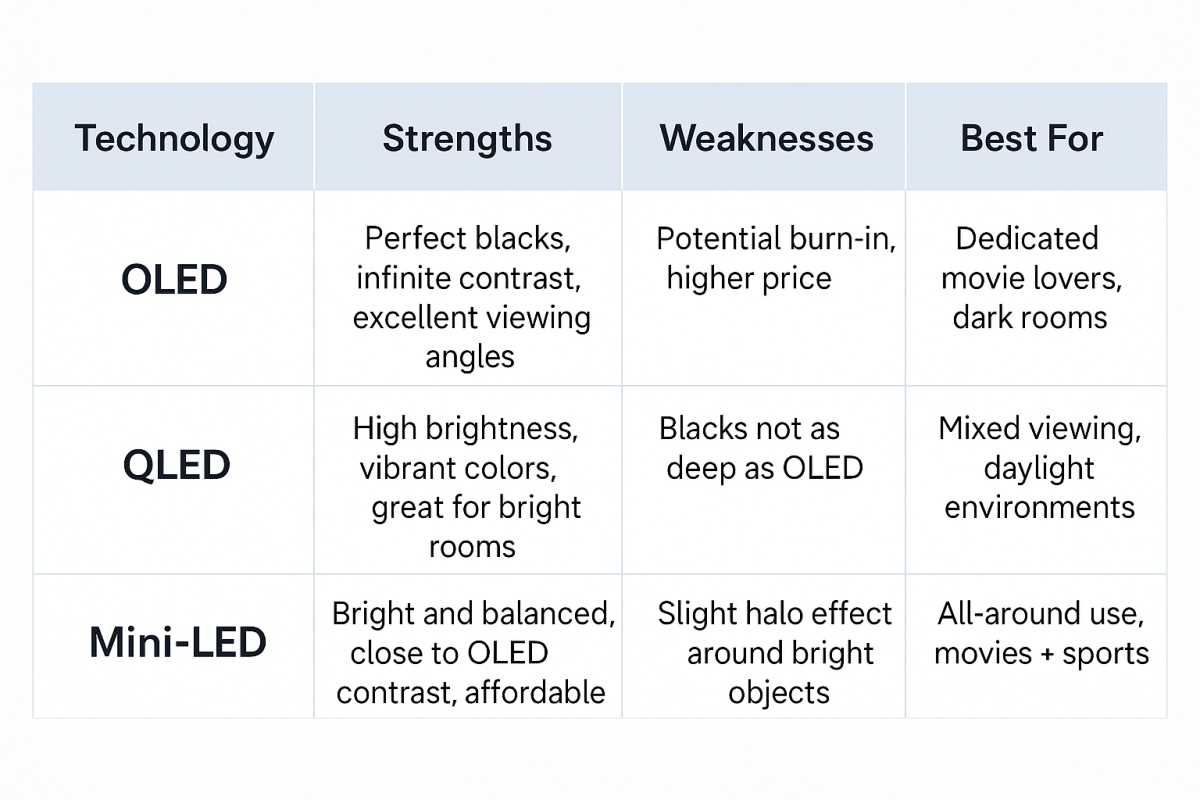
OLED vs QLED vs Mini-LED: Which Screen Technology Is Best for Movies?
Top TVs for Movies in 2025 — Our Expert Picks
After reviewing over 40 models, we’ve selected the best TVs for movie lovers in 2025. These models were tested for contrast ratio, HDR brightness, black level accuracy, and cinematic tone mapping.
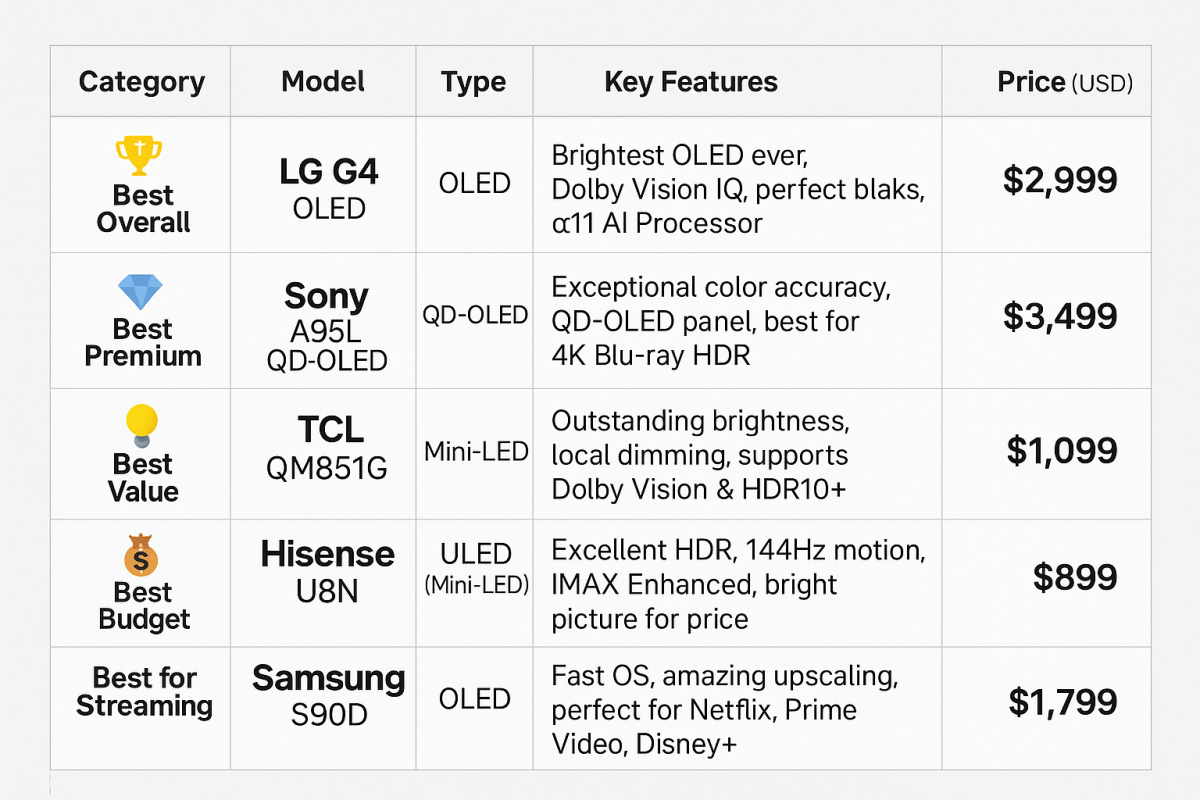
Whether you prefer Hollywood HDR blockbusters or classic cinema, each of these TVs delivers rich contrast, accurate color, and smooth tone mapping — the foundation of a true home theater experience.
Why HDR and Contrast Matter More Than Resolution
In 2025, the biggest leap in TV quality doesn’t come from 8K resolution — it comes from better HDR, color accuracy, and brightness control.
- Contrast Ratio: Deep blacks define cinematic realism. OLED panels offer near-infinite contrast, making dark scenes look truly immersive.
- Color Accuracy: Wide Color Gamut (DCI-P3 99% or higher) ensures you see the movie exactly as graded by the director.
- HDR Formats:
- HDR10 – baseline format for most 4K Blu-ray content.
- Dolby Vision – dynamic metadata, frame-by-frame optimization for true cinema lighting.
- HDR10+ – Samsung’s open alternative, used in Prime Video titles.
- Peak Brightness: For daylight viewing, Mini-LED and QLED TVs often exceed 1,500–2,000 nits, while OLEDs shine in dark rooms with perfect contrast.
When watching movies like Oppenheimer or Dune: Part Two, the right HDR tone mapping makes explosions, shadows, and colors feel dramatically closer to the cinema experience.
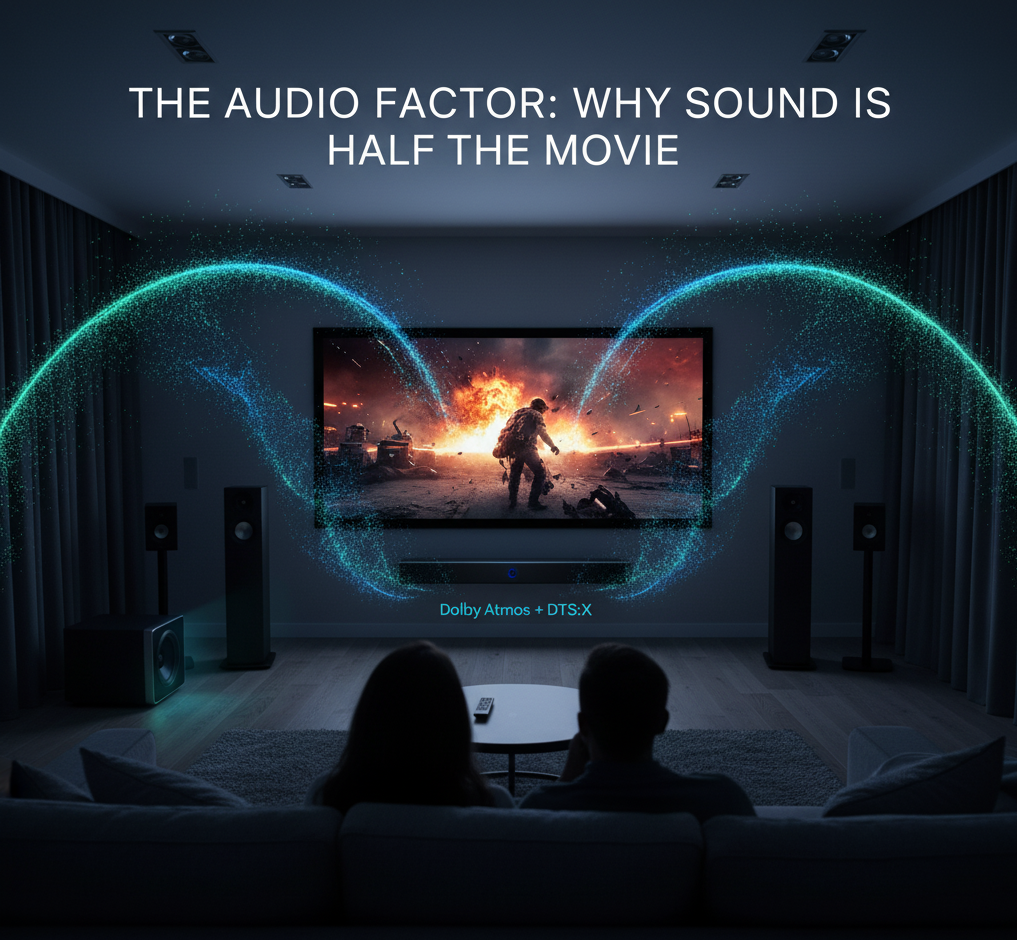
The Audio Factor: Why Sound Is Half the Movie
Even the best picture can feel lifeless without proper sound. In 2025, top TVs integrate powerful sound systems, often supporting Dolby Atmos and DTS:X virtual surround formats.
For movie nights, you’ll want more than built-in speakers. Here are our top recommendations for immersive audio setups:
- Soundbar Upgrade: A compact Dolby Atmos soundbar (like the Sonos Arc or LG S95QR) adds vertical sound effects and clear dialogue.
- Home Theater System: 5.1 or 7.1 surround setups remain unbeatable for pure cinema experience. Pair your TV with a subwoofer for deep, rumbling bass.
- Acoustic Tuning: Some premium models (like Sony and LG OLEDs) use AI to calibrate sound to your room layout automatically.
Bottom line: A great TV deserves great sound. Investing in audio upgrades multiplies immersion far beyond what screen quality alone can do.
Smart Features and Streaming Performance
In 2025, smart TV platforms have evolved far beyond simple apps. For movie lovers, smooth streaming, accurate upscaling, and automatic HDR switching are essential features.
Best Smart Platforms for Movies:
- webOS 24 (LG) – Fast, intuitive, great app store, Dolby Vision IQ support.
- Google TV (Sony / TCL) – Personalized movie recommendations and Chromecast integration.
- Tizen (Samsung) – Clean interface, supports HDR10+, lacks Dolby Vision but perfect for Prime Video users.
- Roku TV (Hisense / TCL) – Simplest interface for casual streamers, strong app availability.
For streaming services like Netflix, Disney+, and Apple TV+, the TV’s processor plays a big role in maintaining consistent HDR tone and smooth motion. Models like the LG G4 and Sony A95L feature AI upscaling that turns even old HD content into sharp, cinematic 4K.
Getting the Most Out of Your TV: Movie Mode and Calibration
Even the best TV for movies can look average if not calibrated properly. Out of the box, many TVs are set to “Vivid” or “Dynamic” modes — great for store demos but far from cinematic accuracy.
Follow these steps for the best movie experience:
- Switch to Filmmaker Mode or Cinema Mode — these use neutral color temperature and disable motion smoothing.
- Lower sharpness to avoid artificial outlines.
- Set color temperature to Warm 1 or Warm 2 for realistic skin tones.
- Turn off “TruMotion” or “MotionFlow” if you dislike the soap opera effect.
- For advanced users, use a calibration disc or app (like Calman Home) for precision adjustments.
Pro Tip: Many OLED TVs now come with built-in light sensors that auto-adjust brightness and white balance based on room lighting — perfect for both day and night movie sessions.
Best Budget TVs for Movies (Under $1000)
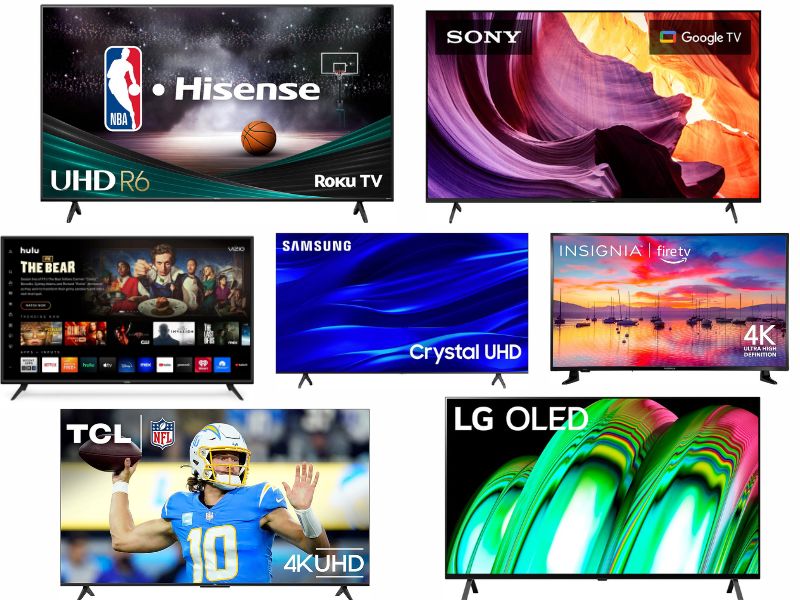
You don’t need to spend a fortune for great cinematic quality. These are the best affordable TVs for movies in 2025 that deliver exceptional value:

All three offer rich HDR contrast and solid motion clarity, making them perfect for cozy living rooms or bedrooms. They lack the absolute black levels of OLED, but for the price, their movie performance is outstanding.
Price vs Performance: What to Expect at Each Level
Not sure how much to spend? Here’s a realistic breakdown of what each price tier gets you in 2025:
| Price Range | What You Get |
|---|---|
| $600–$900 | Mid-tier Mini-LED or QLED. Excellent brightness and HDR for streaming movies, good local dimming. |
| $1,000–$2,000 | High-end QLED or entry-level OLED. Great Dolby Vision, better motion control, improved contrast and color accuracy. |
| $2,000–$3,500+ | Flagship OLED / QD-OLED models. Near-perfect picture quality, premium materials, AI processors, top-tier audio. |
If your main goal is the best cinematic picture for the money, the $1,000–$1,500 range offers the best balance of performance and value in 2025.
Final Thoughts: Finding Your Perfect Movie TV in 2025
The best TV for movies in 2025 depends on your viewing environment and budget. If you want the deepest blacks and true cinematic contrast, go for an OLED like the LG G4 or Sony A95L. For bright rooms or mixed use, Mini-LED models like the TCL QM851G and Hisense U8N are outstanding alternatives.
Remember, the real magic of movie watching comes from balance — accurate colors, smooth motion, good sound, and proper room lighting. Combine any of these TVs with a quality soundbar or surround setup, and you’ll bring the cinema home for years to come.
Recommended models for 2025:
- LG G4 OLED — Best overall cinematic experience.
- Sony A95L QD-OLED — Best color accuracy and HDR performance.
- TCL QM851G — Best value Mini-LED for home theater.
- Hisense U8N — Best affordable TV with Dolby Vision.
- Samsung S90D OLED — Best streaming and smart experience.
Whether you’re a film enthusiast or just love a cozy movie night, your perfect screen is waiting. Choose wisely — and enjoy the show.
FAQ: Best TV for Movies 2025
- What type of TV is best for watching movies?
- OLED TVs deliver the most cinematic experience thanks to perfect blacks and effectively infinite contrast. Dark scenes and shadows look exactly as the filmmaker intended.
- Is OLED better than QLED for movies?
- In dark rooms — yes. OLED provides deeper blacks and more natural contrast. QLED/Mini-LED can get brighter, so they’re better for daylight viewing.
- Which TV has the best picture quality in 2025?
- LG G4 OLED and Sony A95L QD-OLED lead for color accuracy, HDR tone-mapping, and overall realism.
- What’s the best TV for Netflix and streaming?
- Samsung S90D OLED (Tizen) and LG C4 OLED (webOS 24) offer excellent upscaling and smooth app performance for Netflix, Disney+, and Prime Video.
- Can I get a good movie TV for under $1,000?
- Yes. Hisense U8N and TCL 6-Series R655 (2025) provide bright HDR, Dolby Vision support, and strong contrast under $1,000.