Overview
Going Medieval emerges from early access as a compelling blend of colony simulation and strategic survival that successfully carves out its own niche in the increasingly crowded management genre. Developed by Foxy Voxel, this medieval-themed builder challenges players to guide a small group of survivors through the harsh realities of a post-apocalyptic 14th century world where civilization has crumbled and danger lurks around every corner.
What immediately sets Going Medieval apart is its emphasis on verticality and defensive architecture. Unlike many colony sims that focus primarily on horizontal expansion, this game encourages players to think in three dimensions, building towering fortresses with multiple floors, murder holes, and elaborate defensive systems. It’s a game that rewards careful planning and strategic thinking while offering the satisfying progression loop that genre fans crave.
Story & Setting
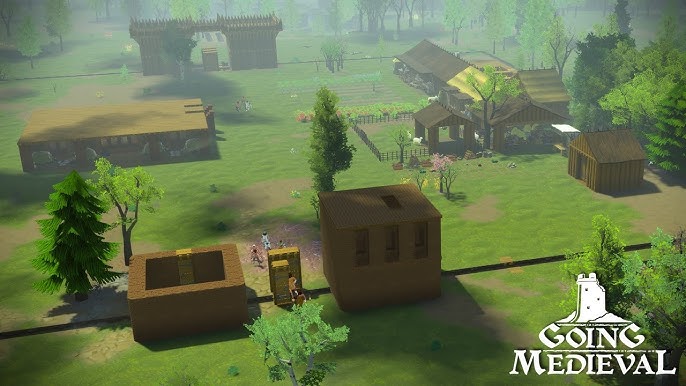
The narrative backdrop of Going Medieval is refreshingly straightforward yet effective. Set in an alternate history where a catastrophic event known as ‘The Happening’ has devastated medieval Europe, players must rebuild civilization from the ashes. The world is populated by bandits, wild animals, and other hostile factions competing for scarce resources.
While the overarching story remains relatively light, the game excels at emergent storytelling through its character system. Each colonist arrives with their own backstory, skills, and personality traits that influence their behavior and relationships with others. These individual narratives often prove more engaging than any scripted plot, as players become invested in the personal journeys of their settlers.
The medieval setting feels authentic without being overly restrictive. Technology progression follows a logical path from basic wooden tools to advanced metalworking and architectural techniques. The aesthetic successfully captures the gritty, lived-in feel of medieval life while maintaining the accessibility that modern gamers expect.
Gameplay
At its core, Going Medieval follows the familiar colony simulation formula: assign tasks, gather resources, research technologies, and keep your colonists happy and healthy. However, the game’s unique mechanics create a distinct experience that feels fresh even to genre veterans.
The building system is undoubtedly the game’s strongest feature. Players can construct multi-story buildings with incredible detail, from simple wooden huts to massive stone castles complete with throne rooms, dungeons, and defensive towers. The interface for building is intuitive, allowing for complex architectural projects without overwhelming micromanagement.
Combat strikes an excellent balance between strategy and automation. While colonists will defend themselves automatically, successful defense requires careful positioning, proper equipment, and well-designed fortifications. Raids escalate in difficulty over time, forcing players to continuously improve their defenses and military capabilities.
The research system provides clear progression paths across multiple disciplines including construction, crafting, and military technology. Each unlock feels meaningful and opens new strategic possibilities. Resource management remains challenging without being frustrating, requiring players to balance immediate needs against long-term planning.
One area where the game occasionally stumbles is in the late-game content. While the mid-game offers plenty of engaging challenges and goals, the endgame can feel somewhat directionless once players have established a thriving colony. Additional long-term objectives would help maintain engagement during extended play sessions.
Key Gameplay Elements
- Multi-story construction with detailed architectural options
- Dynamic weather and seasonal systems affecting gameplay
- Complex crafting chains for equipment and structures
- Relationship systems between colonists affecting morale and efficiency
- Scalable difficulty through increasingly challenging raids
Graphics & Sound
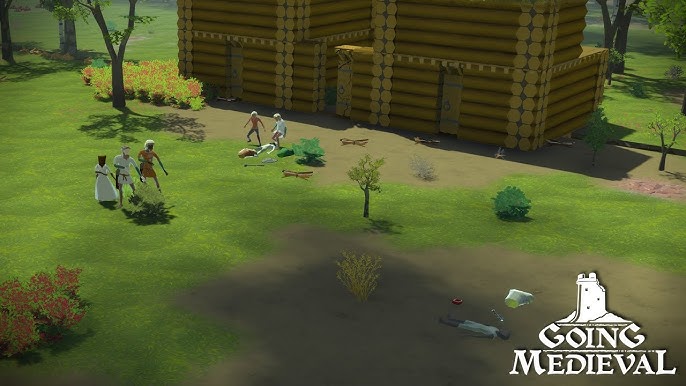
Going Medieval opts for a charming low-poly art style that perfectly complements its medieval theme. The visual design is clean and readable, making it easy to parse complex colony layouts at a glance. Character animations have personality and charm, bringing the medieval world to life without requiring cutting-edge graphics technology.
The game’s lighting system deserves particular praise, with dynamic day-night cycles and seasonal changes that create atmospheric variations throughout the year. Indoor spaces feel appropriately cozy when lit by torches and hearths, while outdoor areas showcase beautiful sunrise and sunset effects.
Environmental details add significant immersion, from smoke rising from chimneys to crops swaying in the wind. The destruction physics during raids create satisfying visual feedback when walls crumble under assault.
Audio design effectively supports the medieval atmosphere with a soundtrack that ranges from peaceful ambient tracks during quiet building phases to more intense compositions during combat encounters. Sound effects are well-implemented, with satisfying audio feedback for construction, crafting, and combat actions. Voice acting is minimal but appropriate, with colonists occasionally offering brief contextual comments.
Performance
Going Medieval runs smoothly on a wide range of hardware configurations, demonstrating solid optimization work from the development team. Frame rates remain stable even with large colonies and complex multi-story buildings, though some minor stuttering can occur during particularly intense raid sequences.
Loading times are reasonable, and the game’s memory usage is well-managed. Players with older systems should still be able to enjoy the experience, though those with more powerful hardware will benefit from smoother performance and reduced wait times during larger construction projects.
The user interface scales well across different screen resolutions and maintains readability even when managing complex colony layouts. Occasional pathfinding hiccups can occur in elaborate multi-story buildings, but these issues are minor and rarely impact gameplay significantly.
System Requirements
Key Features
- ✓ Multi-story fortress construction
- ✓ Medieval survival and crafting
- ✓ Dynamic weather and seasons
- ✓ Strategic raid defense
- ✓ Character relationship system
- ✓ Research and technology progression
Verdict
Going Medieval succeeds in creating a distinctive and engaging colony simulation experience that stands confidently alongside genre leaders. Its emphasis on vertical construction and defensive architecture provides a unique strategic focus that sets it apart from competitors. The game delivers the addictive ‘just one more upgrade’ progression loop that defines the best colony sims while offering enough mechanical depth to satisfy strategic players.
While the late-game content could benefit from additional long-term objectives and the pathfinding system occasionally struggles with complex buildings, these issues don’t significantly detract from what is ultimately a polished and entertaining experience.
Going Medieval proves that there’s still room for innovation in the colony simulation genre, offering a fresh take on familiar mechanics with its medieval setting and architectural focus.
For fans of games like RimWorld, Dwarf Fortress, or Prison Architect, Going Medieval offers a compelling alternative that emphasizes different strategic considerations while maintaining the core appeal of the genre. The game’s accessibility makes it an excellent entry point for newcomers while providing enough depth to keep experienced players engaged for dozens of hours.