App Swap / VPN / ExpressVPN
ExpressVPN
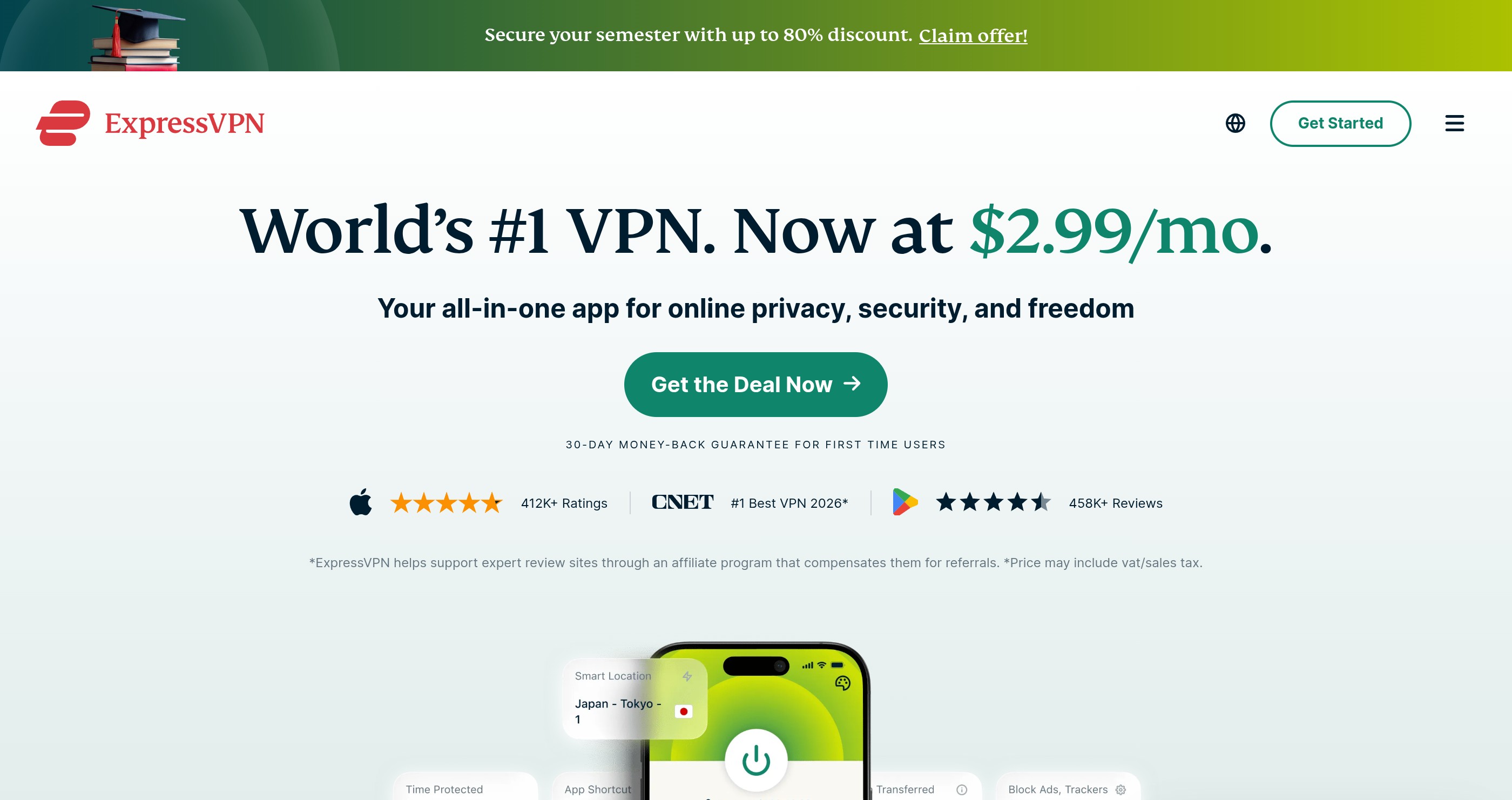
The most-audited VPN on the market, built on its own Lightway protocol — genuinely excellent, and priced like it knows it.
Product
Screenshots
Scorecard
How it scores
At a glance
Key facts
The pricing trap
What you actually pay per month
Month-to-month runs $12.99/mo — among the highest in the category. The 2-year plan is the only way ExpressVPN competes on price, and the renewal rate climbs after the first term.
The verdict
The most polished, most rigorously audited VPN available — worth the premium if you'll actually use the extra security tools, overkill if you just want a fast, private tunnel.
What's good
- Lightway rebuilt in Rust (~2,000 lines, post-quantum key support) alongside a from-scratch hardened WireGuard — real protocol engineering, not marketing.
- 27 independent third-party audits since 2018 — more publicly disclosed audits than any other VPN, including the no-logs claim (KPMG, Feb 2025).
- RAM-only TrustedServer infrastructure, PwC-verified — servers physically cannot write session data to disk.
- Reliably unblocks Netflix, BBC iPlayer, Disney+ and Max across 15+ regional libraries, with P2P allowed on every server.
- Consistently the easiest apps in the category across every platform, plus a pre-configured Aircove router for non-technical homes.
What to watch
- Owned by Kape Technologies, which also owns CyberGhost, Private Internet Access and ZenMate — three "rival" brands share one parent, undercutting the independence of roundups that rank them together.
- List and renewal pricing are the highest among major VPNs ($12.99/mo month-to-month; tiers renew above their promo rate).
- Device limits are tier-gated (10–14) rather than a flat number like most rivals.
- Its newest tool, Identity Defender, already drew 7 medium-severity findings in its first Cure53 audit — expansion is outpacing audit cadence in places.
The full audit
What you actually get
ExpressVPN, launched in 2009 and now owned by Kape Technologies, has built the closest thing the industry has to a trust moat. Since 2018 it has commissioned 27 independent audits — from KPMG, PwC and Cure53 — covering its apps, its no-logs claim and its newer security tools. No other consumer VPN discloses anything close to that number, and in a market thick with unverifiable marketing, a paper trail that long is the single strongest reason to take ExpressVPN seriously.
Security & encryption
Encryption runs through Lightway, ExpressVPN’s own protocol, which the company rewrote in Rust in 2025. The rewrite kept the codebase deliberately small — roughly 2,000 lines — so auditors can actually read the whole thing, and it uses the FIPS 140-2-validated wolfSSL library with post-quantum key exchange. ExpressVPN also rebuilt its WireGuard implementation from scratch, adding post-quantum protection and ephemeral credentials so no long-lived keys sit on a server. Every server runs on RAM-only TrustedServer infrastructure: nothing is written to disk, and each machine is wiped and rebuilt from a verified image on every reboot. PwC has separately verified that the servers actually behave this way, which is a stronger claim than the design promise alone.
Privacy & the Kape question
On paper the privacy story is excellent. ExpressVPN operates from the British Virgin Islands, outside the 5/9/14 Eyes alliances and free of any data-retention law, and its latest no-logs review — KPMG, dated the end of February 2025 — found no activity logging on the TrustedServer network. The complication is ownership. ExpressVPN belongs to Kape Technologies, which also owns CyberGhost, Private Internet Access and ZenMate, and Kape in turn sits under a Cyprus-based private vehicle tied to investor Teddy Sagi. That matters because plenty of “best VPN” roundups rank ExpressVPN, CyberGhost and PIA as independent rivals when three of them share a single parent — a fact any honest buyer deserves to know before trusting a comparison table. None of this is evidence that ExpressVPN logs your traffic — the audit record argues strongly that it doesn’t — but ownership structure is part of a VPN’s threat model, and here it’s more tangled than the marketing lets on.
Speed & network
Performance is genuinely strong rather than merely adequate. Independent 2026 testing clocks Lightway at north of 700 Mbps on good routes and around 75–85% of baseline speed even on long international hops, where many VPNs collapse. The network spans 113 countries and 214 selectable locations after a July 2026 expansion, though ExpressVPN — unusually — publishes only a vague “more than 3,000 servers” figure rather than an exact count, so treat the raw server number as approximate. What that spread buys in daily use is consistency: leaning on its own protocol rather than off-the-shelf WireGuard, and distributing load across 214 locations, ExpressVPN tends to see fewer peak-hour slowdowns and dropped sessions than thinner networks do.
27 independent audits since 2018 — more than any other consumer VPN discloses.
Streaming & torrenting
Streaming and torrenting are effectively solved problems here. ExpressVPN reliably unblocks Netflix, BBC iPlayer, Disney+ and Max across 15-plus regional libraries, and P2P traffic is allowed on every server rather than corralled onto a handful of nodes. For most people this is the least stressful part of the product — it simply works, on whatever platform you point it at.
The security suite
ExpressVPN is no longer just a tunnel. Threat Manager blocks trackers and malicious domains app-wide; Identity Defender adds dark-web monitoring and, on the top tier, ID-theft insurance of up to $5M; ExpressKeys is a built-in password manager; and ExpressMailGuard generates email aliases. The breadth is impressive, but it comes with a caveat worth stating plainly: Identity Defender’s first Cure53 audit surfaced seven medium-severity findings, a sign that ExpressVPN’s feature expansion is, in places, outpacing its otherwise exemplary audit cadence. Most of these extras also sit behind the pricier tiers, so the headline price you compare against rivals often isn’t the one that unlocks the tools ExpressVPN markets hardest.
Pricing
Price is where the score comes down. Month-to-month, ExpressVPN charges $12.99 — among the highest in the category — and even on an annual plan it lands around $5/mo, above NordVPN, Surfshark and most rivals at every tier. The two-year plan is the only configuration where it competes on cost, and, as with most of its peers, the renewal rate climbs after the introductory term. You are paying a real premium for the audit history and the polish.
Who should buy it
Buy ExpressVPN if you want the most independently verified VPN on the market and you’ll actually use the extra security tools it bundles. Skip it if all you need is a fast, private tunnel for less money — several competitors deliver that core experience for a fraction of the renewal price, and you won’t miss the suite you weren’t going to open.
Comparison row
How it lands in the VPN table
| Price / mo (cheapest annual) | ~$4.99 (annual) |
| Servers | 3,000+ |
| Countries | 113 |
| Devices | 10–14 (by tier) |
| Jurisdiction | British Virgin Islands (outside 5/9/14 Eyes) |
| No-logs audited | Yes — KPMG 2025 (27 total) |
| Protocols | Lightway, WireGuard, OpenVPN |
| Streaming | Netflix, iPlayer, Disney+, Max |
| Money-back | 30 days |