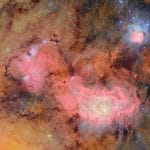
A Galactic Portrait in Unprecedented Detail
Astronomers have captured the most intricate and color-rich image of a galaxy ever recorded — a galactic portrait of the Sculptor Galaxy (NGC 253) that’s being hailed as a scientific masterpiece. Using ESO’s Very Large Telescope (VLT), researchers collected data over 50 hours to create this stunning mosaic.
Each section of the galaxy lit up in thousands of colors simultaneously. This rich spectral data offers researchers a multidimensional view into the structure, age, composition, and motion of stars, gas, and dust across the entire system.
Why This Image Is So Revolutionary
While traditional astronomical photos offer only a few color bands, the new image of Sculptor incorporates thousands of individual spectral signatures. This spectral richness enables scientists to:
- Measure the age and chemical makeup of different regions.
- Track star formation and stellar evolution across the galaxy.
- Identify planetary nebulae and map stellar death zones with high precision.
“The Sculptor Galaxy is in a sweet spot — close enough to study in extreme detail, but large enough to observe as a full galactic system.”
Zooming from Stars to Structure
This unique vantage point allows astronomers to both zoom in to near-star resolution and zoom out to analyze the full galactic system.
Kathryn Kreckel of Heidelberg University explains:
“We can zoom in to study regions where stars form at nearly the scale of individual stars, but also zoom out to study the galaxy as a whole.”

Scientific Highlights: 500+ Planetary Nebulae Discovered
Among the early findings from this galaxy-wide survey was the identification of approximately 500 planetary nebulae — glowing shells of gas ejected by dying sun-like stars. For context, that’s five times more than what scientists typically detect in a galaxy of this size.
How the Image Was Made
Researchers used the Multi Unit Spectroscopic Explorer (MUSE) instrument aboard ESO’s VLT in Chile. To capture the full 65,000-light-year span of NGC 253, the team stitched together over 100 separate exposures — making this one of the most data-rich images of a galaxy ever assembled.
Why It Matters
- This map provides a reliable way to confirm the distance to the galaxy — a cornerstone for all further research.
- It sets a new benchmark for how scientists study the internal anatomy of galaxies.
- The dataset will serve as a reference model for galactic evolution studies for years to come.