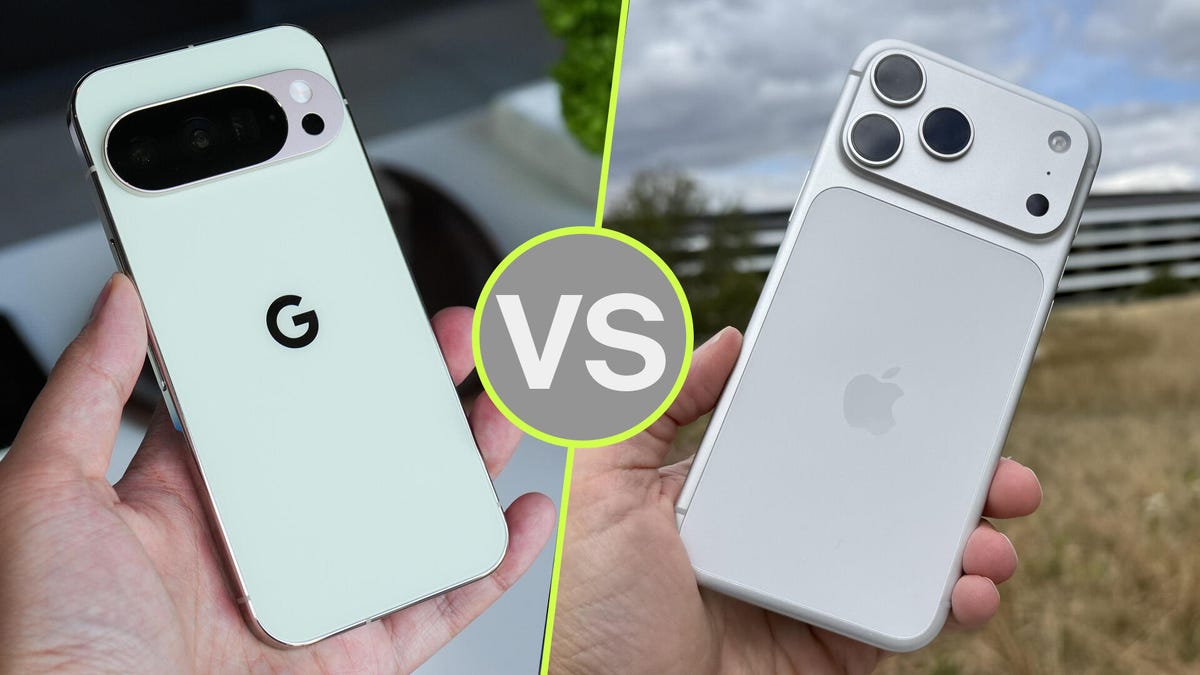
The flagship smartphone wars have never been more brutal — or more interesting. In 2026, we’re no longer debating which phone has the best camera or the fastest chip in isolation. We’re asking a deeper question: which device actually fits your life better? Google’s Pixel 10 Pro and Apple’s iPhone 17 Pro Max represent the absolute pinnacle of what each company believes a smartphone should be, and the gap between them has never been smaller — or more philosophically wide. After weeks of hands-on testing, benchmark runs, and genuinely debating which one I’d buy with my own money, here’s where things actually stand.
Google launched the Pixel 10 Pro in March 2026, starting at $1,099 for the 256GB base configuration, with the larger Pixel 10 Pro XL pushing up to $1,199. Apple’s iPhone 17 Pro Max, which landed in September 2025, still commands a premium at $1,299 for 256GB, going all the way up to $1,699 for the 2TB model — yes, two terabytes in a phone. Both devices sit in a market where premium buyers are increasingly expecting not just great hardware, but genuine intelligence baked into every interaction. The smartphone industry in 2026 is dominated by on-device AI, and both Apple and Google are betting everything on it.
What makes this comparison particularly fascinating is that these two phones come from such different design philosophies. Google builds the Pixel 10 Pro around its custom Tensor G5 chip — a processor engineered specifically to accelerate machine learning tasks on the device itself. Apple, meanwhile, ships the iPhone 17 Pro Max with the A19 Pro Bionic, a chip that continues to dominate raw compute benchmarks by embarrassing margins. But benchmarks don’t tell the whole story in 2026. They never really did.
Performance and Raw Power: Benchmarks Meet Real Life
Let’s talk numbers, because they matter — even if they don’t tell the whole story. In Geekbench 6 testing, the iPhone 17 Pro Max’s A19 Pro scores approximately 3,450 single-core and 8,900 multi-core. The Pixel 10 Pro’s Tensor G5, by comparison, lands around 2,100 single-core and 6,400 multi-core. On paper, Apple wins this round decisively, and that raw processing headroom shows up in demanding tasks — video exports in Final Cut for iOS, real-time 3D rendering, and heavyweight gaming all feel more fluid on the iPhone.
But here’s where Google plays a completely different game. The Tensor G5 isn’t optimized for raw CPU throughput — it’s built around its Neural Processing Unit, which handles on-device AI inference with extraordinary efficiency. Tasks like real-time language translation, live transcription, photo processing with Magic Eraser Pro, and the new Pixel AI Studio features run faster and more naturally on the Pixel 10 Pro than on any previous Android device. The iPhone 17 Pro Max has Apple Intelligence — which is genuinely excellent — but Google’s implementation feels more deeply woven into every corner of the Android 16 experience.
For everyday users? Both phones are fast. Comically, absurdly fast. Apps open instantly, multitasking is seamless, and neither device will make you feel like you’re leaving performance on the table. Where the A19 Pro gap becomes relevant is in sustained workloads over time — the iPhone maintains peak performance under thermal stress more consistently, thanks in part to Apple’s titanium-framed chassis doing serious thermal management work.
“The Tensor G5 isn’t trying to beat Apple at Apple’s game. It’s trying to redefine what a mobile processor is actually for — and in the context of AI-first computing, that argument is becoming harder to dismiss.”
Camera Systems: Google’s Crown or Apple’s Comeback?
For years, the Pixel series owned the computational photography conversation. The Pixel 10 Pro continues that tradition with a genuinely impressive triple-camera array: a 50MP primary sensor with an f/1.68 aperture, a 48MP ultrawide, and a 48MP 5x periscope telephoto. Google’s image processing pipeline — refined over a decade — remains class-leading for natural skin tones, shadow recovery, and low-light performance. Night Sight on the Pixel 10 Pro is still the benchmark against which every other phone’s night mode is measured.
Apple, however, has closed the gap substantially with the iPhone 17 Pro Max. The 48MP main sensor, 48MP ultrawide, and 12MP 5x tetraprism telephoto setup benefits from Apple’s ProRAW capture pipeline and the dramatic improvements in Apple Intelligence-powered post-processing. Video, in particular, is where the iPhone remains untouchable — 4K 120fps ProRes Log recording with on-device color grading tools makes the iPhone 17 Pro Max the preferred device for content creators who shoot primarily on mobile. The Pixel 10 Pro shoots excellent video, but it doesn’t offer the same professional-grade Log workflow out of the box.
For still photography, especially in challenging conditions, most independent reviewers — including detailed comparisons from DxOMark and Tom’s Guide published in early 2026 — score the Pixel 10 Pro marginally ahead overall, while acknowledging that the iPhone 17 Pro Max outperforms in video and in ultra-bright, high-contrast daylight scenarios. Your personal shooting style genuinely matters here more than any score.
Software, AI Features, and the Ecosystem Question
This is where the philosophical divide becomes a canyon. The Pixel 10 Pro runs Android 16 with Pixel-exclusive features that represent Google’s clearest vision for what AI-augmented computing looks like day-to-day. Pixel Screenshots — an AI memory layer that indexes everything you’ve seen on your screen — is the kind of feature that sounds gimmicky until you actually use it and realize you’ve been quietly depending on it for months. Gemini Live integration is baked natively into the Pixel experience in a way third-party Android devices simply can’t match.
Apple Intelligence on iOS 19, which shipped alongside the iPhone 17 Pro Max and has been refined through six months of updates, is a more polished, privacy-first implementation. Private Cloud Compute continues to be Apple’s differentiator — complex AI tasks are offloaded to Apple’s servers without your data ever being stored. The Writing Tools, Priority Notifications, and Image Playground features have matured considerably since the initial iOS 18 rollout that felt frankly half-baked.
- Pixel 10 Pro strengths: Deeper AI integration, Google Assistant replacement with Gemini, best-in-class transcription, more customizable Android 16 experience, better Google Workspace integration
- iPhone 17 Pro Max strengths: iOS 19 polish and security, Apple ecosystem lock-in benefits (AirDrop, Handoff, Universal Control), App Store quality standards, better gaming performance, CarPlay Ultra support
- Cross-platform apps: In 2026, the app gap between iOS and Android has essentially closed — major apps launch simultaneously on both platforms, and quality parity is the norm, not the exception
If you live inside Google’s ecosystem — Gmail, Google Drive, Meet, Maps — the Pixel 10 Pro is a native environment that feels purpose-built for you. If your life runs on iMessage, AirDrop, an Apple Watch, a MacBook, and AirPods Pro, the iPhone 17 Pro Max isn’t just a phone, it’s infrastructure.
Battery Life, Build Quality, and the Stuff That Actually Matters Daily
Google equipped the Pixel 10 Pro with a 4,700mAh battery (5,000mAh in the XL variant), supporting 45W wired charging and 23W wireless. In our testing, the standard Pixel 10 Pro delivered a reliable six to seven hours of screen-on time under moderate use — solid, but not spectacular. The iPhone 17 Pro Max packs a substantially larger 4,685mAh cell in a chassis that uses Apple’s titanium-and-microblasted-glass construction to achieve dramatically better battery efficiency thanks to the A19 Pro’s power envelope. Real-world screen-on time on the iPhone 17 Pro Max consistently hit eight to ten hours in our testing, which is simply best-in-class.
Both phones support USB-C, both feature always-on displays with adaptive refresh rates up to 120Hz ProMotion/LTPO, and both are rated for IP68 water resistance. The Pixel 10 Pro’s matte ceramic back feels premium and distinctive, while the iPhone 17 Pro Max’s titanium frame remains one of the most confidently engineered chassis in consumer electronics. At their respective price points, neither phone feels like it’s leaving build quality on the table.
The Verdict: Which Flagship Actually Wins?
Here’s the honest answer: there is no universal winner — but there is a right answer for you specifically. The iPhone 17 Pro Max is the better phone in terms of raw performance benchmarks, video recording capability, battery longevity, and ecosystem cohesion. If you’re already in Apple’s world, leaving it for a Pixel — even a very good Pixel — involves genuine friction and real trade-offs that aren’t worth making for most users.
But the Google Pixel 10 Pro makes a compelling argument that raw performance metrics are increasingly irrelevant when real-world AI capability and software depth define daily utility. At $200 less than the iPhone 17 Pro Max, it’s also the more financially sensible flagship — especially if you’re a Google-first user who wants the most capable Android device money can buy in 2026.
“Buy the iPhone 17 Pro Max if you want the best phone. Buy the Pixel 10 Pro if you want the smartest one.”
That distinction felt like hyperbole two years ago. In 2026, it’s become the most honest summary we can offer — and the fact that the debate is this close is itself a story worth telling.