The spatial computing wars just got a whole lot more interesting. Apple’s Vision Pro 2 and Meta’s Quest 4 landed within months of each other in early 2026, and the industry hasn’t stopped buzzing since. On one side, you have Apple’s obsessively refined, premium-tier headset pushing the boundaries of what mixed reality can look and feel like. On the other, Meta’s most capable standalone device yet — sharper, lighter, and priced in a way that doesn’t require a second mortgage. Both headsets represent genuine leaps forward. But which one actually belongs on your face? We’ve spent weeks with both, and the answer is more nuanced than you’d expect.
Let’s get the elephant out of the room early: the Apple Vision Pro 2 starts at $3,299, while the Meta Quest 4 launches at $499 for the base model and $699 for the Pro variant with eye and face tracking. That’s not just a price gap — it’s an entirely different target audience. Apple is selling a premium spatial computing platform aimed at professionals, creatives, and early adopters who’ve already invested deeply in the Apple ecosystem. Meta is chasing everyone else, and in 2026, “everyone else” represents the vast majority of the market.
But raw price comparisons only tell part of the story. What you get for that money, how each device performs in real-world use, and — perhaps most importantly — how each fits into your daily life are where this rivalry truly plays out.

Display and Visual Fidelity: A Study in Contrasts
Apple didn’t come to play when it comes to optics. The Vision Pro 2 features dual micro-OLED panels running at 4K per eye, delivering a staggering pixel density of approximately 3,400 pixels per inch. The result is text so crisp you’ll forget you’re wearing a headset, and spatial video that borders on the surreal. Apple’s new R2 Pro chip handles sensor fusion and display processing with near-zero latency, clocking input-to-photon delay at under 12 milliseconds — a spec that genuinely matters when you’re trying to feel present in a virtual space.
The Meta Quest 4, by contrast, uses a next-generation pancake lens system paired with LCD panels at 2,160 x 2,160 per eye — a meaningful step up from the Quest 3’s 2,064 x 2,208 resolution. Powered by Qualcomm’s Snapdragon XR4 chip, the Quest 4 hits around 120Hz refresh rate and offers significantly improved color accuracy versus its predecessor. The visual experience is genuinely impressive for the price. But side-by-side with Vision Pro 2? The difference is visible, particularly in fine text rendering and shadow detail.
“Using the Vision Pro 2 for document work is like going from standard definition to 4K. Once you see it, you can’t unsee it. The Quest 4 is excellent — but Apple is operating in a different visual tier entirely.”
That said, for gaming, social experiences, and general VR use, the Quest 4’s display is more than sufficient. And Meta’s improved color passthrough at 18 megapixels per eye makes mixed reality feel remarkably natural for an everyday device. Apple wins the display battle handily, but Meta closes the gap considerably compared to where Quest 3 stood in 2024.
Comfort, Design, and All-Day Wearability
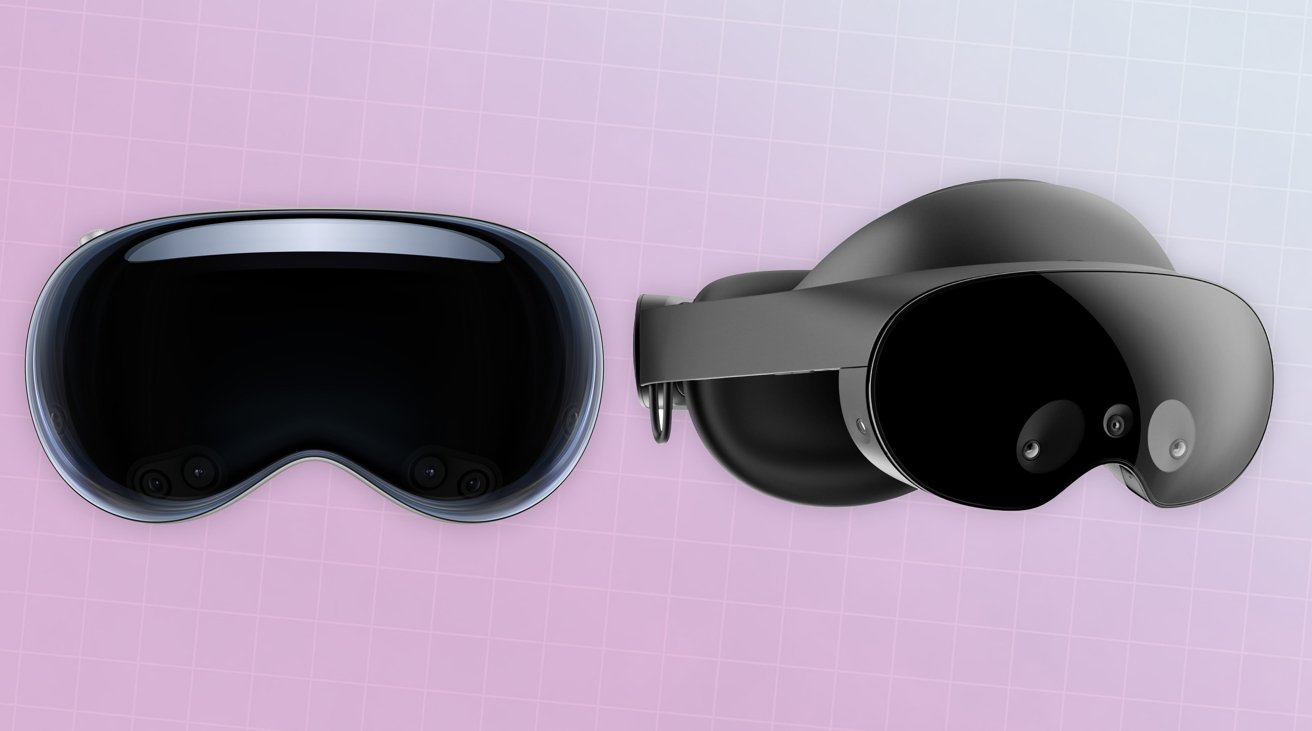
Here’s where things get complicated for Apple. The Vision Pro 2 weighs in at approximately 600 grams — slightly lighter than the original thanks to a redesigned aluminum and carbon fiber chassis — but it’s still a substantial piece of hardware to strap to your face for hours at a time. Apple includes two Light Seal cushion options and an improved Solo Knit Band in the box, and the fit is genuinely better than its predecessor. But after 90 minutes of intensive use, most testers still feel noticeable fatigue.
The Meta Quest 4 weighs just 514 grams and ships with a redesigned Elite Strap as standard across all models in 2026 — a response to years of complaints about the basic strap on earlier Quest devices. The balance is well-distributed, and the narrower depth profile means less leverage pulling your head forward. We wore the Quest 4 through two-hour sessions with minimal discomfort. For fitness apps, casual gaming, and mixed-reality productivity tasks, it simply disappears on your face in a way the Vision Pro 2 can’t quite match yet.
Apple’s EyeSight feature returns on Vision Pro 2, now with improved display brightness and a more natural rendering of your eyes on the external screen. It remains a genuinely clever solution to the social awkwardness of headset use — and one Meta still hasn’t matched. The Quest 4 has no equivalent feature, meaning the social barrier of wearing it in shared spaces remains very real.
Software, Ecosystem, and Content Libraries
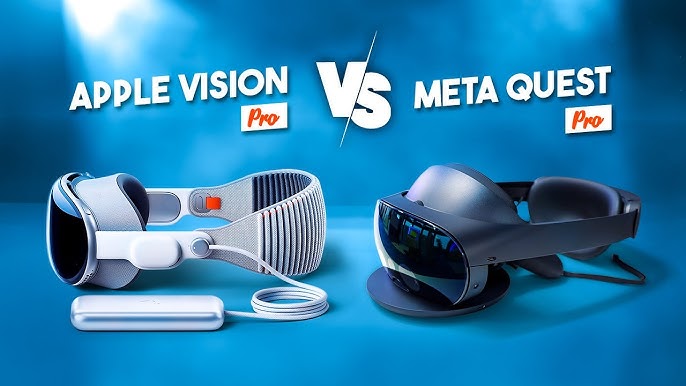
Apple’s visionOS 3 — shipping with Vision Pro 2 — is a mature, polished platform that feels unmistakably Apple. Native apps from Microsoft, Adobe, and a growing roster of enterprise developers have transformed it into a legitimate productivity environment. Spatial FaceTime, Microsoft 365 spatial mode, and Apple’s immersive content library are genuine differentiators. The App Store for visionOS now hosts over 2,500 native spatial apps as of Q1 2026, up from roughly 600 at launch in 2024.
Meta’s ecosystem is simply larger by volume. The Meta Horizon Store boasts over 10,000 apps and games for Quest 4, and Meta’s investment in social VR, fitness, and entertainment content continues to pay dividends. Horizon Worlds, Beat Saber, Supernatural, and a burgeoning library of AAA-adjacent VR titles give the Quest 4 an entertainment depth the Vision Pro 2 still lacks. Meta’s partnership with major game publishers in 2025 also brought higher-fidelity titles to the platform that would have seemed impossible on Quest hardware two years ago.
- Apple Vision Pro 2: 2,500+ native visionOS apps, enterprise-focused productivity suite, immersive Apple TV+ content, seamless iPhone/Mac handoff
- Meta Quest 4: 10,000+ apps and games, strong social and fitness libraries, PC VR streaming via Air Link, growing AAA gaming presence
- Cross-platform reality: Neither platform has achieved the app parity needed to be a true daily driver for all users — but both are closer than ever in 2026
One area where Apple surges ahead: mixed reality for professionals. Architects, designers, and surgeons using spatial computing workflows consistently cite Vision Pro 2’s precision eye and hand tracking — refined to sub-millimeter accuracy — as transformative for their work. Meta’s Quest 4 Pro does include eye and face tracking, and its results are competitive for entertainment use, but it doesn’t approach Apple’s precision in professional contexts.
Battery Life and Practical Limitations
Neither headset will survive a full workday on a single charge, and that’s a shared frustration in 2026. The Vision Pro 2 ships with an updated external battery pack offering approximately 3 hours of mixed-use runtime, up from 2 hours on the original. You can extend it with USB-C passthrough power, but the tethered battery pack remains an ergonomic compromise that Apple still hasn’t elegantly solved.
The Quest 4 packs an integrated 5,800 mAh battery and delivers around 3.5 to 4 hours of active use depending on workload — a genuine improvement over Quest 3’s roughly 2.5 hours. For most gaming sessions and fitness workouts, that’s sufficient. For all-day productivity? You’ll still need a USB-C cable nearby. Both companies need to do better here, full stop.
The Verdict
So which headset wins the crown in 2026? Honestly, it depends entirely on who you are and what you need. The Apple Vision Pro 2 is the most technically impressive consumer headset ever made. Its display, precision tracking, and visionOS polish set a bar that Meta hasn’t cleared. If you’re a professional, a creative, or a power user who lives inside the Apple ecosystem and can stomach the $3,299 entry price, it is genuinely transformative hardware.
But for the other 95% of people? The Meta Quest 4 is the headset to buy in 2026. At $499, it delivers visual fidelity and comfort that would have seemed impossible at that price just two years ago, backs it with the largest VR content library on the planet, and works perfectly well as a standalone device without requiring any additional hardware. It’s not trying to be Vision Pro — and that’s precisely the point.
The spatial computing era isn’t a single device story. Apple is building the future of professional and creative work. Meta is building the future of everyone else. In 2026, both futures are worth getting excited about.
The smarter question isn’t which headset is better — it’s which one is better for you. And for most people reading this, the Quest 4 answers that question with a $499 price tag and a smile.