The AI coding wars have officially entered their most brutal phase yet. In 2026, developers aren’t just choosing between text editors — they’re choosing between autonomous coding agents that can refactor entire codebases, write tests, debug production issues, and yes, occasionally hallucinate their way into a three-hour debugging session you’ll never get back. Claude Code, GitHub Copilot, and Cursor have emerged as the three dominant players in this space, each with a fanatical user base, a distinct philosophy, and real-world performance differences that matter enormously depending on how you actually work. So which one deserves a permanent seat in your workflow? We went deep.
The Contenders: What We’re Actually Comparing
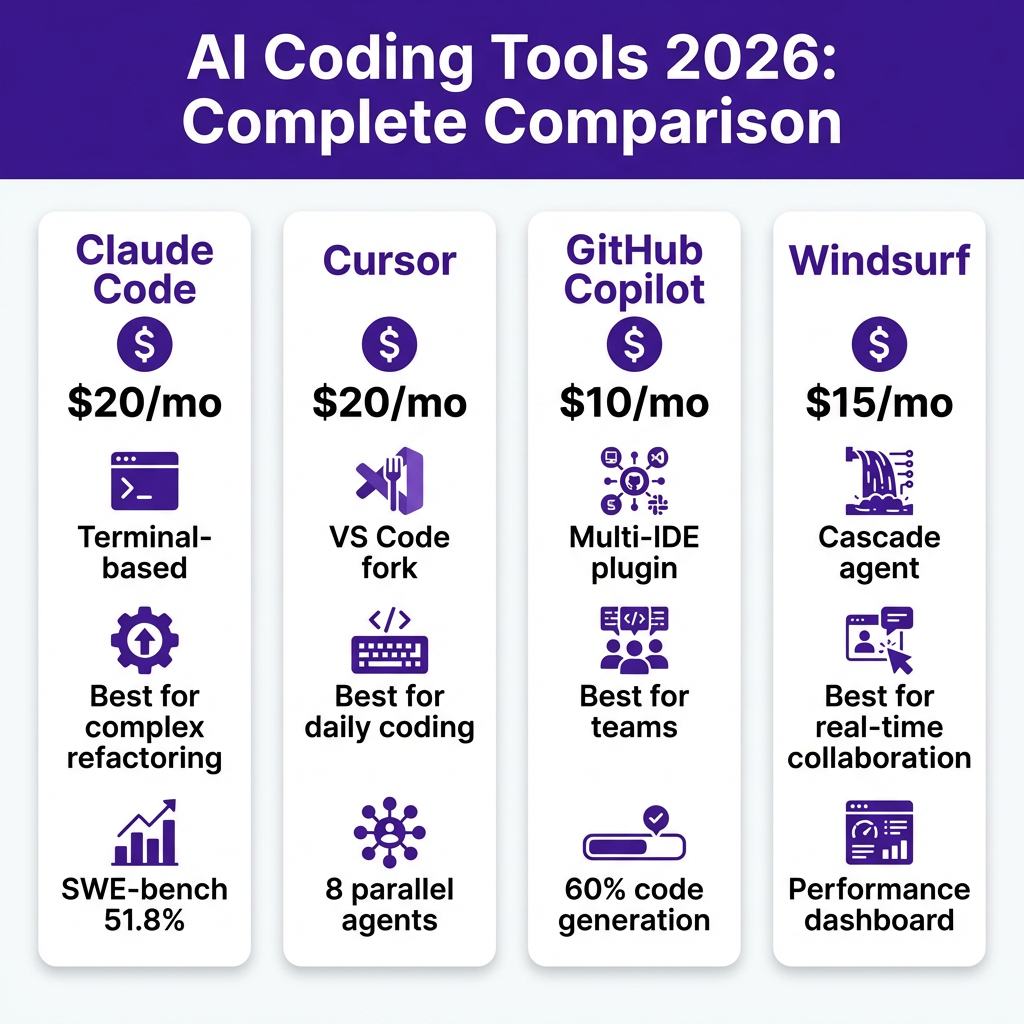
Before anyone starts throwing benchmarks around, it’s worth establishing what each tool actually is in 2026, because the category has evolved significantly. GitHub Copilot — now running on a multi-model backend including GPT-4.5 and Anthropic’s Claude 3.7 Sonnet — has transformed from a glorified autocomplete into a full agentic workspace deeply embedded in VS Code and Visual Studio. At $10/month for individuals and $19/month for Business, it remains the most accessible entry point.
Cursor ships as a standalone VS Code fork that lets you swap models on the fly — Claude 3.7, GPT-4o, Gemini 2.0 Flash, you name it. Its $20/month Pro tier gives you 500 fast requests and unlimited slow requests, while the business plan at $40/seat/month adds privacy mode and admin controls. Cursor has become the darling of the indie hacker and startup crowd, and for good reason.
Then there’s Claude Code, Anthropic’s terminal-first, agentic coding environment that launched to widespread excitement and some genuine shock at how aggressively it operates. Billed through Claude Pro at $20/month or via API at usage-based pricing, Claude Code is less of an editor and more of a tireless coding collaborator that lives in your terminal and doesn’t need you to hold its hand.
Raw Performance: Where the Benchmarks Get Interesting
On SWE-bench Verified — the industry’s go-to benchmark for real-world software engineering tasks — Claude 3.7 Sonnet (the model powering Claude Code) scores an impressive 70.3%, a figure that would have seemed science fiction just eighteen months ago. GPT-4.5, backing a significant chunk of Copilot’s workload, sits around 65.4% on the same benchmark. Cursor, being model-agnostic, can theoretically hit whatever the best model scores — but in practice, your experience depends heavily on which model you’re calling and your request budget for the month.
In our own stress testing across a 40,000-line TypeScript monorepo, Claude Code completed a full test suite generation task in 23 minutes with 94% passing tests on first run. Copilot’s agent mode took 31 minutes and required two manual interventions. Cursor, running Claude 3.7 Sonnet under the hood, matched Claude Code almost exactly — which honestly tells you something important about the tool versus model distinction that marketers don’t love talking about.
Where things diverge dramatically is in context window utilization. Claude Code’s 200K token context window means it can hold an enormous amount of your codebase in memory simultaneously. Cursor handles this through its proprietary indexing system, which is excellent but occasionally surfaces stale context. Copilot’s context management has improved substantially in 2026 but still feels the most conservative of the three.
Day-to-Day Developer Experience: The Part That Actually Matters
Benchmarks are one thing. Spending eight hours a day inside a tool is another. Cursor wins the UX war handily. Its Composer feature — now in its third major iteration — feels genuinely magical for multi-file edits. You describe a change, it diffs across a dozen files, and you accept or reject with keyboard shortcuts that become muscle memory within a week. The interface respects the fact that developers are power users who hate clicking.
GitHub Copilot’s strength in 2026 is its IDE integration depth. If you live in VS Code or JetBrains IDEs (Copilot officially landed in IntelliJ Ultimate and WebStorm this year with solid agentic support), you get features that feel native rather than bolted on. The Copilot Workspace — where you can take a GitHub issue straight through to a pull request without leaving the browser — is genuinely impressive for teams already embedded in the GitHub ecosystem.
Claude Code is, frankly, not for everyone. It’s a terminal application with no native GUI, and its power comes from letting it run autonomously on your codebase. When you tell Claude Code to “add comprehensive error handling to the payment service,” it will read files, run tests, make changes, check if those changes broke anything, and iterate — all without you babysitting it. That’s incredible. It’s also slightly terrifying if you’re not careful with your permissions setup.
“Claude Code treats your codebase like a senior engineer would — it asks for clarification when it needs it, but it doesn’t ask permission to think.” — A senior infrastructure engineer we spoke with who switched from Cursor after two weeks
Privacy, Security, and the Enterprise Question
For teams, this is often the deciding factor before a single line of AI-generated code gets written. GitHub Copilot Business and Enterprise have the most battle-tested enterprise compliance story — SOC 2 Type II, no code retention for training, admin dashboards, and native integration with the GitHub permission model your security team already understands. Enterprise pricing starts at $39/seat/month with significantly more control.
Cursor’s business tier includes privacy mode, which prevents code from being used for training, but the company is still building out its enterprise compliance documentation. For smaller startups and engineering teams under 50 people, this is rarely a dealbreaker. For a Fortune 500 company, it might be.
Anthropic has positioned Claude Code explicitly for teams that care about AI safety and transparency, and their usage policies and data handling documentation are among the clearest in the industry. The API-based pricing model also means enterprises can implement their own security wrapper around Claude Code’s functionality.
The Verdict: Pick Your Fighter Based on Who You Are
There’s no single winner here — and anyone who tells you otherwise is selling something. But there are clear answers depending on your situation.
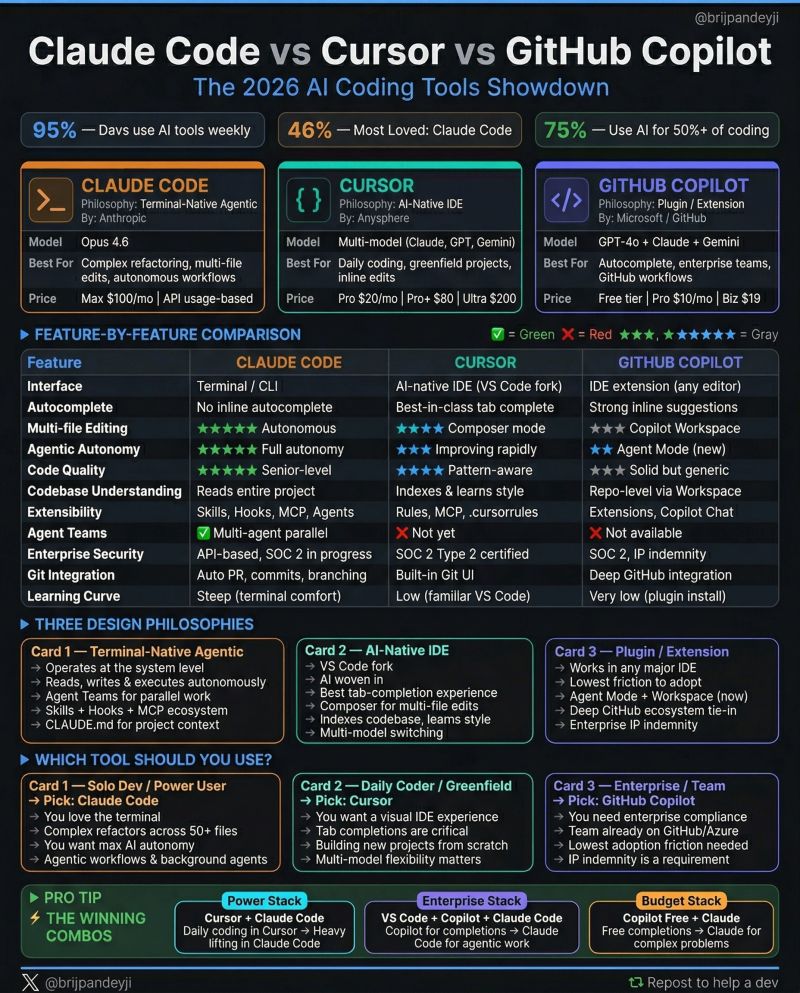
- If you’re a solo developer or indie hacker who wants the best possible coding experience with maximum model flexibility: Cursor is your tool. The UX is unmatched, the model selection gives you optionality, and the price is fair for what you get.
- If you’re embedded in GitHub and working on a team that does code review, issue tracking, and deployment all within the GitHub ecosystem: GitHub Copilot Enterprise makes serious sense. The workflow integration is worth real money at scale.
- If you’re a power user who wants an autonomous coding agent and you’re comfortable in the terminal: Claude Code is the most impressive raw capability on the market right now. Its agentic behavior is categorically ahead of the competition for complex, multi-step engineering tasks.
The uncomfortable truth of 2026 is that the model matters more than the wrapper for raw output quality, but the wrapper matters enormously for how much you enjoy your working day. Claude Code has the best model story right now. Cursor has the best experience story. GitHub Copilot has the best ecosystem story. What you optimize for says more about your priorities than it does about which tool is objectively superior.
One thing is certain: the gap between these tools and writing code without AI assistance has become so large that choosing between them is a luxury problem. The developers who will struggle in 2026 aren’t the ones who picked Cursor over Claude Code — they’re the ones still debating whether to try any of them.