Three years after the original Steam Deck quietly redefined what a handheld gaming PC could be, Valve is once again the subject of breathless speculation. The original Steam Deck launched in February 2022 at a starting price of $399, and it did something nobody expected — it actually worked. It ran AAA games. It ran indie darlings. It ran emulators. It ran your dusty library of forgotten Steam purchases from 2011. And now, as we barrel headlong into 2026, the question on every PC gamer’s lips is the same: Is Valve finally ready to ship a Steam Deck 2? The rumor mill is spinning faster than a GPU fan under a Cyberpunk 2077 benchmark, and there’s more signal in the noise than usual.
Valve has never been a company in a hurry. This is, after all, the studio that took 13 years to release Half-Life: Alyx and famously struggles to count to three. But the handheld gaming market in 2026 looks dramatically different from the landscape that greeted the original Deck. The ASUS ROG Ally X, Lenovo Legion Go S, and a growing wave of Windows-based competitors have sharpened the competitive pressure considerably. Meanwhile, silicon has marched forward — AMD’s next-generation APU architectures promise meaningfully better performance-per-watt ratios, which is exactly what a handheld device lives and dies by. The timing, for once, actually makes sense.
What we know — or at least, what we think we know — comes from a patchwork of patent filings, FCC submissions, supply chain whispers, and a handful of carefully worded non-denials from Valve employees on social media. Piecing it all together paints a picture of a device that could be one of the most consequential gaming hardware releases of the decade. Let’s dig in.

What the Rumors Are Actually Saying
The most credible intelligence around a Steam Deck successor points to a device built around AMD’s next-generation RDNA 4-based APU, tentatively referred to internally as “Sephiroth” in some leaker circles — though Valve has obviously not confirmed any codename. Current reports suggest the new APU could deliver somewhere in the range of 4 to 6 TFLOPS of GPU compute performance, compared to the original Steam Deck’s custom Van Gogh APU, which topped out at roughly 1.6 TFLOPS. That’s not an incremental improvement. That’s a generational leap.
On the display front, the rumors have been particularly exciting. Multiple sources have pointed toward a 1080p or 1200p OLED panel with a 90Hz or 120Hz refresh rate, a significant upgrade over the original model’s 800p 60Hz LCD (and the OLED Steam Deck’s 800p 90Hz panel launched in late 2023). Battery capacity is expected to increase from the current 50Wh to somewhere between 55Wh and 65Wh, though how much of that gain gets offset by a more power-hungry chip remains an open engineering question.
Perhaps most interestingly, there are credible suggestions that Valve is exploring modular or upgradeable RAM configurations — a direct response to one of the loudest criticisms of the original hardware. The existing Steam Deck ships with 16GB of LPDDR5 unified memory, soldered to the board with no upgrade path. If Valve can crack the thermal and form-factor challenges of socketed or expandable memory in a handheld, that would be genuinely unprecedented in the category.
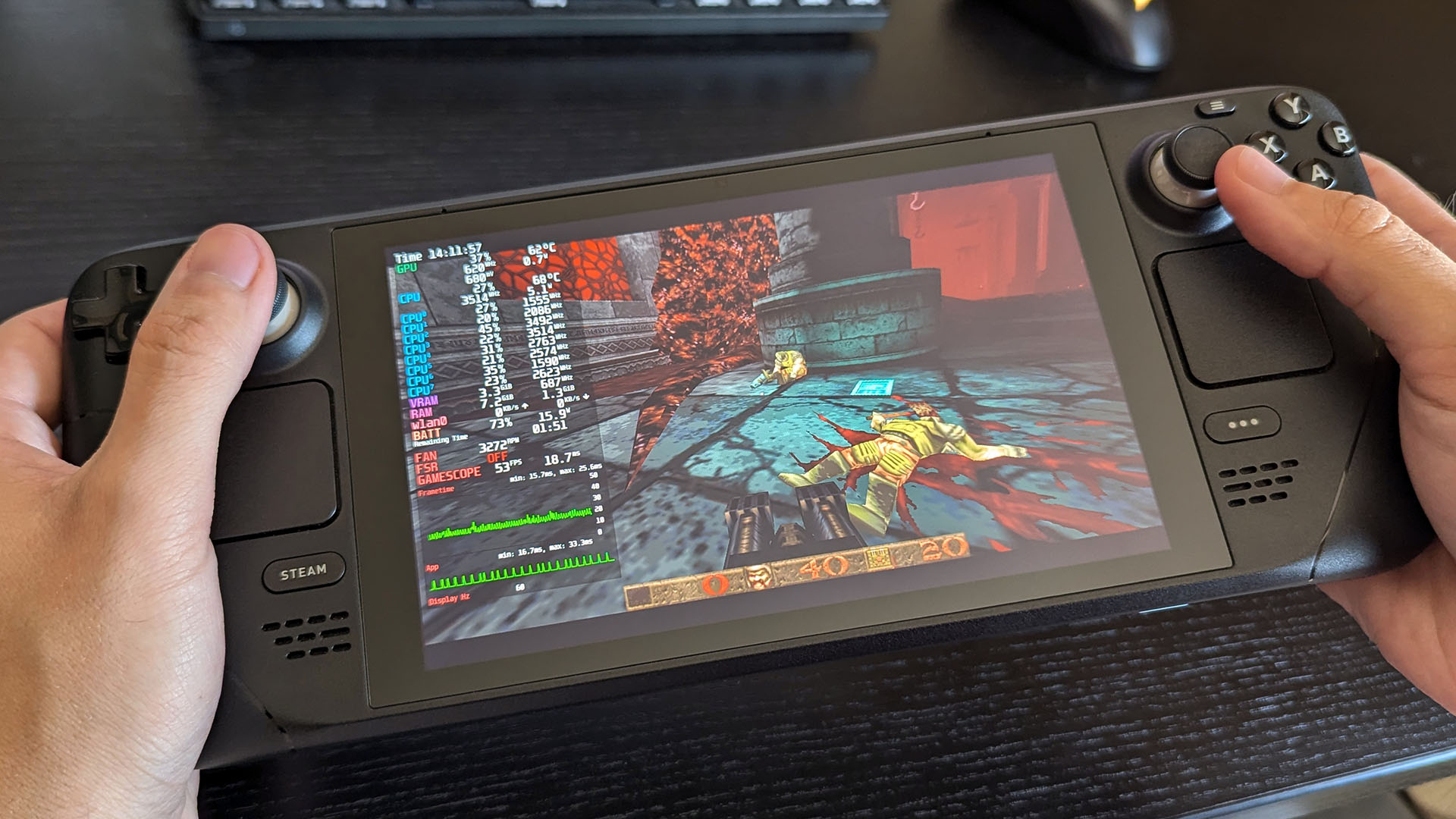
The Competition Has Raised the Bar Significantly
When the original Steam Deck shipped in 2022, it had the handheld PC gaming market almost entirely to itself. That is no longer the case. In 2026, Valve is staring down a genuinely crowded field, and some of these competitors are shipping hardware that makes the original Deck feel its age.
The ASUS ROG Ally X, which launched in mid-2024 at $799, brought a faster AMD Z1 Extreme chip, a 24Wh battery (smaller, oddly), and a more ergonomic chassis. The Lenovo Legion Go S, launching in early 2025, took a different approach with a detachable controller scheme and an 8.8-inch display. And looming over all of them is the specter of Nintendo’s continued dominance in the dedicated handheld space — the Switch 2, which launched in early 2025, reportedly shipped over 8 million units in its first month, reminding everyone that brand loyalty and software ecosystems are worth more than raw specs.
“We definitely are not going to release something that’s just like the same thing with even a little bit better specs, because that’s not what our customers want right now.” — Valve’s Lawrence Yang, in a 2023 interview that still echoes loudly today.
That quote is doing a lot of heavy lifting in 2026. If Valve holds to that philosophy — and the rumored spec bump suggests they very much intend to — the Steam Deck 2 needs to feel like a different device, not just a refreshed one. The jump from 1.6 to potentially 5+ TFLOPS, combined with a premium display upgrade and potentially more RAM headroom, would go a long way toward making that case.
What a 2026 Launch Would Actually Look Like
If Valve pulls the trigger this year, the logistics of a Steam Deck 2 launch would be far smoother than the original’s chaotic, reservation-only rollout that stretched through most of 2022. Manufacturing relationships with Foxconn are more mature, supply chains for advanced APUs have stabilized after years of post-pandemic volatility, and Valve’s internal teams have hard-won experience managing hardware at scale.
Pricing is the critical variable. The original Steam Deck launched in three tiers: $399 (64GB eMMC), $529 (256GB NVMe), and $649 (512GB NVMe). The OLED model that replaced it in November 2023 started at $549. A Steam Deck 2 with meaningfully more powerful silicon, a premium OLED display, and potentially upgraded memory would almost certainly push the entry price higher — speculation has settled around a $549 to $699 base price range, with premium configurations potentially touching $799 or beyond.
That’s a price point that puts Valve in direct competition with its Windows-based rivals rather than safely below them, which is a riskier position to occupy. The saving grace, as always, is SteamOS — Valve’s Linux-based gaming OS that continues to improve with every quarterly update, now boasting compatibility ratings for over 12,000 titles via Proton. No Windows license cost baked into the hardware price, no forced bloatware, no surprise update reboots mid-session. For a certain kind of PC gamer, that alone is worth the premium.
A Potential Q3 or Q4 2026 Window
Industry insiders and supply chain analysts have coalesced around a late 2026 reveal and launch window, potentially timed to coincide with The Game Awards in December or a standalone Valve hardware event earlier in the fall. FCC filings — the canary in the coal mine for consumer electronics launches — have not yet surfaced as of early 2026, which suggests we’re still at least several months from a shipping product. But the pace of leaked information has accelerated noticeably, which historically correlates with a device entering or completing final validation testing.
The Verdict
The Steam Deck 2 feels less like a rumor and more like an inevitability at this point. The silicon is ready. The market pressure is real. The competitive landscape demands it. Valve has never been a company that moves on anyone else’s timeline — but they’ve also never been a company that ignores what their customers are asking for, and the community has been asking loudly.
If the specs hold — an RDNA 4-class APU pushing north of 4 TFLOPS, a high-refresh OLED display, expanded memory, and the continued software excellence of SteamOS — the Steam Deck 2 won’t just be a great handheld. It could be the best all-around gaming device money can buy in 2026, full stop. The only thing standing between us and that reality is the one unpredictable variable in this entire equation: Valve’s timeline. And if history has taught us anything, it’s that patience isn’t just a virtue when dealing with Valve — it’s a prerequisite.
Stay tuned to PixlRun for the latest updates as new information becomes available. If this one is close, we’ll be the first to tell you.