Canon EOS R5 Mark II · The hybrid powerhouse evolves
Full bench sheet & specifications
16 ROWS · 7 GROUPS The Bench Sheet · EOS R5 Mark II
The original EOS R5 was a watershed moment for Canon: a full-frame mirrorless that finally delivered on the promise of 8K video and serious autofocus in a single body. Its successor, the EOS R5 Mark II, doesn’t merely iterate — it re-architects the camera from the silicon up. The shift to a 45-megapixel back-side-illuminated stacked CMOS sensor, paired with a dual-processor pipeline built around the DIGIC X and a dedicated DIGIC Accelerator chip, unlocks capabilities that were physically impossible with the original’s conventional readout architecture.
The headline numbers are striking: 30 frames per second in full RAW, 8K video at up to 60p with internal RAW recording, and an autofocus system that can track eyes, vehicles, and sport-specific subjects with AI-driven prediction. But the more compelling story is how those numbers translate into a camera that a working professional can actually rely on across wildly different shooting disciplines — from high-speed action to landscape to cinema. At $4,299, it is a serious commitment. Whether that commitment is justified depends on which of those disciplines matter most to you.
// 01 Design & Build
The R5 Mark II carries forward Canon’s mature ergonomic language from the original R5 and the professional EOS-1D line. The body is magnesium alloy throughout, with comprehensive sealing at every joint, dial, and button interface — a level of protection that holds up in rain and dusty outdoor environments, though it stops short of the full IPX rating found on some Sony bodies. The grip is deep and confident, accommodating telephoto glass without wrist fatigue in a way that smaller mirrorless bodies simply cannot.
The dual card slot arrangement — CFexpress Type B for primary recording and UHS-II SD as a secondary or overflow slot — is the correct configuration for professionals. CFexpress Type B handles the sustained write demands of 8K RAW and 30 fps burst comfortably; the SD slot remains practical for everyday stills or client deliverables. A new Multi-Function shoe replaces the older hot shoe and adds direct connectivity for Canon’s MIC-B1 microphone adapter and other accessories without a separate cable. At 746 g body-and-battery, it is substantial but not unwieldy — roughly in line with the Sony A7R V and lighter than a Nikon Z8 with grip.
// 02 Sensor & Image Quality
Stacked CMOS architecture matters because it places the readout circuitry directly behind the pixel layer rather than beside it, allowing the sensor to be read out dramatically faster. For the R5 II, that translates to an electronic shutter scan rate of approximately 1/125–1/160s — not as fast as the Nikon Z8’s 1/270s, but a substantial improvement over the original R5 and the Sony A7R V, both of which show more pronounced rolling shutter distortion on fast horizontal motion. In practical shooting — sports, wildlife, handheld street — the R5 II’s rolling shutter behaviour is manageable rather than a constant concern.
At base ISO the files are exceptionally detailed. 45 megapixels at full-frame scale provides significant cropping flexibility while retaining output resolution for large prints or broadcast delivery. Dynamic range performance — around 14 stops at base ISO in RAW — is competitive with the Sony A7R V and comfortably exceeds what the original R5 offered. High-ISO performance is where the stacked architecture shows its only real cost: pixel density at this scale means that above ISO 3200, luminance noise becomes visible in shadow regions, though it responds well to modern RAW processing tools.
The updated IBIS system, rated at up to 8.5 stops of correction when paired with stabilised RF lenses, is genuinely effective for handheld telephoto and low-light work. It does not completely eliminate the advantage of a tripod at slow shutter speeds, but it extends the realistic handheld envelope further than any previous Canon body.
// 03 Autofocus & Speed
Canon’s Dual Pixel CMOS AF II uses two photodiodes per pixel across essentially the full sensor area, giving it phase-detection coverage that competitors using on-sensor PDAF islands simply cannot match in uniformity. Subject detection covers humans (face, eye, head, body), animals (dogs, cats, birds, horses), vehicles (cars, motorcycles, trains, aircraft), and — for the first time in an R-series body — sport-specific modes that apply AI prediction to where an athlete or subject is likely to move next. In testing, the system locks and holds on erratically moving subjects — birds in flight, sprinting athletes, dogs at play — with a consistency that was previously the exclusive domain of the Sony A1 at considerably higher cost.
Eye Control AF returns from the original EOS R5, significantly improved. A revised optical assembly in the viewfinder nearly doubles the eye-tracking frame rate, reducing the lag between where the photographer looks and where the active AF point appears. Once calibrated to an individual user — a one-minute process — it works reliably and feels genuinely different from any other AF selection method in the industry. For photographers who move fluidly between horizontal and vertical compositions, or who frequently need off-center subject placement, it is a meaningful workflow improvement rather than a novelty.
// 04 Video
The R5 Mark II’s video specification is, without qualification, the most comprehensive internal recording capability in any production camera at this price point. 8K/60p RAW internal recording at up to 2,600 Mbps writes to CFexpress Type B and produces files that hold up to aggressive colour grading. Canon Log 3 in particular has become the preferred acquisition format for Canon Cinema EOS users, and having a single body that can feed the same colour pipeline as a C70 or C300 Mark III simplifies multi-camera productions considerably.
Practical 4K output — oversampled from the full 8K sensor area — is exceptionally clean. The 4K HQ mode at up to 60p produces files with visible resolution advantages over competitors who crop the sensor for high-frame-rate video. The 120p slow-motion mode operates from a slight crop but retains enough quality for professional use. Rolling shutter at 4K is well controlled; 8K RAW shows slightly more at 60p but remains within acceptable limits for most applications.
Heat management note: extended 8K/60p RAW recording generates significant heat. In warm ambient conditions, the camera will display a temperature warning after approximately 20–25 minutes of continuous 8K RAW recording. Switching to 8K MP4 or 4K substantially extends the recording limit. For cinema production, an external recorder via HDMI 2.1 bypasses the internal limit entirely.

// 05 Viewfinder & Controls
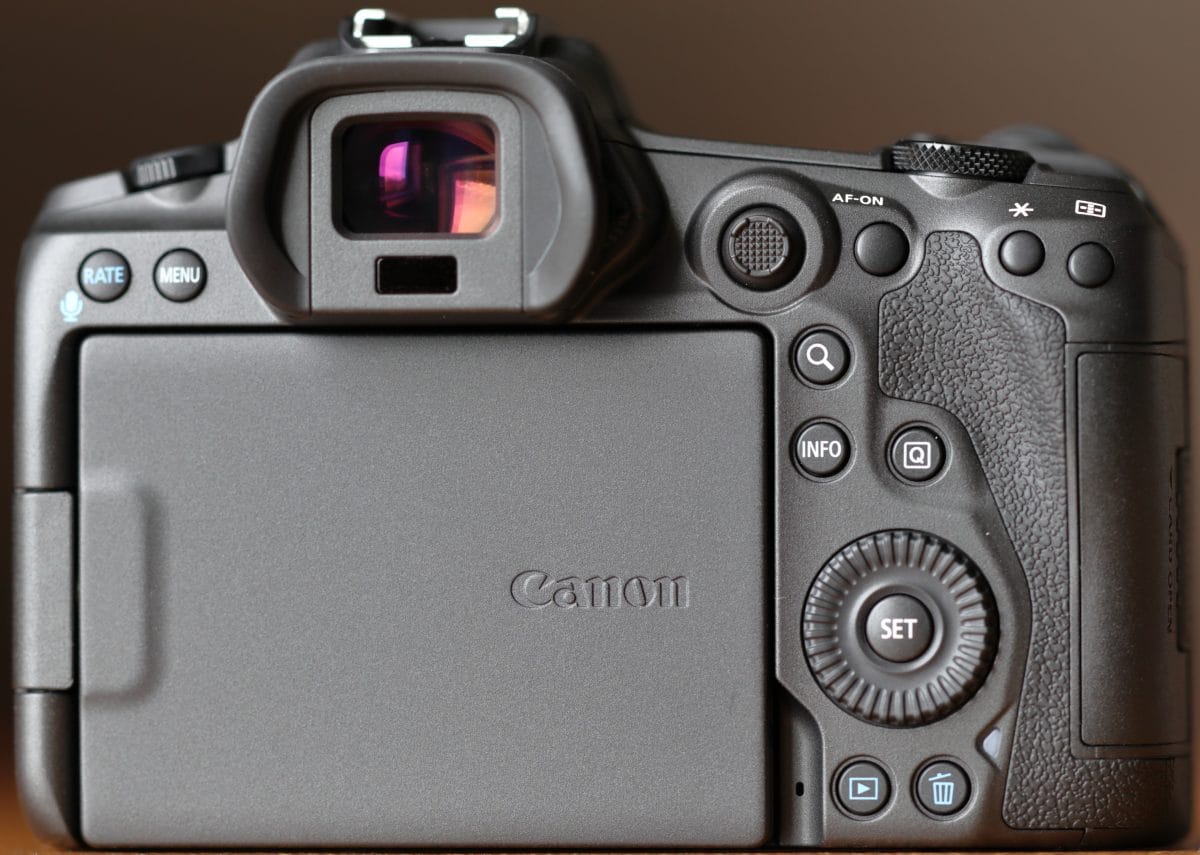
The 5.76 million-dot OLED viewfinder is one of the best available in any mirrorless camera. At 240 fps, blackout during burst shooting is genuinely minimal — subjects stay visible between frames at 30 fps in a way that optical viewfinders at lower shutter speeds often cannot match. Magnification at 0.76× feels natural and spacious, particularly with Canon RF L-series telephoto lenses whose rear elements sit close to the mount.
Eye Control AF is implemented through a sensor grid inside the viewfinder eyepiece that detects which quadrant of the frame the photographer’s pupil is directed at. Once calibrated — and calibration is per-user, stored in the camera’s memory — it responds with sub-100ms latency between look and AF zone shift. The practical effect is that zone selection, which on other cameras requires physically moving a joystick or touch-pad, happens passively and without interrupting the shooting stance. For photographers who wear glasses, calibration takes more attempts but does work reliably once dialled in.
The control layout itself is conventional Canon professional — dual control rings, a rear joystick, customisable M-Fn bar, and a multi-function touch pad above the rear dial. Photographers familiar with the original R5, R3, or 5D series will find muscle memory transfers immediately. The fully articulating rear screen adds video utility without compromising the body’s vertical grip compatibility, a complaint that was often levelled at the original R5’s tilting-only screen.
// 06 Battery Life
CIPA ratings for mirrorless cameras are notoriously conservative, and the R5 II is a good example of the gap between the lab figure and real-world performance. Canon’s official 620-shot estimate (using the rear screen) translates into roughly 300–350 shots per charge when shooting with the EVF in burst mode — the typical sports or wildlife scenario. In practice, photographers reporting single-charge sessions of over 4,000 shots with heavy viewfinder use and intermittent 4K video clips should be understood as outliers using disciplined shooting cadence, but the point stands: real-world endurance substantially exceeds what the CIPA numbers suggest.
USB-C Power Delivery charging is supported in-body, allowing the camera to charge via a laptop or portable battery bank in the field — a meaningful operational convenience for location shoots. The LP-E6NH is backward-compatible with LP-E6N/NH batteries from older Canon bodies, which means existing Canon users often already have spares in rotation. A vertical grip accessory (BG-R10) accepts two batteries and effectively doubles the operational capacity for extended sessions.

// 07 Value
At $4,299, the Canon EOS R5 Mark II occupies a premium tier that requires justification. The Sony A7R V sells for approximately $3,499 and the Nikon Z8 for around $3,999 — both meaningfully less. What the Canon offers for the premium is a combination that neither competitor can fully match: the burst speed and pre-capture capability of a dedicated action camera alongside the resolution and image quality of a high-resolution body, in a single package, with the most capable Eye Control and subject-detection AF system currently available.
For sports and wildlife photographers who previously needed separate bodies — an R3 for action, an R5 for high-resolution work — the Mark II genuinely consolidates those roles. The math of buying one body instead of two changes the value calculation considerably. For portrait and landscape photographers who would never touch 30 fps, the A7R V at $800 less is a more sensible allocation. Canon’s RF lens ecosystem has matured substantially: the RF 100–500mm, RF 70–200mm F2.8, and RF 24–105mm F4 trio covers virtually every professional use case, and Canon’s lens-body stabilisation coordination is currently class-leading.
- + 30 fps RAW burst with 15-frame pre-capture
- + 8K/60p RAW internal video — class-leading
- + Eye Control AF — unique and genuinely useful
- + Subject detection covers humans, animals, vehicles, sport
- + 8.5-stop IBIS (coordinated with RF lenses)
- + 45MP stacked sensor — resolution + speed without compromise
- + Dual CFexpress + UHS-II SD card slots
- + USB-C PD in-body charging; LP-E6NH compatibility
- × $4,299 — premium over Sony A7R V and Nikon Z8
- × RAW buffer limited to ~193 frames at 30 fps (vs 1000+ for Z8)
- × 8K/60p RAW overheats in ~20–25 min continuous in warm conditions
- × Low-light AF (-6.5 EV) trails Nikon Z8’s -9 EV Starlight mode
- × Eye Control AF requires per-user calibration; challenging with glasses
- × RF ecosystem lock-in — adapting EF glass adds size and cost
The Canon EOS R5 Mark II is the right camera for working professionals who need a single body to span action, wildlife, portraiture, and video — and who are already invested in or willing to invest in Canon’s RF ecosystem. Sports and wildlife photographers in particular will find the 30 fps burst, pre-capture, and subject-detection AF combination uniquely capable at this price. It is less obviously the right choice for photographers whose work is primarily static subjects or studio work, where the Sony A7R V’s stronger low-light resolution advantage or the Nikon Z8’s deeper buffer are more relevant than burst speed. Anyone for whom $4,299 is the ceiling — rather than a considered investment — should look carefully at the Nikon Z8 at $300 less or the Sony A7R V at $800 less before deciding whether the Canon’s unique feature set justifies the premium.
Methodology · 14-day cycle
Compare against
Other top-rated cameras we've reviewed.

Camera samples 8
Real photos shot on this device · Flickr EXIF-verified


