Samsung Galaxy A57 · New Samsung smartphone — verified specs from GSMArena.
Full bench sheet & specifications
51 ROWS · 15 GROUPS The Bench Sheet · Galaxy A57
Samsung’s Galaxy A series has always served a quiet contract with the mainstream: consistent cameras, reliable software, and enough performance to stay out of the way of daily life, wrapped in a design that doesn’t embarrass you. The Galaxy A57 5G, released in April 2026, upholds that contract with unusual discipline. It is not a phone that will produce a single jaw-dropping specification — no periscope telephoto, no silicon-carbon battery, no triple-digit charging wattage. What it does deliver is a remarkably thin 6.9 mm chassis, a first-in-class IP68 water rating for the A-series, a genuinely capable 120 Hz Super AMOLED display, and a software support commitment that puts most competitors to shame: six years of Android OS upgrades and six years of security patches, bringing the phone to One UI 14 and beyond.
The Exynos 1680 chipset provides a step up from the A56’s silicon without vaulting the device into gaming territory. The camera system is honest rather than spectacular. And at $549 to start, the A57 occupies a price band where competition from Google and Motorola has intensified meaningfully. Whether Samsung’s brand, ecosystem, and longevity commitment justify the entry ticket against those rivals is the question this review will answer.
// 01 Design & Build
At 6.9 mm thick and 179 g, the Galaxy A57 is a measurably different proposition from its predecessor — the A56 measured 7.4 mm and 198 g. That 0.5 mm shave and 19 g reduction are not cosmetic rounding: the A57 sits notably flatter in a pocket and one-handed use is far more convincing than the numbers might suggest given the 6.7-inch display. Samsung has achieved this without compromising the battery, which remains at 5,000 mAh.
IP68 certification is the single most significant structural upgrade over any previous mass-market Galaxy A device, and it deserves recognition. Submersion protection to 1.5 metres for 30 minutes covers every real-world scenario — poolside use, caught in rain, bathroom counter accidents — and removes one of the few concrete objections to recommending an A-series phone over a Galaxy S. Gorilla Glass Victus+ on both front and rear provides credible scratch and drop resistance, and the flat display is a deliberate practical choice that avoids the edge-damage vulnerability of curved screens.
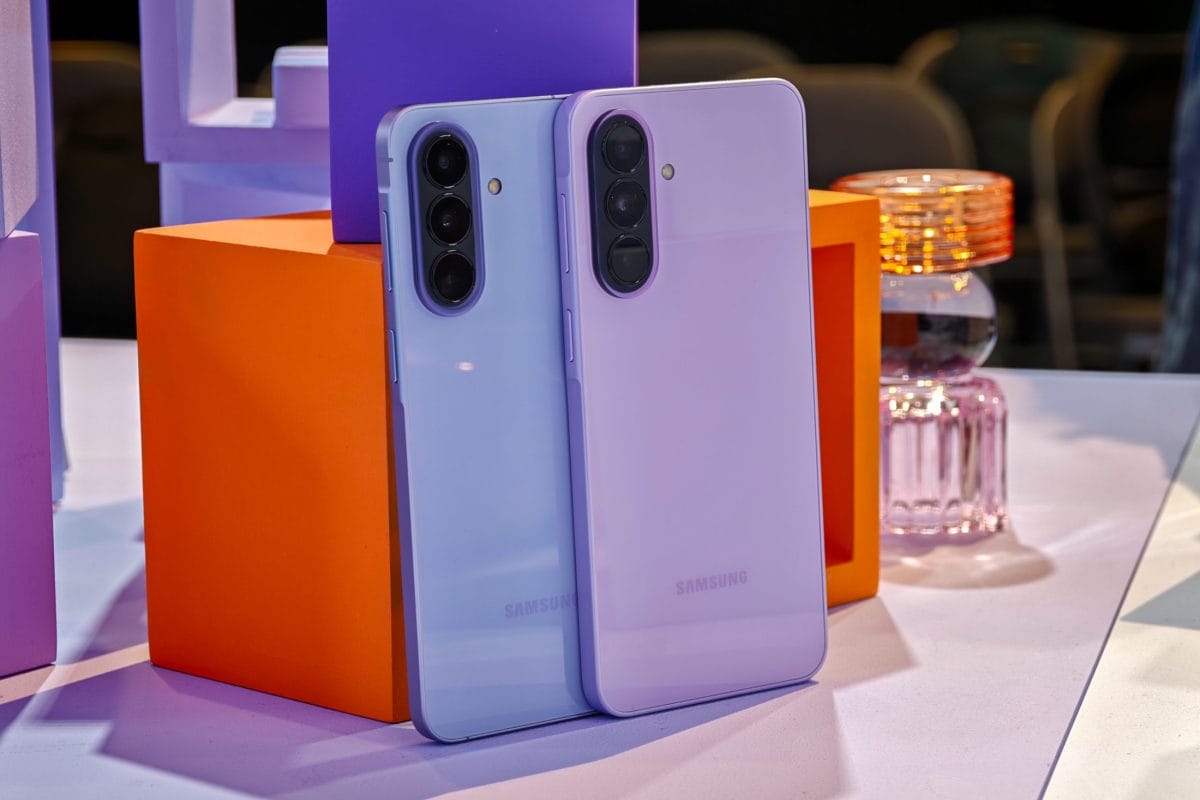
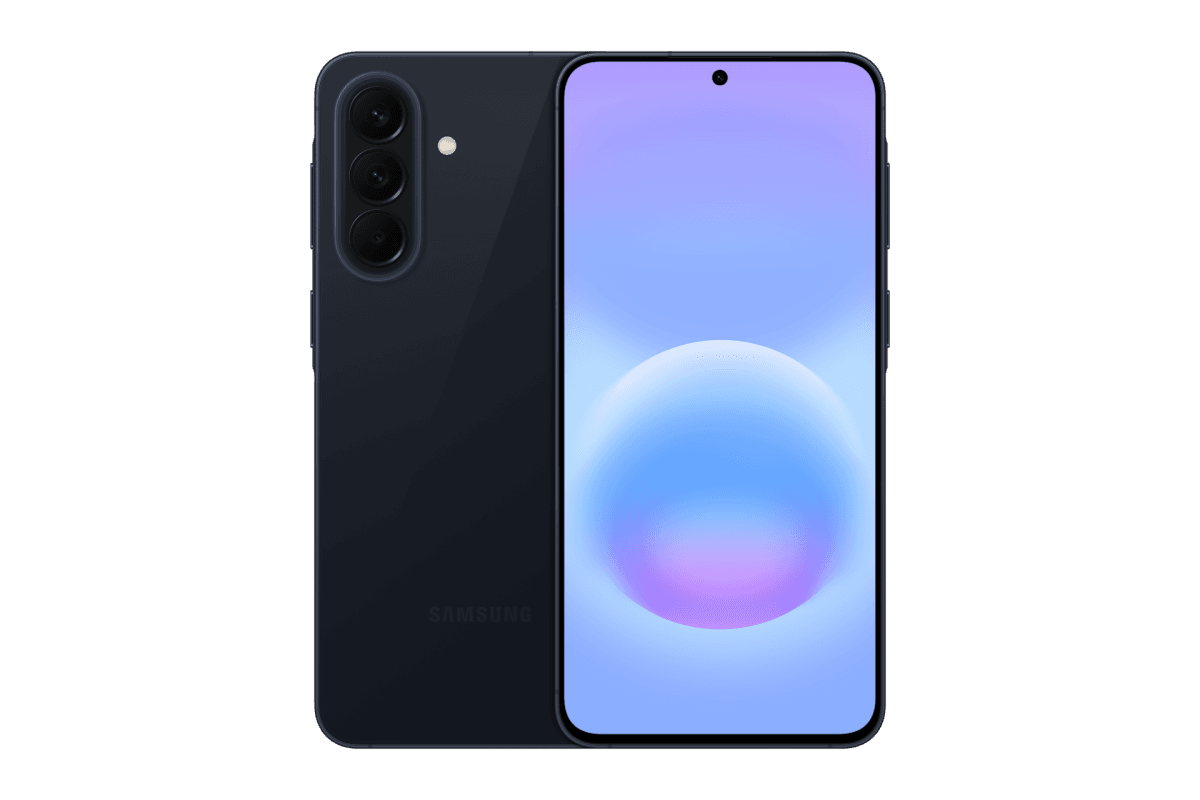
The rear camera module is neatly integrated and does not protrude aggressively — the phone lays flat on a desk without rocking. Available colourways are understated; Awesome Navy is the pick of the range for its subtle depth under different lighting.
// 02 Display
The display is where the A57 earns its daily-driver credentials most convincingly. Samsung’s Super AMOLED panels at this price tier have long been the benchmark for colour quality and contrast in the Android mid-range, and the A57’s 6.7-inch panel continues that tradition. Blacks are genuinely black, colour rendering is vivid without being aggressive on the default Natural setting, and the flat panel geometry keeps text legible all the way to the edges of the screen.
Peak brightness at 1,900 nits is competitive within this segment — sufficient for outdoor legibility on sunny days, though meaningfully behind the 3,000+ nit peaks appearing in 2026 flagships. Vision Booster mode, Samsung’s automatic outdoor enhancement algorithm, handles direct sunlight well in practice, even if the raw number looks conservative compared to Xiaomi and OnePlus competition. The 120 Hz refresh rate is capped to FHD+ rather than QHD+, which is the right trade-off for battery efficiency at this price; the difference between FHD+ and QHD+ is imperceptible to most users on a 6.7-inch panel at normal viewing distances.
HDR10+ support covers the major streaming services, and Samsung has negotiated Netflix and Prime Video HD certification. The always-on display implementation is clean and low-power, and the in-display fingerprint sensor — optical, not ultrasonic — is quick and consistent in normal conditions, though it can struggle in bright outdoor light, a known limitation of optical implementations.
// 03 Performance
The Exynos 1680 is a 4 nm part built on Samsung’s own foundry — not TSMC — and that distinction matters for honest assessment. It represents a genuine CPU improvement over the Exynos 1580 in the A56: faster single-core scores and improved sustained efficiency mean the phone handles web browsing, social media, light productivity, and camera processing without hesitation. Samsung’s own thermal testing shows 79% sustained CPU performance under extended load, and the device runs warm rather than hot — a real-world advantage for longevity.

The Xclipse 550 GPU is the weakest part of the package. It handles casual gaming, streaming, and UI compositing without complaint, but demanding 3D titles — Genshin Impact, Call of Duty Mobile on high settings — will see frame rate dips that a Snapdragon 7s Gen 3 or Dimensity 7300 competitor handles more gracefully. Buyers who game seriously should look elsewhere; buyers who treat gaming as an occasional activity will not find the A57 frustrating.
The inclusion of a microSD slot — absent from many rivals at this tier — is a practical differentiator worth naming. Storage expansion to 1 TB via card is supported, which extends the phone’s useful life without forcing a storage tier upgrade at purchase.
// 04 Cameras
The 50 MP main sensor with optical image stabilisation is the camera system’s backbone, and it performs honestly for a phone at this price. Daylight shots exhibit good dynamic range, accurate white balance on Samsung’s default processing, and sufficient detail for large prints or cropping. Samsung’s colour science here leans natural rather than saturated — a deliberate choice that photographs well but may disappoint users who expect the punchy Instagram-ready output of some Chinese rivals.
Night mode is functional without being exceptional. It brightens scenes adequately and controls noise reasonably, but it cannot match the computational photography depth of a Pixel 9a, which uses a larger sensor and Google’s more mature HDR pipeline. Side-by-side, the Pixel’s night shots retain more shadow detail with less noise; the A57’s output is fine for social media but not for anyone using their phone as a primary camera in low light.
The honest disappointment is the absence of a telephoto lens. Three-times zoom is available only as a crop from the 50 MP main sensor, which works adequately in good light but degrades quickly in anything less than bright overcast. At $549, the Google Pixel 9a also omits a telephoto, so this is a category-level limitation rather than a Samsung-specific failure — but buyers upgrading from older phones with periscope telephoto lenses will feel the absence acutely.
Macro lens note: The 5 MP macro sensor is honest at what it is — a feature for occasional novelty rather than a serious creative tool. Resolution and low-light performance are limited. Samsung’s 10× digital macro mode using the main sensor actually yields better results in most lighting conditions.
Video capture tops out at 4K/30 fps on the main lens, which is standard for this tier. OIS keeps handheld footage smooth in 1080p mode; at 4K, stabilisation is functional but less decisive. No log recording, no Dolby Vision capture — this is a consumer-facing camera system, and it makes no pretence otherwise.
// 05 Battery & Charging
A 5,000 mAh battery in a 6.9 mm slim chassis is a respectable engineering outcome, and endurance is solid rather than exceptional. Mixed daily use — several hours of browsing, social media, some camera work, occasional video — reliably produces full-day results with 15–25% remaining at bedtime for average users. Heavier use patterns or extended video streaming will trim that to about 8–9 hours of screen-on time, still competitive for the segment.
The 45 W wired charging is where Samsung’s mid-range historically lags Chinese competitors. It is an improvement over the 25 W cap on older Galaxy A models, but OnePlus and Motorola rivals in this price band frequently ship 68–125 W charging. The A57 hits 60% in approximately 30 minutes and reaches full charge in around 65 minutes — serviceable, but not the “plug in while you shower and leave at 100%” experience of faster-charging rivals.
Wireless charging at 15 W (standard Qi) is a useful convenience feature that works with any Qi pad. It is not fast enough to depend on for quick top-ups, but it removes the cable-hunting overhead for overnight charging on a nightstand. Reverse wireless charging is absent — a minor omission that few buyers will miss.
// 06 Software & Updates
This is where the Galaxy A57 makes its most compelling argument — and it is an argument that competitors have not yet meaningfully answered. Six years of Android OS upgrades and six years of security patches is a commitment Samsung has extended to the entire Galaxy A57 and A37 line for 2026, matching the Galaxy S series policy for the first time in the A tier. The phone launches on Android 16 with One UI 8.5 and will receive updates through to Android 22, with maintenance patches running until 2032.
The practical impact of this policy is significant for buyers who hold their phones for three to five years — which is the majority of the market. A phone purchased today at $549 will receive security patches and new Android features for the duration of most typical ownership cycles without qualification. By contrast, Motorola’s Edge 60 carries a three-year OS and four-year security commitment; Google’s Pixel 9a promises seven years but at a higher entry price.
One UI 8.5 itself is the most polished version of Samsung’s interface to date. The AI feature suite — Galaxy AI — includes live translation during calls, on-device photo editing with Generative Edit, and a summarisation assistant that works locally on supported languages. These are not transformative in isolation, but they represent a meaningfully integrated set of tools rather than bolted-on additions. The interface is occasionally dense with options — Samsung has not discovered restraint — but the core experience is fast, stable, and responsive to the 120 Hz panel.
On bloatware: US carrier variants ship with additional pre-installed applications that cannot all be uninstalled. The unlocked Samsung.com model is the cleaner purchase, with a more manageable initial app footprint. International models vary by region.
// 07 The Verdict
The Samsung Galaxy A57 5G is a phone of deliberate competence rather than breakthrough ambition. Its chipset is honest but not class-leading. Its camera system is reliable but short of the Pixel 9a’s computational photography depth and missing the telephoto lens that would round out the package. Its 45 W charging is a step forward for Samsung’s A-series but a step behind Chinese alternatives at similar prices.
What the A57 does extraordinarily well is assemble a complete, reliable package and then guarantee it will remain secure and current for six years. IP68 protection, Gorilla Glass Victus+, a 120 Hz Super AMOLED display that looks excellent indoors and holds up outdoors, a full-day 5,000 mAh battery, expandable storage via microSD, and a software commitment that stretches past 2032 — these are the specifications that matter at the end of year four of ownership, when the Pixel 9a and Motorola rivals have exhausted their update windows.
At $549, the A57 is not obviously cheap. It requires the buyer to value longevity and the Samsung ecosystem over outright benchmark performance or camera capability. For the right buyer, that is a straightforward exchange. For a performance-first or camera-first buyer, the Pixel 9a and several well-spec’d Motorola and OnePlus devices present stronger cases at the same or lower price.
- + 6 OS upgrades + 6 years security patches — best-in-class longevity at this price
- + IP68 water resistance — first time in Galaxy A mainstream series
- + Impressively slim at 6.9 mm / 179 g for a large-screen phone
- + 120 Hz Super AMOLED, 1 900 nit peak, HDR10+
- + One UI 8.5 polished and feature-complete including Galaxy AI
- + 50 MP main camera with OIS delivers reliable daylight results
- + microSD slot supports storage expansion up to 1 TB
- + 15 W Qi wireless charging included
- × Xclipse 550 GPU struggles with demanding 3D games
- × No telephoto lens — 3× zoom is a main-sensor crop only
- × 45 W charging is slow by 2026 mid-range standards
- × No charger included in box — extra cost for buyers
- × Night photography trails Google Pixel 9a noticeably
- × 5 MP macro lens is low-utility — mainly a spec-sheet entry
- × Carrier models carry pre-installed app bloat
The Galaxy A57 5G is the right phone for buyers who plan to keep their device for four or more years and want the assurance of continued software support, IP68 protection for an active lifestyle, and a seamless Samsung ecosystem experience with Galaxy Buds, Watch, and tablet. It is also a strong choice for family or small-business purchasers buying in volume who need a consistent, maintainable platform. It is not the right phone for gamers, dedicated mobile photographers who rely on zoom, or anyone who prioritises benchmark performance or charging speed over longevity and software polish.
Methodology · 14-day cycle
Compare against
Other top-rated smartphones we've reviewed.

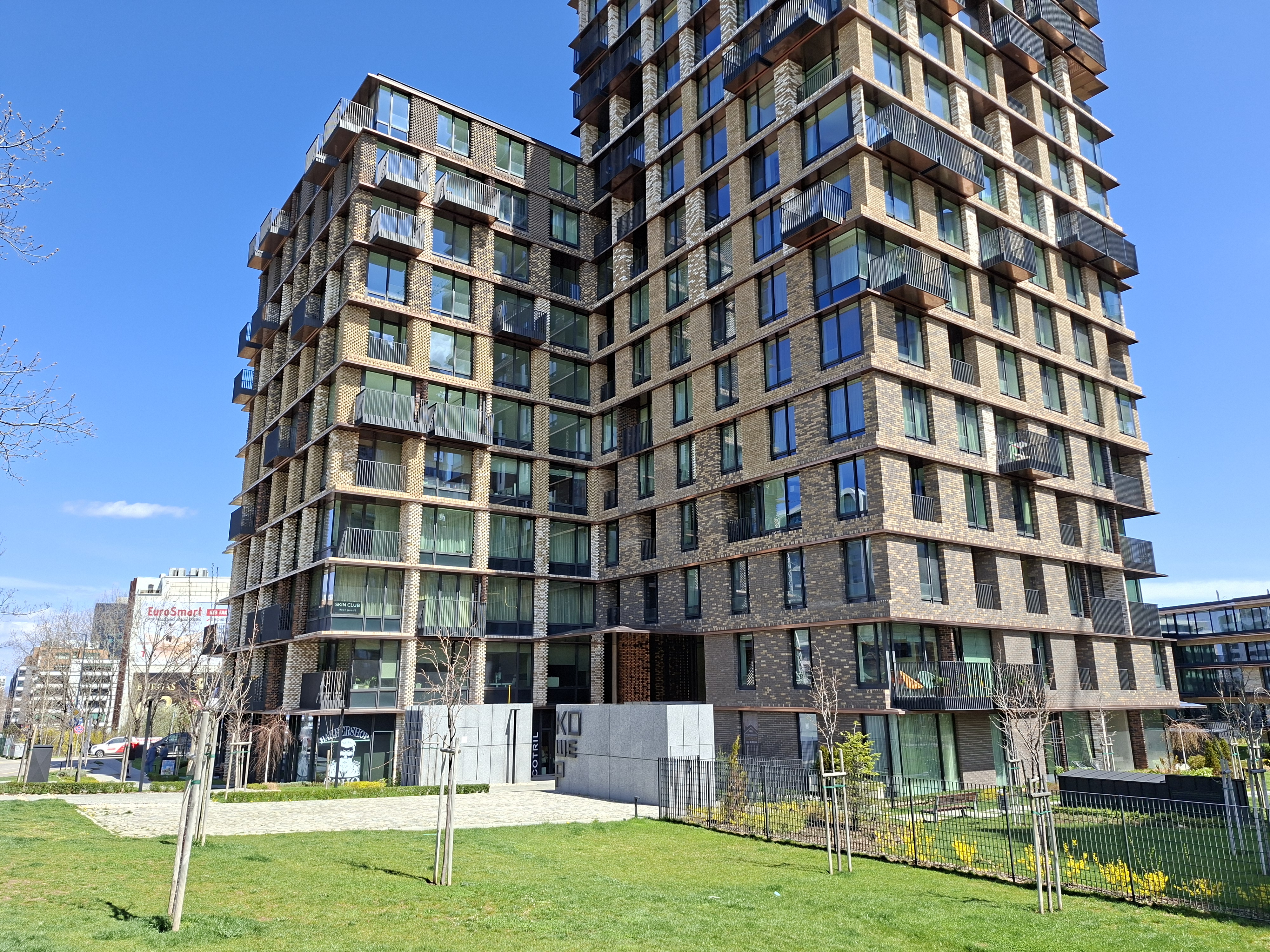
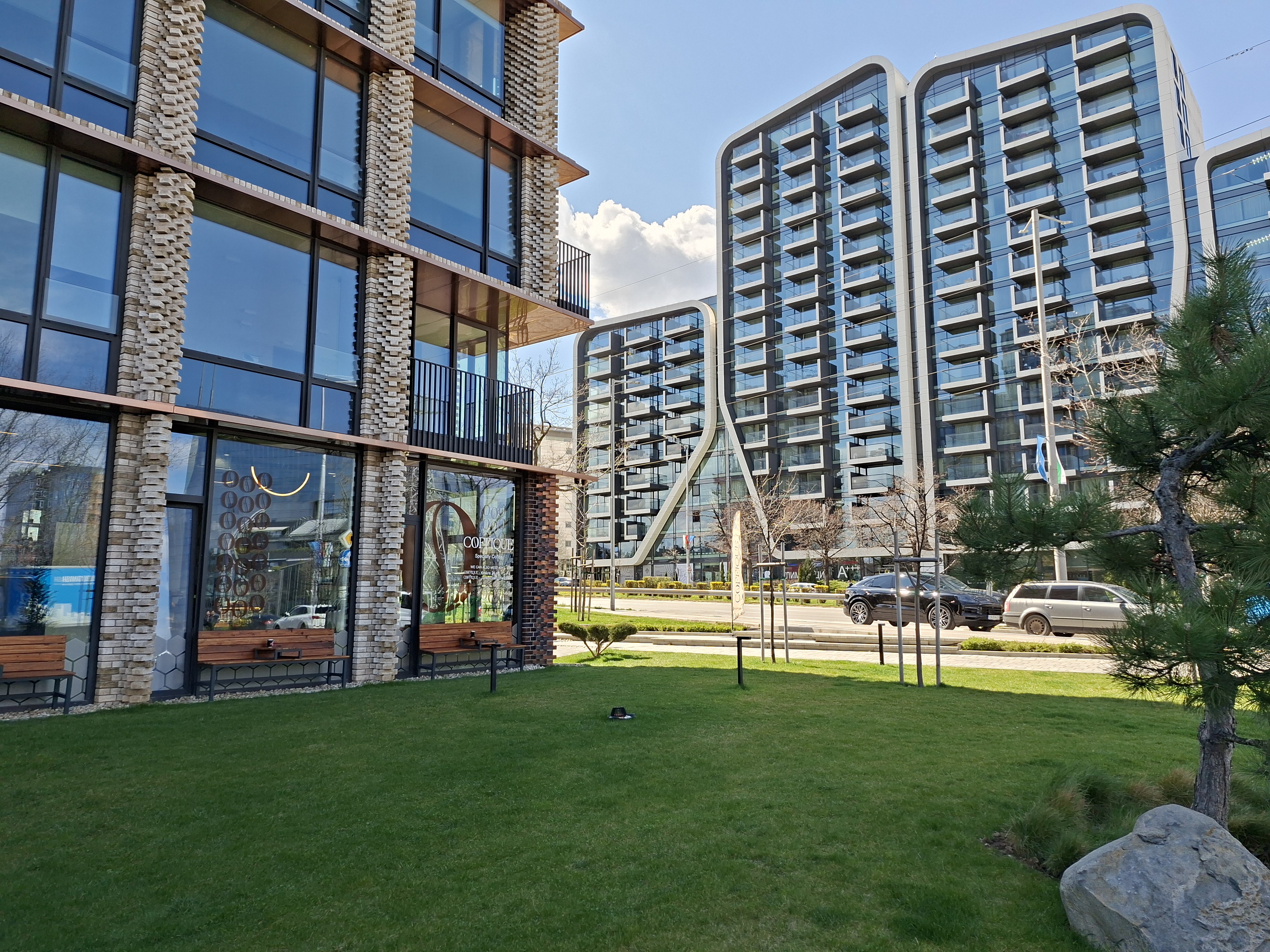
Camera samples 8
Real photos shot on this device · Flickr EXIF-verified