Replit AI Build-and-host in one
The only AI tool that builds, runs, and hosts your app in one place — from a plain-English prompt to a live URL in minutes, no environment setup required.

Where Replit came from
Replit was founded in 2016 by Amjad Masad, Haya Odeh, and Faris Masad with a mission framed around one idea: programming should be accessible from any device, anywhere, without setup. The original product was a browser-based REPL — hence the name — aimed at students and developers who couldn't or wouldn't install a local environment. Getting a beginner to write and run their first line of Python in a classroom without an IT department fight? That was the initial use case.
By 2021 the company had grown its user base into the millions and had raised Series A and B rounds from Andreessen Horowitz, Y Combinator, and others. The product expanded from a learning REPL into a full cloud IDE with collaboration features, deployments, and a marketplace. Then the AI moment arrived.
Replit moved early and decisively. Ghostwriter — its inline code completion — launched in 2022. But the bigger shift came with Replit Agent, first announced in late 2023 and shipping incrementally through 2024. Agent wasn't an autocomplete feature. It was an attempt to hand the entire build process to AI: describe an app, Agent builds it, Agent deploys it. The company raised a $97.4M Series B in 2024, then a landmark $400M round in 2026 — a signal of how seriously the market is taking the build-in-one-place thesis.
Agent 3 launched in September 2025 with claims of "10x more autonomy" — autonomous testing, extended thinking, background automation, and multi-agent orchestration. Agent 4 followed in 2026, adding a visual design canvas, parallel agent execution, and tighter mobile app generation. Today Replit has over 35 million registered users. That community scale is itself a feature: there are templates, forks, and community repls for almost any starting point you can imagine.
What Replit actually is
The positioning has evolved but the core pitch is unusually clear: Replit is the only mainstream AI tool that handles the entire stack in one place. Code generation, a live runtime, a PostgreSQL database, authentication, hosting, deployment, monitoring — all inside a single browser tab, all provisioned without any configuration on your part.
Every competing tool in this space makes you choose. Bolt.new generates great code but hands deployment off to Netlify or Cloudflare. Lovable builds polished frontends but relies on Supabase for the database layer. v0 by Vercel produces component-quality UI but assumes you have a Next.js app to drop it into. Replit is the only one that stays with you all the way from first prompt to live URL, and it does this for backends too — not just frontends.
What you get on Core ($25/month):
- A cloud IDE with full terminal access and AI Agent
- Built-in PostgreSQL database, key-value store, and object storage
- Built-in authentication (Replit Auth) — one toggle, no OAuth setup
- One-click deploy with automatic SSL and a
*.replit.appdomain (custom domains supported) - Real-time multiplayer editing — up to 5 collaborators on Core
- Mobile access via iOS and Android apps
- $25/month in credits for Agent usage
The IDE itself is a first-class tool. Not a toy. You have a full terminal, proper file tree, git integration, environment variable management, and the ability to install any system package you need. The AI layer is on top of a real environment — when Agent writes code, it can actually run it, read the error, and fix it. This is the distinction that matters for complex backend work.
First ten minutes in Replit
Create an account. Land in the dashboard. Click "Create Repl." You get two paths: start from a template (hundreds of them, covering React, Python/Flask, Node/Express, Go, Ruby on Rails, Rust) or start with an Agent prompt. Pick the Agent path.
Type something like: "Build a task management app with user accounts, a projects list, and the ability to add tasks with due dates." Agent 4 responds almost immediately with a plan — a short outline of what it will build and in what order. You can approve the plan or tweak it before any code is written. This planning step is underused. When the output isn't what you want, it's usually because the plan was wrong, and catching it there is much cheaper than fixing it after forty files have been written.
Approve the plan. Agent starts building. Watch the file tree populate in real time — components, API routes, schema migrations, environment setup. Within a few minutes you have a running app in the preview pane on the right side of the screen. Agent then runs its own tests, catches errors, and fixes them. When it finishes, there's a "Deploy" button. Click it. Live URL in roughly thirty seconds.
From blank prompt to deployed app: about ten minutes for a simple CRUD app. That is not an exaggeration. For a non-technical founder who has spent months trapped in conversations with developers, this ten-minute window changes everything.
Before you approve Agent's plan, read it carefully. One sentence in the plan that's wrong ("uses SQLite for the database" when you need PostgreSQL) will cost you thirty minutes of corrections later. Thirty seconds of reading the plan now is the highest-leverage move in every Replit session.

Agent 4: what's actually new
Agent 4 shipped in 2026 and is a meaningful generational upgrade, not a marketing refresh. The three changes that matter in practice:
Parallel agent execution
Previous versions of Agent worked sequentially — build auth, then build the database schema, then build the frontend. Agent 4 runs independent tasks simultaneously. Auth setup and frontend scaffolding happen in parallel threads. The result is noticeably faster builds and, more importantly, a preview that updates in near-real-time as different subsystems come online. On Core you get 2 parallel agents. Pro unlocks 10.
Visual design canvas
Agent 4 ships with a design-in-code canvas — an infinite board where you can visually explore layout variants, adjust components in context, and generate design alternatives without leaving the IDE. It's not Figma. It's closer to a smart inspect panel that can regenerate components based on your feedback. For non-technical builders who think visually, this reduces the "I can't describe what I want in words" problem significantly.
Mobile app generation
Describe an iOS or Android app. Agent 4 scaffolds a React Native + Expo project, wires up the same database and auth as your web app if you have one, and produces a QR code you can scan with Expo Go to test on an actual device. This is genuinely novel in the space — it's not a responsive web wrapper, it's a real React Native app with native navigation patterns. The quality ceiling is lower than handwritten React Native, but for MVPs the ceiling is more than enough.
Agent 4 also deepens integrations — Figma-to-code at roughly 80% fidelity, Stripe billing in a few prompts, connections to Linear, Notion, Salesforce, and Excel out of the box. The days of spending a weekend wiring together scaffolding are genuinely over for the use cases Replit targets.
How it actually feels (the honest take)
Replit hits different depending on who you are. For a non-technical founder it feels like a superpower materialized. You describe your product, it appears, it runs. The gap between idea and live prototype collapses from weeks to hours. That emotional shift is real and it matters.
For an experienced developer it's a different experience. You quickly notice the edges. Agent makes confident architectural decisions you'd never make — reaching for global state where props would do, using string-based routing instead of typed params, skipping input validation unless you specifically ask for it. The code works. Whether it's good is a separate question. Experienced developers tend to use Replit the way a chef uses a prep cook: let Agent do the scaffolding and the boilerplate, then step in and clean up the parts that matter.
The in-browser model is both Replit's biggest strength and its most significant constraint. You never install anything, which is genuinely magical. But your project lives on Replit's servers, which means migrating it out later — to a proper cloud provider, to a self-hosted environment — is nontrivial. The platform dependency is a real consideration for anything you intend to scale beyond prototype stage.
One thing that stands out positively: Agent self-corrects better than any competing tool we've used. When it writes a database migration and the migration fails, it reads the error, diagnoses it, and rewrites the migration. This feedback loop — write code, run code, read error, fix code — happens automatically and saves enormous amounts of time compared to manually copying error messages into a chat window.
Three real workflows, end-to-end
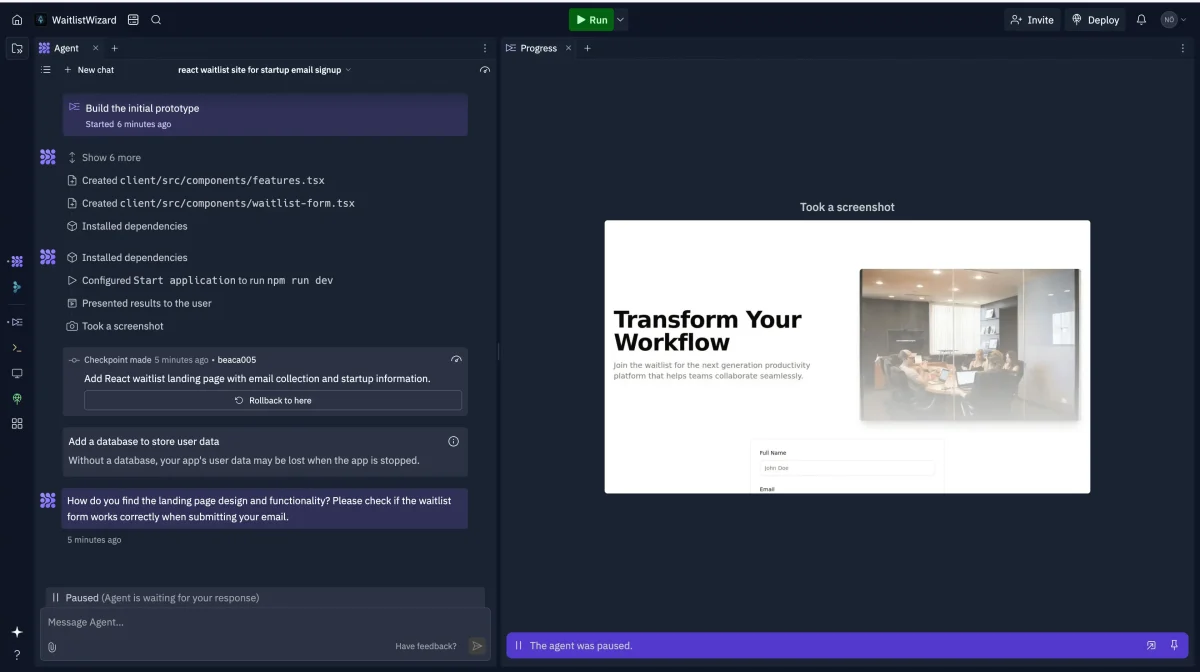
Waitlist app with email collection, admin dashboard, referral tracking
Starting point: a product idea, no code experience, a Core plan. Prompt: "Build a waitlist app where people can sign up with their email. Show them their position in the queue. If they refer a friend who signs up, they move up. I want an admin page where I can see all sign-ups and export them to CSV."
Agent's plan covered: a landing page with signup form, a PostgreSQL table for subscribers with a referral code column, logic to calculate position based on referral count, a password-protected admin page, and a CSV export endpoint. The plan was correct. Approved.
Twelve minutes later: running app, admin login working, referral links generating and tracking. The builder deployed it, shared the link, and had 40 people sign up the same afternoon — on an app they built the same morning. Agent self-corrected one database index error without being asked and caught a missing environment variable for the admin password before it caused a live issue.
The one thing Agent missed: it used a simple sequential row number for queue position rather than a weighted calculation that prioritized more referrals. One follow-up prompt fixed it in three minutes. Total from prompt to deployed: 45 minutes including iteration.
Stripe webhook processor with retry queue and admin log viewer
This is the use case where Replit genuinely beats Bolt and Lovable: persistent server-side processes. A Stripe webhook processor needs a long-running Express or FastAPI server, a queue for retries, database writes on each event, and an admin interface for debugging failed deliveries. Bolt can generate the code for this. Replit can run it.
Prompt: "Build a Stripe webhook processor in Node.js. It should verify Stripe signatures, store each event in PostgreSQL, retry failed events up to three times with exponential backoff, and show a log view in a simple admin UI where I can see recent events and their status."
Agent built a working Express app with Stripe's webhook middleware, a webhook_events table with status and retry_count columns, a background job runner using node-cron, and a minimal but functional admin dashboard. The retry backoff logic was correct on the first pass — exponential with jitter, not naive fixed delay. That's the kind of detail that usually requires a manual review.
Where Agent needed help: it initially wrote the admin UI without authentication ("I'll add auth later" was in a comment). A follow-up prompt to "add Replit Auth to the admin UI so only I can access it" added it correctly in two minutes. The developer's total active time was about 25 minutes for an app that would take a full day to scaffold by hand.
Assignment portal where students submit code and get automated feedback
A computer science instructor wanted a portal where students submit short Python scripts, the system runs them against test cases, and students see immediate results without the instructor manually running code. This is a use case with real security implications — executing student-submitted code requires sandboxing.
Replit's environment was uniquely suited here: it has a native concept of isolated code execution (every repl is already sandboxed). Agent built the submission form, a test runner that executed uploaded Python in an isolated subprocess with a timeout, and a results table showing pass/fail per test case. It added the timeout and subprocess isolation without being asked — Agent inferred from the "student code" context that execution safety mattered.
The instructor added ten test assignments, had students test the portal, and used it in class the following week. The biggest manual intervention was writing the test cases themselves — Agent can't know what the correct outputs should be for your specific assignments. Everything else was hands-off. The $18 of credits for this session was the most productive $18 in the instructor's budget that semester.
Real prompt → real output
We gave Agent 4 this prompt on a fresh Core account:
Agent's plan came back in nine seconds: React frontend with drag-and-drop via @dnd-kit/core, PostgreSQL table for links, an Express API with CRUD endpoints, a password-check middleware for /admin, and a deploy config. Plan was accurate. After approval, the full build took fourteen minutes.
The warning about the environment variable is the kind of production-safety detail that separates Agent 4 from earlier versions. It didn't just build the feature — it told us what we'd need to do before making it public. The drag-to-reorder worked on first load. The CRUD operations were correct. We changed one thing manually: the card design. Agent's default styling was functional but plain, and a single follow-up prompt ("make the cards look cleaner, white background, subtle shadow, emoji larger") handled it in two minutes.

The built-in infrastructure advantage
This is where Replit earns its differentiation most clearly. Every competing tool in the AI app builder category assumes you'll wire up your own backend services. Bolt.new generates excellent code but you're responsible for choosing and connecting a database provider, an auth service, a hosting platform, and possibly a CDN. That's four vendor relationships, four pricing decisions, four setup flows. For a solo builder with no DevOps experience, that's a week of learning before you ship anything.
Replit bundles it:
- PostgreSQL — provisioned automatically, connection string in your environment by default, Replit's database browser for direct inspection
- Key-value store — a Redis-compatible store for session data, rate limiting, or caching — zero config
- Replit Auth — a toggle. One toggle enables sign-in with Replit accounts. No OAuth setup, no session management code to write, no JWT library to configure. When Agent adds auth to your app, it almost always uses this.
- Hosting and deployment —
*.replit.appdomains with SSL out of the box, custom domains on Core and above, automatic scaling for deployments - Monitoring — logs, uptime tracking, and error alerts in the same dashboard as your code
The trade-off is coupling. Your database is Replit's database. Your auth is Replit's auth. This is fine — even optimal — for a prototype, a small tool, or an internal app. It becomes a meaningful constraint if your app grows to the point where you need to migrate to AWS RDS, self-host your auth, or move hosting for compliance or cost reasons. That migration exists, but it's not trivial. Go in clear-eyed: Replit is a platform, not just a tool.
Replit vs Bolt.new
a/replit b/bolt-new
Bolt.new by StackBlitz runs a full Node.js environment in your browser via WebContainers. No server required — the runtime is WebAssembly in your tab. It's brilliant for frontend-heavy apps and framework-flexible work (React, Vue, Svelte, Astro, Expo). Replit runs on actual servers, which is the right choice for persistent backends.
replit wins at
- persistent backend processes — Slack bots, webhook servers, cron jobs
- built-in database, auth, and hosting — zero external services
- long-running agents that can test and self-correct in a real runtime
- mobile app generation via React Native/Expo
- Python backends — FastAPI, Django, data science stacks
bolt wins at
- pure frontend speed — no server round-trip, runs in the browser
- framework choice — Vue, Svelte, Astro vs Replit's React-first defaults
- Expo mobile support without leaving the web
- token-based pricing is predictable for small projects
- no platform coupling — export and deploy anywhere
Verdict: Bolt for frontend-heavy apps where you want deployment flexibility. Replit when your app has meaningful backend logic — APIs, jobs, databases, persistent state. The real test: does your app need a server process that stays running after the user closes the tab? If yes, Replit.
Replit vs Lovable
a/replit b/lovable
Lovable is the most polished AI app builder for non-technical founders — clean UI output, seamless Supabase integration, account-based pricing that's predictable for teams. It wins on design quality and MVP polish. Replit wins on backend depth and runtime environment.
replit wins at
- actual server runtime — code executes, not just generates
- Python and backend-heavy stacks natively
- 35M community — templates and forks for almost anything
- mobile app generation built in
- single-platform: no Supabase/Netlify account required
lovable wins at
- design quality — output is genuinely polished, not functional-only
- Supabase integration is tighter and more scalable
- easier for truly non-technical users — less IDE, more wizard
- predictable seat-based pricing for small teams
- conversational refinement loop is more forgiving
Verdict: Lovable for polished consumer-facing UIs and SaaS MVPs where design matters most. Replit when you need real backend code to run — not just be generated. If you can't tell the difference yet, start with Lovable and switch to Replit when you hit its ceiling.
Replit vs v0 by Vercel
a/replit b/v0-by-vercel
v0 is a component generator, not an app builder. It produces high-quality React/Tailwind UI components and full pages that you paste into an existing Next.js project. The output quality is exceptional — the best-looking generated UI in the market. But v0 assumes you have a project already. Replit builds the whole project.
replit wins at
- greenfield apps — builds from nothing to deployed
- backend logic, databases, APIs — not just UI components
- non-technical users — no existing project required
- mobile app generation
- end-to-end deployment without a separate hosting account
v0 wins at
- component quality — the best-looking output in the market
- dropping into existing Next.js projects
- shadcn/ui depth — native, not approximated
- tight Vercel ecosystem integration
- free tier is extremely generous for component generation
Verdict: v0 when you have an existing Next.js app and need polished UI fast. Replit when you're starting from zero and need the full stack, not just the frontend. These tools aren't really competing — many developers use both.
Where Replit breaks down
No review is useful without the failure modes. Here's where Replit consistently disappoints:
Unpredictable credit costs
The effort-based pricing model is honest about what it charges — you pay for actual compute effort, not a flat rate per checkpoint. But "honest" doesn't mean "predictable." A session that goes wrong — Agent makes a bad architectural decision, you correct it, Agent rebuilds — can burn $15-20 of credits in what felt like a simple thirty-minute session. The Core plan's $25/month in credits disappears faster than most users expect. Real-world reports from active users put typical usage at $50-150/month once you're building seriously.
Large codebase degradation
Replit Agent is excellent for greenfield projects of moderate complexity. As projects grow past a certain size — roughly when the codebase exceeds what fits comfortably in context — Agent starts making changes that contradict previous decisions, duplicating functions that already exist, or missing important conventions established earlier in the project. This isn't unique to Replit, but the platform's "keep building in the same repl" model makes the degradation more noticeable over time.
Code quality ceiling
Agent's output is architecturally functional but stylistically inconsistent. You'll find a mix of camelCase and snake_case variable names, missing input validation on some routes but not others, and error handling that catches exceptions in some places and lets them propagate in others. For a prototype you don't care. For a production service you're handing to users, you'll spend time cleaning up. This isn't a knock on Replit specifically — all AI builders have this issue — but Replit's all-in-one model means you're less likely to have a developer review pass before it goes live.
Vendor lock-in is real
Your Replit PostgreSQL database isn't a standard managed Postgres you can pick up and move to AWS RDS. Replit Auth isn't a portable identity layer you can migrate to Auth0. These integrations work beautifully inside Replit's ecosystem and are genuinely zero-effort to add. But the exit cost is meaningful. Before you build something you expect to scale or commercialize seriously, make sure you've planned for what happens if you need to leave the platform.
Support tiers create real gaps
Free and Core users get community-based support. When something breaks — an Agent session that corrupted a file, a deployment that's stuck in a bad state — the help path is a Discord community and a documentation search. Response times can be long. Pro and Enterprise users get priority support, but $100/month is a significant jump from $25. The gap between the tiers in support quality is wider than the price suggests.
A single complex Agent session — building a multi-feature app, running into errors, iterating — can consume your entire month's $25 Core credit allocation. Budget conservatively, check your usage in the billing dashboard after each major session, and consider the Pro plan ($100/month, $100 credits) if you're building more than one or two projects per month.
Pricing, in real terms
Replit's pricing has four tiers as of early 2026:
Starter (Free) includes the IDE, free daily Agent credits (limited), basic deployment with a Replit badge, and community access. Sufficient for learning and experimentation. Hits limits quickly for actual product work.
Core at $25/month (or $20/month billed annually) is the entry plan that matters. You get $25 in monthly credits, 5 collaborators, 2 parallel agents, custom domains, multi-region deployment, and the Replit badge removed. For solo builders and founders testing MVPs, this is the right starting point. The $25 credit allocation runs out faster than you'd expect — plan to supplement with top-ups or move to Pro if you're building more than a couple of projects per month.
Pro at $100/month (or $95/month annually) targets commercial and team use. $100 in credits, 15 collaborators, 10 parallel agents, 28-day database rollback, access to the most powerful AI models (High Power Mode), and priority support. For teams that are using Replit as their primary build tool, the jump from Core to Pro frequently pencils out — the 10 parallel agents alone meaningfully reduce build time for complex apps.
Enterprise is custom pricing with SSO/SAML, single-tenant infrastructure, static outbound IPs, VPC peering, custom seat limits, and data warehouse connections. Contact sales if you're evaluating Replit for a company with compliance or security requirements.
The effort-based credit math
Credits are consumed via effort-based pricing — not a flat rate per interaction. Simple edits (fixing a typo, changing a color, adding a field to a form) cost less than $0.25. Complex multi-step tasks (building a full authentication flow with database schema, API endpoints, and frontend components) cost more — sometimes significantly more. There's no pre-session cost estimate, which is the source of the "surprise bill" complaints you'll find in the community.
Practical calibration from real usage: a landing page build runs roughly $1-3 in credits. A full CRUD app with auth runs $5-15. A complex multi-feature build with iteration can hit $25-40 in a single session. The Core plan at $25/month gives you one to three serious builds per month before you're buying top-ups.
Who should use Replit (and who should skip it)
Use Replit if you are
- A non-technical founder who needs a working, deployed app to show investors or test with users
- A developer prototyping a backend-heavy idea — webhooks, bots, data pipelines, APIs — where you need a real runtime, not just generated code
- An educator building tools for a classroom, where zero setup for students is the whole point
- A solo developer who wants to skip the DevOps layer entirely and just build
- Someone building a Python backend — Replit's Python support and data science ecosystem are deeper than Bolt or Lovable
Skip Replit if you
- Are working with an existing large codebase — Agent degrades in quality as project size grows
- Have compliance requirements (HIPAA, SOC 2, FedRAMP) — enterprise plan is the floor for regulated data, and even then verify
- Need strict version control workflows — Replit has git, but it's not the center of the experience
- Are cost-sensitive at scale — credit burn accelerates with project complexity in ways that can be hard to predict
- Need guaranteed data portability from day one — plan your exit before you're locked in

What's next for Replit
- Agent 4 expanded mobile output — deeper native iOS and Android support beyond React Native/Expo, including direct App Store and Play Store submission flows from the Replit dashboard
- Improved cost transparency — a pre-session credit estimate before Agent starts building, addressing the biggest complaint from Core users
- Data warehouse integrations — BigQuery, Snowflake, and Redshift connections built into the IDE, currently Enterprise-only, signaled for Pro
- Visual agent history — a timeline view of every change Agent made to your project, with the ability to roll back to any checkpoint without losing subsequent unrelated work
- Offline-capable export — a one-click "export to standard stack" that converts a Replit project into a portable Docker Compose setup, reducing vendor lock-in anxiety
Alternatives worth knowing
FAQ
Do I need to know how to code to use Replit?
No, but it helps with iteration. Non-technical users can describe an app in plain English and get a deployed result. Where coding knowledge pays off is reading Agent's output critically — catching a decision you didn't want before it goes live. Beginners who read the plan step carefully do well. Beginners who approve blindly and then try to fix problems after the fact have a harder time.
How does the credit system actually work?
Credits are consumed based on effort — the complexity and length of each Agent task. Core includes $25/month in credits. Simple tasks (small edits, UI tweaks) cost under $0.25. Complex tasks (building a full auth system, multi-file refactors) cost $2-10 or more. There's no pre-session estimate (though Replit has signaled this is coming). Check your usage in Account → Billing after each major session so surprises don't hit you at month end.
Can I use Replit for production apps, or just prototypes?
Replit deployments are production-capable — SSL, custom domains, automatic scaling, uptime monitoring. Many small apps and internal tools run in production on Replit with no issues. The practical limits are: Agent-generated code needs a review pass before you trust it with real users, the infrastructure lock-in becomes meaningful at scale, and for regulated data you need the Enterprise tier. For a side project or early-stage startup: production-ready. For a Series B SaaS: consider the migration path.
Replit vs Cursor — can I use both?
They serve different use cases and yes, many developers use both. Cursor is an editor for people who write code professionally and want AI assistance at every keystroke. Replit is a platform for building and deploying apps with AI doing most of the work. The overlap is in the "vibe coding" middle — building something new with heavy AI involvement. For that specific use case, Replit is faster to ship but Cursor gives you more control over the result.
What languages and frameworks does Replit support?
Over 50 programming languages including Python, JavaScript/TypeScript, Go, Rust, Ruby, Java, C/C++, and more. Framework templates exist for React, Next.js, Vue, Svelte, Express, FastAPI, Django, Flask, Rails, and others. Agent defaults to React for frontends and tends to reach for Node.js or Python for backends depending on the task — you can override this in your prompt.
Is my code private?
On Core and above, repls are private by default. Free tier projects default to public. Replit stores your code on their servers — standard cloud provider terms apply. Enterprise customers get single-tenant infrastructure for stricter data isolation. If you're handling sensitive data, read Replit's data processing terms carefully and use the Enterprise plan for anything with regulatory implications.
What happens to my app if Replit goes down?
Your deployed app runs on Replit's infrastructure and is subject to their uptime. Replit has an uptime page and has historically maintained solid availability for deployed apps. For anything business-critical, maintain a git backup of your code (Replit has built-in git) so a migration to another host is possible. The database export path exists but isn't one-click — plan it before you need it.
How does Agent 4 compare to Agent 3?
Agent 4 adds three things that matter: parallel task execution (builds faster, up to 10 parallel agents on Pro), a visual design canvas (tweak UI visually instead of describing changes in words), and mobile app generation via React Native/Expo. The underlying AI models are the same — Claude Sonnet 4 and GPT-4o — but the orchestration around them is significantly more capable. Agent 4 also integrates with more external services out of the box (Linear, Notion, Figma at 80% fidelity).
The verdict
The only AI tool that stays with you from first prompt to live URL.
Replit's core proposition is genuinely unique: one platform, one subscription, and you go from an idea to a deployed, database-backed app with no external services required. For non-technical founders, educators, and developers who want to skip the DevOps layer, that's not a feature — it's the whole product. Agent 4's parallel execution and mobile generation make it the most capable version of this tool yet.
The caveats are real. Credit costs at serious usage run higher than the $25 Core entry suggests. Code quality needs a review pass before you trust it in production. And the platform lock-in is a real architectural decision, not a footnote. But for the use cases Replit targets — prototype fast, deploy immediately, iterate with AI — nothing else on the market closes the loop as completely.
Start on the free tier for your first project. Move to Core when you're building seriously. Evaluate Pro when your monthly credit burn exceeds $25 or you need more than two parallel agents. The tool earns its place in the toolkit.