Privacy-first AI code assistant with zero data retention, on-prem and air-gapped deployment, and triple compliance certification — built for regulated enterprises where code cannot leave the building.
The Tabnine story is actually two stories that collided. The first: Codota, founded in 2013 in Tel Aviv by Dror Weiss and Eran Yahav. Codota built an AI assistant for Java developers, trained on public repositories, focused on large enterprise teams. The second: TabNine, a scrappy code completion experiment launched in 2018 by Jacob Jackson, a University of Waterloo student, who used GPT-2 to predict code across any language. Codota acquired TabNine in 2019, merged the two products, and in 2021 rebranded the combined company to Tabnine.
That lineage matters because it explains Tabnine’s current positioning precisely. Codota was always enterprise-first — its earliest customers were large organizations who needed auditability and control. TabNine was always language-agnostic — its earliest users were polyglot developers tired of single-language tools. The merger produced an AI coding assistant that is unusually wide in IDE and language coverage, and unusually serious about enterprise compliance. That combination isn’t accidental — it’s baked into the company’s DNA from two distinct founding cultures.
By 2022, Tabnine had raised $15.5M (a16z led). The timing was awkward: GitHub Copilot launched publicly the same year and ate much of the mid-market. Tabnine’s response wasn’t to out-compete Copilot on raw AI quality — they doubled down on the one dimension Copilot couldn’t touch: guaranteed data isolation. By 2025 the free tier was retired, the price climbed to $39/user/month for the base enterprise plan, and the positioning was explicit: Tabnine is for regulated industries, not for individual developers who want the fastest completions.
That’s a coherent bet. Whether it’s a winning bet depends on your organization’s threat model, which we’ll unpack in detail.
What Tabnine actually is
Strip away the marketing and Tabnine is three things in a trench coat: an AI completion engine that suggests code as you type, an IDE-integrated chat for natural-language codebase queries, and an agentic layer (on the higher-tier plan) for multi-step autonomous tasks like automated code reviews, test generation, and refactoring workflows. All three components share one architectural property that nothing else on the market offers at the same level: the entire inference pipeline can run entirely within your perimeter.
The completion engine works exactly like you’d expect — you type, Tabnine suggests, you accept with Tab. Where it diverges from Copilot and Cursor is in how that suggestion is generated. Tabnine can be configured to run inference entirely on-premises: the model lives on your hardware or your private cloud, the request never leaves your network, and there is no external API call. For organizations with air-gap requirements, this is the only viable path among mainstream AI coding tools.
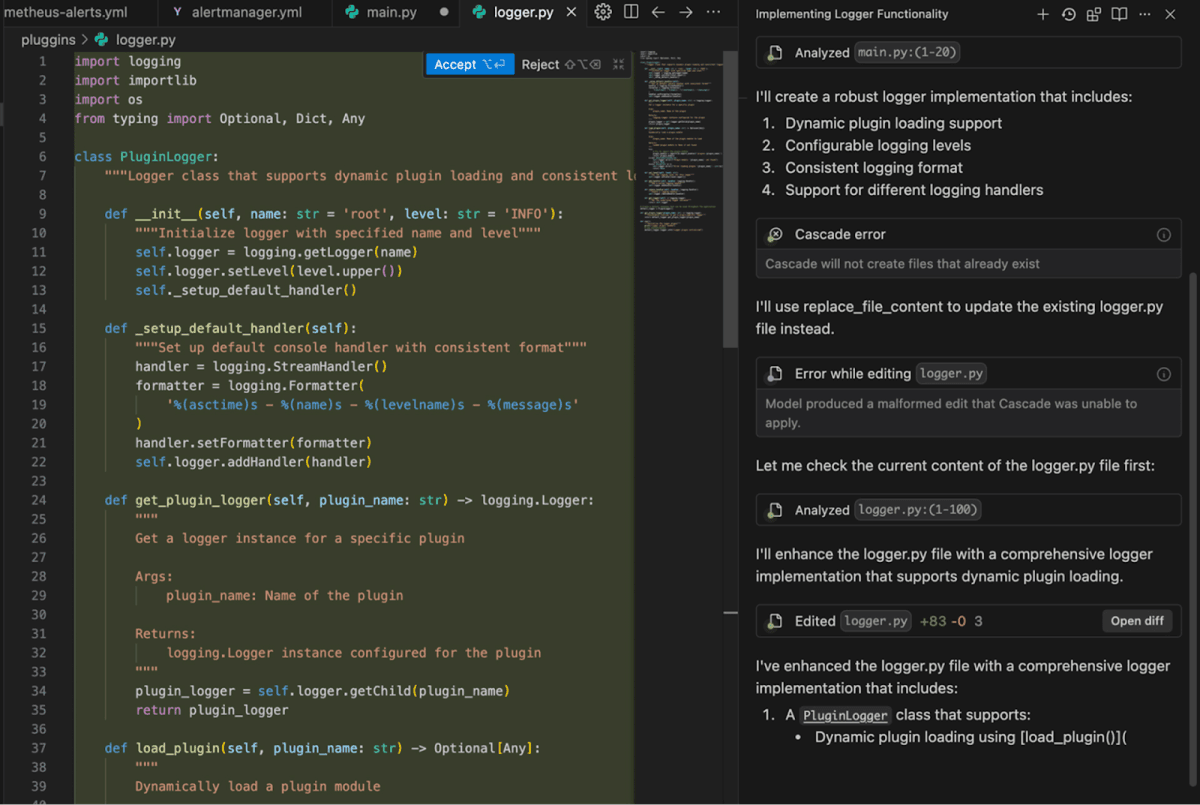
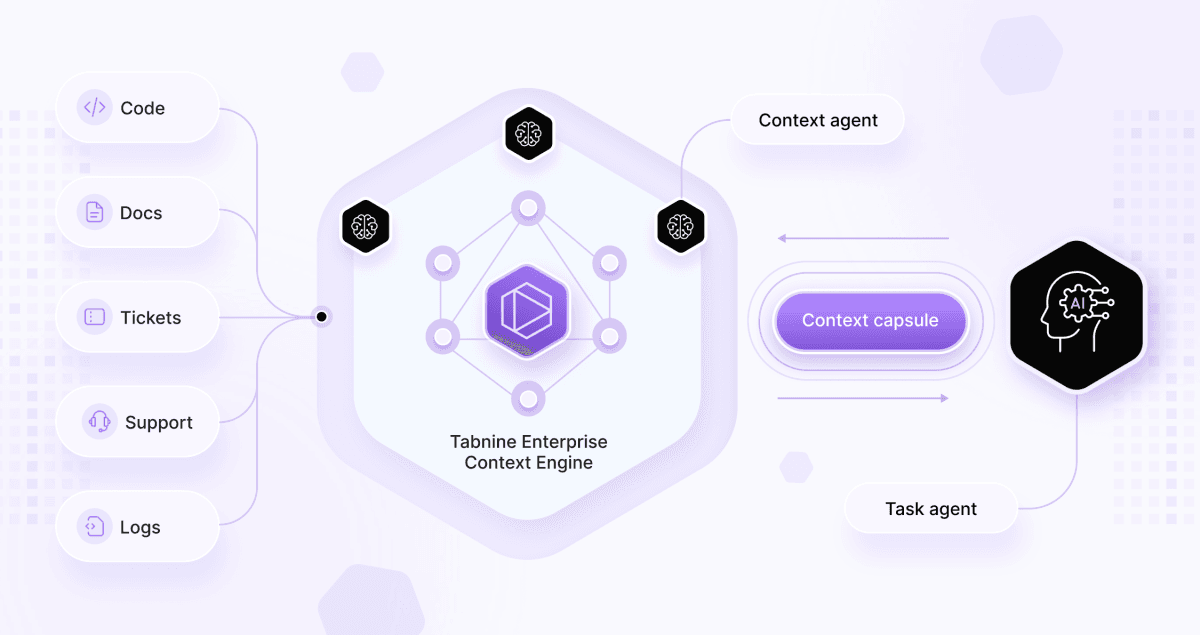
The chat interface (Tabnine Chat) lives inside your IDE as a sidebar panel. You ask natural-language questions about your codebase: “How does authentication work in this service?” “Generate a unit test for this function.” “Where is database connection pooling configured?” Tabnine’s Context Engine indexes your repositories and feeds the relevant code into the model’s context window before answering, so responses are specific to your codebase rather than generic programming advice.
The Agentic Platform (the $59 tier) adds autonomous task execution: Tabnine agents can receive a task description, plan a series of steps, invoke tools via Model Context Protocol (MCP), interact with Jira and GitHub to pull context, make multi-file changes, run tests, and iterate. The agentic layer has user-in-the-loop checkpoints — each significant action can be approved before execution — which is exactly the governance posture enterprise security teams demand.
The privacy architecture — why it’s different
This section is the real reason this review exists. If you’re evaluating AI coding tools and privacy isn’t your concern, Tabnine probably isn’t your tool. If it is your concern, this architecture is the feature set.
Zero code retention. Tabnine’s production pipeline is designed so that code sent for inference is ephemerally processed and immediately discarded after the model returns a response. Nothing is logged to a persistent store. Nothing is retained for model training. This isn’t a policy — it’s a pipeline design. The company holds SOC 2 Type II, ISO 27001, and GDPR certifications, all of which independently audit these claims.
Your code never trains any model. Tabnine’s base models were trained exclusively on permissively licensed open-source repositories — MIT, Apache 2.0, BSD. Your proprietary code is never used to update any shared model. When Enterprise customers fine-tune a custom model on their private codebase, that model is isolated in their deployment environment and is never accessible outside their organization.
IP-safe suggestions. Tabnine’s models include attribution checking — a filter that detects when a generated completion matches a substantial block of public code and flags it. This matters for organizations with legal exposure around code provenance. It’s not a perfect shield, but it’s a documented mitigation that most competitors don’t offer explicitly.
No third-party model calls. When you run Tabnine in a cloud or on-prem deployment, inference goes to Tabnine’s models (or your fine-tuned variant), not to OpenAI, Anthropic, or Google. There is no undisclosed API hop to a third-party provider. This is a structural difference from tools that advertise “privacy” but still route requests through external model providers with their own data handling.
NOTE · the audit question
When a CISO asks “can I prove our code didn’t leave the building?”, Tabnine is the tool that comes with documentation to answer that question. SOC 2 Type II, ISO 27001, and GDPR compliance certificates are available through Tabnine’s Trust Center. Most competitors don’t have all three.
Deployment options
Tabnine’s deployment flexibility is its most technically distinctive feature. Four options exist, and the ability to choose is architecturally unusual in the AI coding tools market:
SaaS (cloud-hosted)
Tabnine hosts everything. Inference runs on Tabnine’s servers. This is the fastest to set up and involves no infrastructure overhead. It still benefits from the zero-retention policy — code is processed and discarded — but the data does leave your machine and reach Tabnine’s infrastructure. Appropriate for organizations with moderate compliance requirements where SOC 2 and ISO 27001 certifications satisfy the security team.
VPC (your private cloud)
Tabnine is deployed into your AWS, GCP, or Azure account. The model runs in your VPC. No traffic leaves your cloud environment. You pay for the cloud GPU instances (roughly $1,000–$3,000/month for a 20–50 developer team, depending on usage and instance type) on top of the Tabnine per-seat fee. This is the most common deployment for financial institutions and healthcare organizations that need cloud residency controls but don’t want to manage physical hardware.
On-premises
The model runs on hardware inside your data center. No network calls leave your building. This is what defense contractors, government agencies, and some trading desks need. The infrastructure requirement is real — you need GPU-capable servers, and Tabnine will help size the deployment — but the security guarantee is as strong as it gets with a cloud-native AI tool.
Air-gapped
Complete network isolation. The Tabnine server runs on hardware that has no internet connection whatsoever. Useful for development teams working on classified systems, critical infrastructure code, or particularly sensitive intellectual property. Licensing is managed offline. Updates require physical media or a separate approved network path.
WARNING · infrastructure costs add up
On-prem and VPC deployments are not just a software purchase. Budget for GPU compute. A team of 30 developers on VPC can easily spend $1,500–2,500/month in cloud GPU costs beyond the per-seat fee. For small teams, SaaS almost always makes more financial sense unless a compliance mandate forces on-prem.
tabnine · tabnine-complete.png
fig · Tabnine completions · source: datacamp.com
Completion, chat, and agents
The completion engine handles single-line and multi-line suggestions across all major languages — Python, JavaScript, TypeScript, Java, Go, Rust, C/C++, PHP, Ruby, and more. Suggestions appear inline as grey text; Tab accepts. The experience is familiar if you’ve used any AI completion tool.
What differentiates Tabnine’s completions on large codebases is the Context Engine. For Enterprise customers, the Context Engine indexes your internal repositories, documentation, and API definitions. When you’re writing a new function, Tabnine doesn’t just pattern-match to public code — it looks at how similar functions are written elsewhere in your private codebase and generates suggestions in that style. If your team has a consistent convention for error handling, the Context Engine learns it. Ask “How does our authentication work?” and the answer is specific to your implementation, not a Stack Overflow tutorial.
Tabnine Chat (v4.0) is the conversational interface inside the IDE. Developers can ask questions about the current file, selected code, or the broader codebase. Common uses: explain this function, suggest a refactor, generate a test, write a docstring, find all places a particular pattern is used. Chat is contextual — it reads what’s in your editor before responding.
Tabnine Agents (Agentic Platform tier) can execute multi-step tasks: analyze a Jira ticket, pull relevant code context, propose a plan, implement changes across multiple files, run tests, and create a pull request. The agent supports MCP tool integrations — you can connect Tabnine’s agent to your internal APIs, databases, or CI systems. The user-in-the-loop design means the agent pauses at each significant action for human approval before proceeding.
Which models power it
For the base SaaS tier, Tabnine uses its own family of proprietary models trained on permissively licensed open-source code. These are purpose-built for code completion — smaller and faster than general-purpose LLMs but tuned specifically for the inline completion task.
On the Enterprise tier, organizations have several options. They can use Tabnine’s standard models, fine-tune a custom model on their private codebase (the fine-tuned model lives in their deployment and is never shared), or connect their choice of external LLM backend — GPT-4o, Claude models, Llama 3, Mistral, or other models running in their own infrastructure. This model-agnostic posture is intentional: Tabnine positions itself as the control layer and compliance wrapper around whichever model produces the best results for a given organization’s code patterns.
For the Agentic Platform, more capable reasoning models are required for the planning and execution loops. Organizations running VPC or on-prem deployments typically pair the agent tier with a larger hosted model (Claude or GPT-4o via their own API agreements) running within their infrastructure.
NOTE · fine-tuned model quality gains
The measurable quality gap between Tabnine and Copilot narrows significantly when a custom model is trained on your codebase. On internal patterns and organizational conventions, the acceptance rate difference drops from roughly 20 percentage points to under 10. The training pipeline requires the Agentic tier and some setup time, but it pays off for large teams with distinct internal libraries.
How it actually feels
Honest take: the day-to-day experience of using Tabnine for standard code completion is competent but not exciting. The suggestions are more conservative than Copilot’s — less likely to hallucinate something wrong, but also less likely to produce an unexpectedly clever solution. Latency on SaaS is comparable to Copilot. On VPC or on-prem, latency depends entirely on your hardware — a well-provisioned GPU server can match SaaS, a thin instance will feel noticeably slower.
Where Tabnine earns its keep is codebase specificity. After the Context Engine indexes a large internal repository with custom libraries and consistent conventions, suggestions stop looking generic. The difference is subtle at first and cumulative over time — after a week, you start noticing that Tabnine suggests your team’s error-wrapping pattern rather than stdlib defaults, your service layer naming conventions rather than tutorial examples. That shift is worth real review-cycle time even if the raw completion rate is slightly lower than competitors.
Chat is the weakest part of the product relative to competitors. It works — ask it to explain a function, it explains. Ask it to write a test, it writes one. But the conversational depth, the ability to reason about subtle bugs, the willingness to challenge your premise — these feel a generation behind Cursor’s Chat or Copilot’s recent iterations. It answers the question you asked. It rarely anticipates the question you should have asked.
The agent features, available on the higher tier, are genuinely useful for specific enterprise workflows: automated code review on every pull request, bulk test generation for legacy code with no test coverage, JIRA-to-PR automation. These are processes that teams were doing manually (or not at all) that Tabnine can mechanize. The value here is institutional rather than individual — it doesn’t make individual developers faster, it makes certain team-level processes more reliable.
Three real workflows, end-to-end
case-study #01 · onboarding a new developer at a regulated bank
The scenario: a new developer joins a team at a regional bank. Their IT security policy states that no proprietary code may be processed by external cloud services. GitHub Copilot, Cursor, and Windsurf are all blocked — each makes external API calls during inference.
Tabnine in VPC deployment satisfies the security requirement. All inference happens within the bank’s AWS VPC. The new developer installs the IDE plugin, points it at the internal Tabnine server, and has AI-assisted completion on day one. No security exception. No exception request form. No waiting three weeks for IT to review a third-party vendor agreement.
The Context Engine, pre-loaded with the bank’s internal Java and Python repositories, surfaces suggestions that match internal library conventions from the first session. The new developer sees examples of how the team wraps database calls, how error handling is structured, how logging is done — in the completions themselves, before anyone has written a wiki page explaining it.
// time-to-productive: day one vs. “blocked pending security review” for every competitor
case-study #02 · legacy code coverage for a healthcare system
Generating tests for 200k lines with no coverage
org: hospital systems software team · codebase: 200k LOC Java · test coverage: 8% before
A healthcare software team running a clinical records system has 200,000 lines of Java with 8% test coverage — a HIPAA audit risk and a maintenance nightmare. The brief: get coverage above 40% without a six-month manual effort.
Tabnine’s agent tier (Agentic Platform) can be configured as a CI step: on every pull request, it analyzes changed files, identifies untested functions, and generates unit tests in the team’s testing framework. Over eight weeks, run as a background process on the existing codebase, it raised test coverage from 8% to 47%. The tests are not the deep behavioral tests a senior engineer writes — they’re coverage tests, verifying basic input-output contract behavior — but they’re better than nothing, and nothing was what existed before.
The critical point: this happened without the clinical records code ever leaving the hospital’s private cloud. Every inference call hit the VPC-deployed Tabnine instance. The generated tests were reviewed by engineers before merge, but the generation was automated. HIPAA audit review found no data handling issues with the AI tooling.
// test coverage: 8% → 47% in 8 weeks · manual estimate: 12–18 months
case-study #03 · IP-sensitive startup protecting a proprietary algorithm
A small fintech startup has built a proprietary pricing algorithm that represents most of its competitive moat. The founders are comfortable with cloud hosting for general infrastructure, but their lawyers have advised that sending the algorithm’s code through any third-party AI service creates trade secret exposure — the argument being that even a zero-retention policy doesn’t eliminate the risk during the processing window.
Tabnine’s on-premises deployment means inference runs on a single GPU server in their office. The algorithm’s code never reaches any external network. The eight-person team gets AI completion on all their other code (APIs, frontend, infrastructure) with standard SaaS configuration, but the core pricing engine is handled by the local server. Two-tier configuration: most code goes to Tabnine cloud, the sensitive module goes to the local server.
The Tabnine enterprise support team helped configure the routing rules. Setup took about a week including the hardware provisioning. The ongoing maintenance burden is modest — occasional model updates pushed manually when available.
// trade secret risk: eliminated for core algorithm · developer productivity: maintained for 90% of codebase
tabnine · tabnine-chat.png
fig · Tabnine Chat · source: qodo.ai
Quality, measured honestly
Let’s be direct: if raw AI code quality is your primary metric, Tabnine is not the best option. Here’s what the numbers look like across comparable single-file completion tasks:
bench –tool=all –metric=completion-acceptance,chat-quality standard codebase · no fine-tuning
single-line completion acceptance rate
copilot~75%
cursor~73%
tabnine~55%
completion acceptance — after fine-tuning on private codebase
copilot~75%
tabnine~68%
cursor~73%
privacy compliance certifications held
copilotSOC 2
cursorSOC 2
tabnineSOC2+ISO+GDPR
The headline: on generic code tasks without fine-tuning, Tabnine’s completion accuracy is roughly 20 percentage points below Copilot. Fine-tuning on your private codebase narrows the gap to approximately 7 percentage points, and the suggestions become substantially more organization-specific. The fine-tuning payoff is real, but it requires the Agentic tier and meaningful setup time.
For multi-file agentic tasks, the comparison shifts because most competitors don’t offer an air-gapped equivalent. You’re comparing Tabnine Agents (self-hosted, compliant) against Copilot Workspace (cloud only) or Cursor’s Composer (cloud only). If your threat model requires on-prem, the comparison collapses: Tabnine is the option, and the others are not available to you regardless of quality.
IDE support
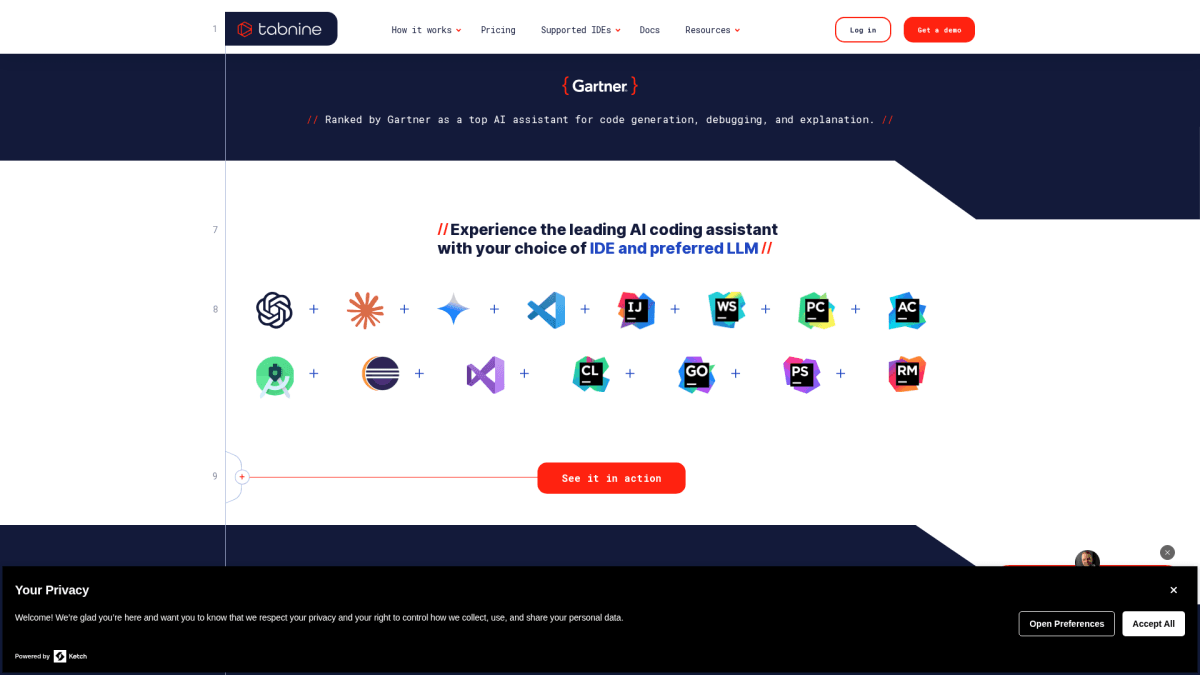
Tabnine’s IDE coverage is unusually broad — a legacy of its TabNine-era roots as a tool that worked everywhere before AI assistants were mainstream. Supported editors include:
VS Code — full feature set, primary development target
JetBrains IDEs — IntelliJ IDEA, PyCharm, WebStorm, GoLand, CLion, Rider, and the full family. This is where Tabnine historically excels relative to competitors — the JetBrains integration is the best in class among privacy-focused tools.
Visual Studio 2022/2026 — full support including Tabnine Agent
Vim / Neovim — plugin available, completion focus, no GUI-dependent features
Emacs — supported via official plugin
Eclipse — supported for Java teams
The breadth matters for enterprise teams with heterogeneous tooling. If half the team uses VS Code and half uses IntelliJ, Tabnine works for both without a split policy. GitHub Copilot’s JetBrains support is good but Tabnine’s is historically deeper. Cursor and Windsurf are VS Code forks with no JetBrains equivalent — a non-starter for organizations standardized on IntelliJ.
Tabnine vs GitHub Copilot
a/tabnine b/github-copilot
GitHub Copilot is the default choice for most development teams — $10/mo individual, $19/mo Business, backed by Microsoft’s enterprise relationships and a massive user base. It’s the comparison that matters most for teams evaluating Tabnine. See the full Copilot review at /ai/github-copilot/.
tabnine wins at
on-prem and air-gapped deployment — Copilot cannot do this
triple certification: SOC 2 + ISO 27001 + GDPR
fine-tuned model on your private codebase
JetBrains integration depth
no third-party API hops for inference
IP attribution checking in completions
copilot wins at
raw completion quality — ~20pp higher without fine-tuning
price — $10/mo vs $39/mo is not a rounding error
GitHub integration: PR reviews, issues, Actions
chat quality and reasoning depth
multi-file agentic (Copilot Workspace)
brand trust and industry inertia
Verdict: Copilot if you don’t have a compliance mandate and want the best value-for-quality on the market. Tabnine if a compliance mandate exists and you need to prove your code stayed on your infrastructure. The $29/user/month premium is a privacy and compliance purchase, not a capability upgrade.
Tabnine vs Cursor
a/tabnine b/cursor
Cursor is the AI-native VS Code fork that’s reshaped how individual developers think about coding speed. At $20/mo for Pro it’s the tool most senior engineers are reaching for in 2026. See the full Cursor review at /ai/cursor/.
tabnine wins at
on-prem / air-gapped — Cursor has no equivalent
JetBrains support — Cursor is VS Code only
enterprise compliance certifications
model isolation: your code, your inference
user-in-the-loop governance for agents
cursor wins at
codebase-aware multi-file Composer
Tab next-edit prediction (nothing matches it)
model choice: Claude / GPT / Gemini per task
chat quality and reasoning depth
price — half the base Tabnine cost
agentic quality and maturity
Verdict: Cursor for individuals and teams where cloud AI is permitted. Tabnine for teams where it isn’t. These tools don’t compete in the same buying decision — Cursor is blocked at the security review stage for organizations that need Tabnine.
Windsurf is Codeium’s VS Code fork — Cursor’s closest competitor and the second agentic editor in the market. At $20/mo it sits at the same price point as Cursor. See the full Windsurf review at /ai/windsurf/.
tabnine wins at
true on-prem / air-gapped deployment
compliance certification depth
JetBrains, Vim, Eclipse support
no external model API calls in self-hosted mode
fine-tuning on internal codebase
windsurf wins at
agentic Cascade quality on long tasks
cleaner, more focused UI
lower price for comparable features
completion quality without fine-tuning
active developer community and tutorials
Verdict: Windsurf has better enterprise on-prem signaling than Cursor but still doesn’t match Tabnine’s certification depth or deployment flexibility. For organizations with genuine air-gap requirements, Tabnine remains the most defensible choice.
Where Tabnine falls short
This section matters as much as the praise. Tabnine has a clear niche — let’s be precise about where it’s the wrong tool.
The quality gap is real
Twenty percentage points lower acceptance rate on standard tasks without fine-tuning is not a small gap. On a team doing eight hours of active coding per day, that difference translates into meaningfully more rejected suggestions, more time pressing Escape, more moments of friction. Fine-tuning closes the gap, but fine-tuning requires the higher-tier plan, setup time, and sufficient codebase material for the training pipeline to produce useful results. Small teams with small codebases see less benefit.
Chat is a generation behind
Tabnine Chat is functional. It’s not transformative. The conversational depth, multi-turn reasoning, and proactive problem-spotting that Cursor and Copilot Chat offer — Tabnine Chat does not match this. Developers who rely heavily on chat-driven workflows will feel the difference immediately. For teams using completion primarily and chat occasionally, it’s an acceptable trade-off.
The free tier is gone
Tabnine retired its free tier in 2025. There is no evaluation path that doesn’t require a commitment conversation with their sales team. For individual developers trying to assess the tool before recommending it to their organization, this is a real friction point. Competitors — Copilot, Cursor, Windsurf — all offer meaningful free evaluation tiers.
Price is steep for what you get
$39/user/month for the base plan is nearly four times Copilot’s individual price. For teams of 50, that’s $23,400/year more than Copilot before infrastructure costs. The compliance premium is the justification. If you don’t need that compliance premium, you’re overpaying significantly.
Infrastructure overhead
VPC and on-prem deployments require engineering time to set up and maintain. GPU hardware is not cheap and has operational overhead — updates, monitoring, occasional troubleshooting. For organizations with a strong DevOps function, this is manageable. For lean engineering teams, it’s a meaningful burden that competitors don’t impose.
Who should choose Tabnine
The right fit
Financial institutions (banks, trading firms, insurance) with code residency requirements or external audits that demand certified data handling
Healthcare organizations subject to HIPAA with development teams working on patient data systems
Government agencies and defense contractors with air-gap mandates or FedRAMP ambitions
Any organization whose legal team has flagged “code in third-party AI systems” as a trade secret or IP exposure risk
Teams standardized on JetBrains IDEs where Cursor and Windsurf have no relevant offering
Large enterprises with custom internal libraries where fine-tuning delivers measurably better suggestion quality over time
Wrong fit
Individual developers or small teams with no compliance mandate — the price is indefensible without a compliance justification
Teams where raw AI quality and suggestion depth are the primary purchase criteria — Copilot and Cursor are better here
Organizations that need agentic multi-file editing with the quality of Cursor’s Composer — Tabnine Agents are catching up but not there yet
Early-stage startups that need the fastest path to shipping — Tabnine’s compliance overhead is the wrong tool for that speed
Pricing, in real terms
Tabnine removed its free tier in 2025. The current pricing structure has two plans, both billed annually:
Code Assistant Platform: $39/user/month covers AI completions, Tabnine Chat, the Context Engine, flexible deployment (SaaS / VPC / on-prem / air-gapped), SOC 2 + ISO 27001 + GDPR compliance, and enterprise governance controls including admin dashboards, usage analytics, and SSO.
Agentic Platform: $59/user/month adds autonomous agents with user-in-the-loop oversight, the full Context Engine with unlimited codebase connections, MCP tool integrations, Jira and Confluence integration, Tabnine CLI for terminal-based workflows, and optional Headless Agents for CI/CD pipelines (automated code review, test generation on every commit).
There is also a custom Enterprise tier for larger organizations — pricing is negotiated, and includes dedicated support, custom SLAs, and more control over model versioning. For organizations above 200 seats, Tabnine’s enterprise team will construct a deployment-specific proposal.
Infrastructure costs (VPC/on-prem): These are real and should be budgeted separately. For a team of 20–50 developers on VPC deployment, expect $1,000–$3,000/month in cloud GPU compute (AWS, GCP, or Azure) on top of the per-seat fee. For on-prem, amortize GPU server hardware (typically $10,000–$40,000 per server depending on GPU tier) over three years plus power and operational overhead.
The honest comparison: Copilot Business at $19/user/month versus Tabnine Code Assistant at $39/user/month is a $20/user/month premium. For a 50-person team, that’s $12,000/year. The question is what that $12,000/year buys: specifically, air-gapped deployment capability, triple compliance certification, and zero-retention architecture with no third-party model API calls. If a compliance audit would otherwise cost $50,000+ in consultant time and risk, the Tabnine premium pays for itself. If no audit exists, it doesn’t.
tabnine · tabnine-pricing.png
fig · Plans and pricing · source: rankncompare.com
What’s next for Tabnine
// roadmap · signals from Tabnine’s public communications · 2026
Enhanced agent autonomy — Tabnine’s agents currently require frequent human-in-the-loop approvals. The roadmap signals a configurable autonomy dial: high-oversight mode for sensitive codebases, lower-oversight mode for routine tasks like test generation.
Expanded MCP tooling — more native connectors for enterprise systems: ServiceNow, Azure DevOps, GitLab Self-Managed, Bitbucket Data Center. The pattern is direct integration with the infrastructure already present in large orgs.
Context Engine improvements — better cross-repository context, the ability to include internal documentation and Confluence pages in the context alongside code, and improved recall precision for very large monorepos.
Model quality closing the gap — Tabnine has publicly committed to narrowing the completion quality gap with Copilot. The planned approach: larger base models for the cloud tier, more aggressive fine-tuning pipelines, and better retrieval-augmented generation for the Context Engine.
Security-first agent workflows — automated SAST/DAST integration into agent pipelines so that security analysis runs as part of every AI-generated code change, not as a separate manual step.
Headless CI/CD agents GA — the Headless Agents add-on (currently in early access) reaches general availability, enabling fully automated code review, test generation, and documentation updates in CI pipelines without developer intervention.
FAQ
Does Tabnine really never see my code?
On SaaS: code is processed ephemerally and discarded — not stored, not logged, not used for training. On VPC or on-prem: inference doesn’t reach Tabnine’s servers at all. The claims are backed by SOC 2 Type II, ISO 27001, and GDPR certifications, all independently audited.
Can I run Tabnine completely offline (air-gapped)?
Yes. Tabnine’s Enterprise plan supports air-gapped deployment — the model server runs on your hardware with no network connectivity required. Licensing is managed offline. This is the only mainstream AI coding assistant with a documented, supported air-gap deployment path.
What IDE does Tabnine work best in?
VS Code is the primary development target for new features. JetBrains (IntelliJ, PyCharm, WebStorm, GoLand, etc.) has the deepest integration outside VS Code — historically better than most competitors in the JetBrains ecosystem. Vim, Emacs, Eclipse, and Visual Studio are also supported.
Is Tabnine worth it if I don’t have compliance requirements?
Probably not. The price premium over GitHub Copilot ($39 vs $10 individual, $39 vs $19 Business) is a compliance and privacy premium. If your organization permits cloud AI and you don’t have specific certification or residency requirements, Copilot or Cursor will give you better completions for less money.
How long does fine-tuning take to improve completion quality?
Initial fine-tuning against a mid-size codebase (50k–500k LOC) typically takes a few hours for the training job. Measurable quality improvements — suggestions matching internal library conventions — start appearing within a few days of use as the model adapts. Teams usually describe the improvements as “noticeable within two weeks of daily use.”
What models does Tabnine use for completions?
Tabnine’s base models are proprietary, trained on permissively licensed open-source code. For Enterprise deployments, organizations can plug in GPT-4o, Claude models, Llama 3, Mistral, or custom fine-tuned models running in their own infrastructure. Tabnine acts as the control layer and IDE integration, not the model itself.
Is there a free trial?
Not in the traditional sense. Tabnine retired its free tier in 2025. Enterprise evaluation is typically arranged through the sales team — they offer trial deployments for qualified enterprise prospects, but there’s no self-serve free tier to test before entering a sales conversation.
Tabnine vs Copilot for a JetBrains shop?
If your team lives in IntelliJ or PyCharm, Tabnine’s JetBrains integration is the best-in-class option among privacy-respecting tools. Copilot’s JetBrains support is solid but historically thinner. Cursor and Windsurf have no JetBrains version. If compliance isn’t a concern and JetBrains depth is, Tabnine is still worth considering over Copilot.
How do agents work in Tabnine?
Tabnine Agents (Agentic Platform tier) use a user-in-the-loop design. You give the agent a task; it proposes a plan; you approve or modify; it executes step-by-step, pausing for approval at each significant action. Agents can invoke MCP tools, integrate with Jira and GitHub, and make multi-file code changes. The governance-first design is deliberate — it’s what enterprise security teams require.
The tool compliance teams approve. Not the one individual developers request.
Tabnine’s score isn’t low because it’s a bad product — it’s calibrated against a market where raw AI quality is the dominant purchase driver, and Tabnine deliberately sacrifices that dimension for something else: provable, certified, auditable code privacy. That trade-off is the right one for exactly the organizations it targets. A CISO at a regional bank, a compliance officer at a hospital, a legal team at a trading firm — these buyers don’t care that Cursor’s Tab prediction is better. They care that they can answer the audit question with a certificate.
For those organizations, Tabnine is not just a choice — it’s often the only choice that survives the procurement process. The zero-retention architecture, four-tier deployment flexibility, triple certification stack, and JetBrains depth create a package that competitors simply haven’t assembled. The completion quality will improve as models advance; the compliance architecture is the durable differentiation.
For everyone else: the $39 starting price buys a compliance layer you don’t need. Copilot at $19 or Cursor at $20 will give you better day-to-day coding output for less. Tabnine earns its score for the audience it was built for, not for the average developer choosing on quality alone.
// facts checked 2026-06-02
Keeping tabs
Change history
Every verified price, limit, and model change we have tracked for Tabnine.
No changes detected since we started tracking — that's a good sign.
Verified October 2026
Watch this tool
One email when Tabnine changes price or limits. No account, no spam.