Shutdown data checked Oct 26, 2026 · 41 apps tracked · 20 dying now · next: Crunchyroll (Nintendo Switch app) in 3 days
Shutdown data checked Oct 26, 2026 · 41 apps tracked · 20 dying now · next: Crunchyroll (Nintendo Switch app) in 3 days
AI Tool
HE
HeyGen
HeyGen
HeyGen
AI video platform for creating expressive avatar videos, translating footage into 175+ languages with lip-sync, and generating UGC ads at scale — no camera or studio required.
HeyGen was founded in 2020 by Joshua Xu and Wayne Liang, both veterans of Snap’s augmented reality team. The company started life as Movio — a quiet B2B avatar platform selling video automation to enterprise marketing teams — before rebranding to HeyGen in 2022 as the consumer opportunity became impossible to ignore. The rename changed nothing about the underlying technology, which was already well ahead of the public perception of “AI avatar video.”
What actually put HeyGen on the map wasn’t a press release or a product launch. It was a Twitter video. In late 2023, a clip circulated showing a creator translate their English YouTube video into Spanish — with the original speaker’s mouth moving in perfect sync with the Spanish words. The comments were a split reaction: equal parts disbelief and immediate sign-up clicks. The Video Translate feature had been live for weeks before that video surfaced. It took one viral moment to turn a feature into a category.
Since that inflection point the growth has compounded fast. HeyGen crossed a million users before most marketing teams had a HeyGen budget line. In 2024 they raised a $60M Series A at a reported $500M valuation and crossed $100M ARR by early 2026 — a remarkably lean trajectory given the team size. Avatar IV shipped in mid-2025 with expressiveness that genuinely closed most of the uncanny valley gap that had plagued the category for years. Then, on April 8, 2026, Avatar V arrived — a 15-second video-to-digital-twin model that set a new benchmark for what consumer AI video could produce.
The company’s trajectory matters because it explains the product’s current character: optimized for speed and creative impact first, enterprise governance second. HeyGen is where you go when you want publishable results today, not after six procurement reviews. That strength is also its clearest limitation, and we will be direct about both.
What HeyGen actually is
HeyGen is a browser-based AI video platform with three distinct product surfaces that can be used independently or together: Avatar Studio for scripted presenter videos, Video Translate for dubbing existing footage into other languages, and Video Agent (launched late 2025) for prompt-to-complete-video workflows that handle scripting, avatar selection, visuals, and scene assembly in one pass.
The common thread across all three is the avatar engine. HeyGen’s avatars — available as 500+ stock options or as your own custom digital twin — are what distinguish every output from a slide deck with a voiceover. The avatar is the product’s soul. Without it, HeyGen is a text-to-video tool. With it, you get a professional talking-head video that costs a fraction of what human production would.
Access is entirely browser-based. There is nothing to install. You log in, choose an avatar, paste or type a script, pick a voice (including a clone of your own), and generate. Standard processing returns a finished video in three to four minutes. Priority processing, available on paid plans, is meaningfully faster. The output is an MP4 you can download immediately or push directly to a CDN link.
The platform supports 175+ languages and dialects, voice cloning from a short recorded sample, 4K export on Pro plans and above, and SCORM export for LMS delivery on Business. It is not a video editor in the traditional sense — there is no timeline, no B-roll assembly, no multi-track audio mixing. That absence is a real limitation we will return to. HeyGen is purpose-built for one specific job: getting a polished, human-like presenter video out fast and in any language.
Avatar IV: the expressiveness breakthrough
Before Avatar V arrived in April 2026, Avatar IV was the headline. Understanding what it changed is important for calibrating expectations about what the platform actually delivers in production use today — because Avatar IV is still what most paid-plan users are running the majority of their content through.
Earlier avatar models — including HeyGen’s own v2 and v3 — animated a face by mapping phonemes to a trained expression set. The result was technically accurate lip-sync but emotionally flat. Expressions arrived in isolation: a smile here, a raised eyebrow there, with no sense that the face was reacting to the meaning of what was being said. The uncanny valley problem in that era wasn’t the lip-sync — it was the dead eyes behind it.
Avatar IV changed the fundamental architecture. Rather than mapping phonemes to expression labels, it uses a diffusion-inspired audio-to-expression engine that analyzes vocal tone, rhythm, and emotional arc, then generates facial motion as a coherent sequence rather than a series of discrete states. The outputs include micro-expressions — the subtle tightening around the eyes before a smile lands, the slight downward head angle that accompanies a more serious point — that read as genuinely human to most viewers at normal playback speed.
In practice, Avatar IV content is evaluated differently depending on content type. Business training and explainer content score excellent — the expressiveness adds authority without drawing attention to itself. Short-form social content that needs rapid energy is where Avatar IV still trails a high-energy human creator. And for extended content beyond seven or eight minutes, there is expression pattern repetition that trained eyes can detect on second or third viewing.
NOTE · the credit math for Avatar IV
Avatar IV costs 20 credits per minute to generate. On the Creator plan ($29/month) you receive 600 credits monthly — that’s 30 minutes of Avatar IV footage. A marketing team running weekly content will likely need the Pro tier (1,000 credits, $49/month base) or a credit top-up. Know your output volume before choosing a plan.
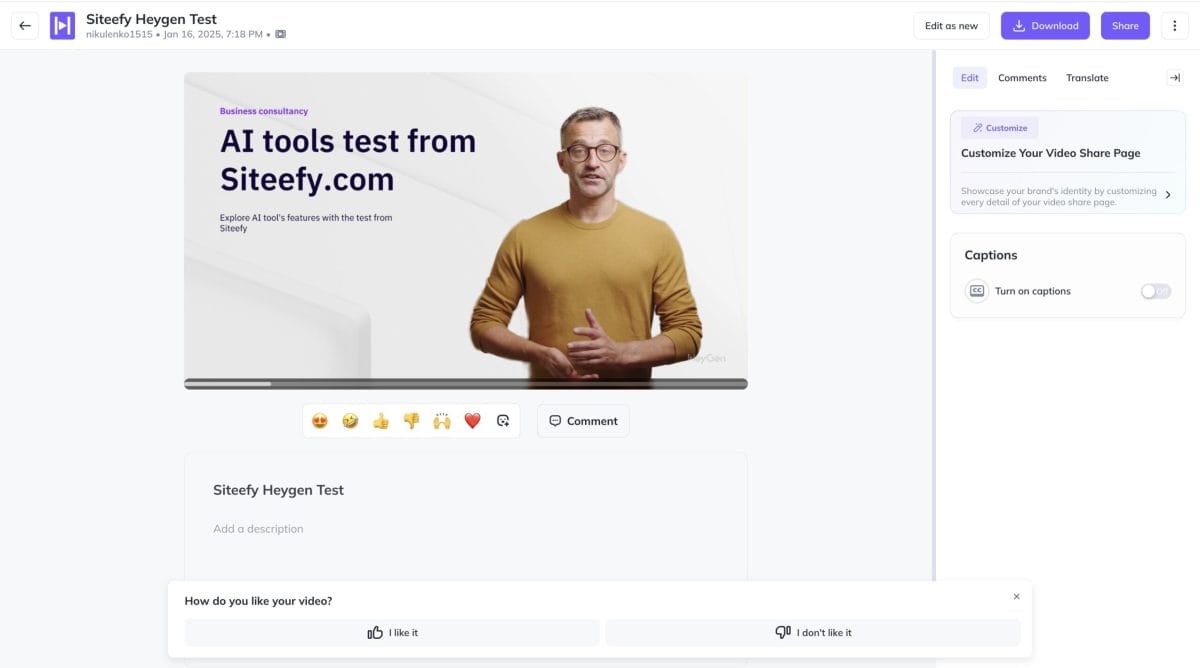
heygen · heygen-studio.png
fig · The HeyGen studio · source: siteefy.com
Avatar V: the 15-second digital twin
Avatar V launched on April 8, 2026, and it does something no previous consumer avatar model had managed cleanly: it creates a digital twin that maintains identity consistency across every video — same face, same gestures, same vocal cadence — from a single 15-second source clip and a voice sample. You record once. You generate indefinitely.
Earlier approaches required either a lengthy studio recording session (the original Digital Twin option, which needed minutes of structured footage under specific lighting conditions) or accepting a photo-based avatar that looked plausible in stills but lost personality in motion. Avatar V collapses both paths into one. Fifteen seconds of natural footage in any environment. HeyGen extracts your motion patterns, facial geometry, gesture tendencies, and voice. From that point forward, unlimited video in any language — without appearing on camera again.
The technical performance figures are verifiable: Avatar V achieves a Face Similarity score of 0.840 versus 0.714 for Veo 3.1 on the same benchmark set, and a lip-sync LSE-C of 8.97. More useful for everyday decisions: the character consistency holds across scene changes, outfit swaps, and background replacements — things that cause competing models to drift toward generic outputs after a few generations.
The tradeoffs are real. Avatar V renders take 8–12 minutes even on priority tiers, versus 3–4 minutes for standard Avatar IV. The credit cost per minute is higher. And Avatar V generation is currently limited to Creator plans and above — the free tier can view Avatar V outputs but not generate them. For creators who publish regularly, the economics are compelling: record once, generate indefinitely. That is a fundamentally different model of video production than anything that existed before 2026.
Video Translate: the killer feature
If you had to pick one HeyGen capability to show someone who had never seen the platform, it is Video Translate. The demo sells itself in under 60 seconds: upload any video of a person speaking, select a target language from 175+ options, and receive a version where the speaker’s mouth movements match the translated audio. Not subtitles. Not a voiceover track playing over static lips. Lip-synced translation that makes the speaker look fluent in a language they do not speak.
The pipeline behind the one-click interface is more sophisticated than it appears. HeyGen first runs the source audio through a proprietary ASR model optimized for business vocabulary and accented speech. The transcript is translated with sentence-length constraints and formality-level preservation — the system is aware that a casual English speaker should not come out the other side as a stiff formal Spanish one. The Avatar IV engine then predicts how a native speaker physically forms each word in the target language, generating new lip and jaw motion that overlays the source face.
Field performance varies significantly by language pair. European languages — Spanish, French, German, Italian, Portuguese — achieve near-professional results that most viewers would not flag without close inspection. East Asian languages (Mandarin, Japanese, Korean) are very good, with inaccuracies confined to complex consonant clusters at normal speed. Arabic remains the most challenging and shows detectable lag on some dynamic head movements. HeyGen publishes quarterly improvements and the gap has narrowed materially from 2024, but it exists.
The business case is not hard to calculate. A 2025 Wistia study found viewers watch dubbed content 34% longer than subtitled equivalents. For a team publishing explainer videos, course content, or marketing material to international audiences, that retention delta compounds into measurable revenue. Traditional professional dubbing for a five-minute corporate video runs $1,500–$4,000 per language. HeyGen brings the same output under $50 per language on the Pro plan. Recording once in English and publishing in twelve languages with real lip-sync is no longer a production miracle — it is a Tuesday afternoon.
TIP · always edit the translation script before rendering
On the Pro plan and above, you can review and edit the auto-generated translation script before the lip-sync render runs. Use this. Fix product names, branded terms, and formality mismatches before the render step. Re-renders cost the same credits as originals. Twenty minutes of script review saves you from an expensive redo.
Photo avatars: instant mode for quick concepts
Not every video needs a fully trained digital twin. HeyGen’s Photo Avatar feature — powered by the Avatar IV photo-to-video engine — animates a still image into a talking presenter in seconds. Upload any photo of a person (a headshot, a product stock image, a LinkedIn photo), type a script, and the avatar speaks it with plausible lip-sync and facial motion.
The use cases are narrow but genuinely useful: for teams that want a presenter in a slide deck without filming. For solo operators who want to test a concept before committing to a full Avatar V creation session. For rapid creative prototyping where the priority is validating the hook or the script angle, not the final avatar quality.
The limitations are real and worth stating plainly. Photo avatars work best for clips under 15 seconds. Beyond that, the lack of full-body motion and the compressed facial model start to read as artificial — the face looks pasted on rather than inhabited. Use photo avatars as a fast-iteration tool. Use Avatar V or a full digital twin for anything you are publishing at scale or where realism matters.
Interactive avatars: a face on your chatbot
HeyGen’s Interactive Avatar feature lets you deploy a real-time conversational version of any avatar — including your own digital twin — as an embedded web component. The avatar responds to user input with spoken, lip-synced answers, maintaining eye contact and natural expression throughout. Think of it as a chatbot that has a human face, a voice that sounds like a specific person, and gestures that follow conversational cadence.
The technical implementation runs on HeyGen’s streaming inference infrastructure with sub-2-second response latency for most queries. The avatar’s knowledge comes from a connected knowledge base — a document, FAQ, or structured data source you provide during setup. The avatar does not have general intelligence; it speaks from what you have given it.
The use cases where interactive avatars land well are predictable: customer support portals where a human-looking interface reduces the clinical coldness of a traditional chat widget. E-learning modules where a virtual instructor answers student questions between lesson segments. Sales enablement pages where a brand spokesperson is always available. The failure modes are equally predictable: any context where users have been burned before by the gap between a chatbot’s apparent intelligence and its actual capability will produce frustration, regardless of how good the face looks.
NOTE · interactive avatars require Business plan
The embeddable SDK for deploying interactive avatars externally is locked to the Business plan ($149/mo) and above. Creator and Pro plans include interactive avatar access within the platform UI, but not the embed endpoint for external deployment. Build this into your budget before scoping an interactive avatar project.
heygen · heygen-avatar.png
fig · An AI avatar · source: heygen.com
UGC ads and the marketing angle
HeyGen has leaned hard into the UGC (user-generated content) ad market, and the logic is sound. TikTok and Instagram reward content that looks organic — a real person talking directly to camera, recommending a product, sharing a result. HeyGen’s avatars can produce this format at machine volume without a real person on set, without usage rights negotiations, without scheduling or retakes.
The UGC workflow is purpose-built for performance marketing. Choose from 500+ diverse avatar looks tuned to feel like authentic creators rather than corporate spokespersons. Write the script in-platform or generate it with HeyGen’s built-in LLM. Select a voice. Export in 9:16 vertical for TikTok and Instagram Reels, or 1:1 square for feed placements. The pipeline from concept to exported creative runs under ten minutes for a standard 30-second ad.
For performance marketers, the compelling part is not speed alone — it is combinatorial volume. If you want to test 50 script variations against five avatar looks across three languages, a human production process costs weeks and tens of thousands of dollars. HeyGen turns that into an afternoon at a few hundred dollars. Teams using HeyGen for systematic creative testing have reported cost-per-iteration drops exceeding 90% compared to on-camera human production. The winning creative — the hook angle nobody on the team had considered — only surfaces when you can afford to test at that volume.
WARNING · platform disclosure policies are moving
Meta, TikTok, and Google Ads are each moving toward required disclosure labels for AI-generated creative in paid advertising. What is compliant today may require a visible disclosure banner within six months. Build AI content disclosure language into your creative review process before regulators force you to. The platforms are not moving slowly on this.
One English course becomes seven languages without re-recording
format: 60-min video course · 12 lessons · output: 7 languages · tool: Video Translate + Pro script edit
A solo Udemy course creator with strong English-language sales wanted to expand to Spanish, Portuguese, French, German, Italian, Japanese, and Mandarin markets. The traditional path: hire native-speaker actors or a professional dubbing studio, produce seven re-recorded versions, coordinate review with language consultants. Estimated cost: $8,000–15,000. Estimated timeline: six to eight weeks.
The HeyGen path: upload the 12 lesson videos to Video Translate, select each target language, use the Pro plan script editor to fix three product-specific terms that auto-translated incorrectly (one technical term and two branded phrases), and run the lip-sync renders overnight. Total HeyGen credit cost across two months: approximately $180. Total human time invested: four hours of script review and one round of quality spot-checks.
European language results were near-broadcast quality. Japanese and Mandarin showed minor lip-sync imperfections during rapid speech — specifically during passages where the English source had fast cadence. The creator published all seven versions anyway. The imperfections were undetectable at normal mobile playback speed, which accounted for over 80% of the audience. All seven language versions are now live and generating revenue.
// wall-clock: 2 days (mostly overnight render time) · traditional path: 6–8 weeks and $10k+
case-study #02 · performance marketing team, systematic UGC testing
Systematic creative testing at 100x the previous volume
platform: Meta Ads + TikTok · output: 90 ad variants · monthly spend: under $300 HeyGen
A DTC brand’s paid social team had been running the same three creative angles for three months. The production cost of testing new hooks — $800–2,000 per human UGC creator per video — had capped them at three to five new creatives per month. They were optimizing within a limited creative space and returns were plateauing.
The team built a HeyGen workflow: select three avatar profiles covering their target demographic range (younger woman, mid-30s man, older woman), write ten hook variants for each of three product angles, export 90 video variants in 9:16 format. Total generation time: one afternoon. Total cost including the Pro plan: under $300 for the month.
They ran all 90 variants at $5/day each for one week. Identified the top three performers by CTR and scroll-stop rate. Scaled those to full budget. The winning creative came from a hook angle nobody on the team had previously considered — it only surfaced because the volume of testing made exploring unexpected combinations affordable. The campaign’s cost-per-acquisition dropped 38% in the following month.
// creative cost: $300 for 90 variants · equivalent human UGC production: $72,000+
case-study #03 · SaaS company, personalized onboarding at API scale
Personalized welcome videos at 2,000 signups per month via API
integration: HeyGen API + CRM webhook · trigger: new user signup · volume: ~2,000 videos/mo
A mid-size SaaS company wanted to send each new user a short welcome video from their customer success manager — one that referenced the user’s company name, plan tier, and the specific integration they had connected during setup. Personalized video at 2,000 signups per month with a real human was impossible to scale. With a generic pre-recorded video, the welcome email open rate was unremarkable.
The team used HeyGen’s API to build a pipeline: new signup triggers a webhook, the webhook calls HeyGen’s /v2/video/generate endpoint with a script template populated by CRM fields (first name, company, plan, connected integration), HeyGen renders the CS manager’s Avatar V digital twin speaking the personalized script, and the video link drops into the welcome email sequence within 12 minutes of signup. The CS manager recorded the 15-second Avatar V source clip once. Every subsequent video generates automatically.
Video open rate in the welcome email went from 22% to 61%. Users who watched the personalized video had a 23% higher product activation rate at 14 days compared to users who received the generic version. The CS manager spends zero ongoing time on this; the entire workflow runs on triggers.
// video open rate: 22% → 61% · 14-day activation lift: +23%
Avatar expressiveness: HeyGen vs the field
PixlRun’s editorial scores for scripts ranging from 30-second social ads to 6-minute explainer videos — here is how HeyGen’s Avatar V and Avatar IV outputs compare to Synthesia’s current Expressive Avatars 3.0 engine and a human-recorded control:
short-form realism (under 2 min) — viewer can’t tell from real footage
HeyGen V88%
HeyGen IV74%
Synthesia61%
expressiveness rating — does the face carry the emotion of the script
HeyGen V9.1/10
HeyGen IV8.0/10
Synthesia6.2/10
long-form consistency (8+ min) — expression patterns hold without looping
Synthesia8.4/10
HeyGen V7.8/10
HeyGen IV6.3/10
The pattern is clear. For short-to-medium content where expressiveness and realism matter most — social ads, explainers, course intros, personalized outreach — HeyGen Avatar V is the strongest option in the category. For extended training modules where consistency across 20+ minutes matters more than moment-to-moment expressiveness, Synthesia’s more conservative engine holds up better over the long run.
HeyGen vs Synthesia
a/heygen b/synthesia
Synthesia is the most direct comparison. Both platforms sell AI avatar video to business users, both have raised serious capital, and both are targeting the same enterprise content budgets. But their current strengths point in genuinely different directions — HeyGen for expressiveness and global reach, Synthesia for governance and consistency at L&D scale.
heygen wins at
avatar expressiveness — Avatar V micro-expressions vs Synthesia’s more controlled output
Video Translate with lip-sync — 175 languages, Synthesia doesn’t offer this
personal digital twins — Avatar V from 15-sec clip, no studio required
UGC and marketing creative — built-in workflows, format exports, ad-native avatars
entry pricing — $29/mo vs Synthesia’s higher tiers
API simplicity — cleaner REST docs, easier to integrate at volume
synthesia wins at
enterprise compliance — SOC 2 Type II certified (HeyGen still in progress)
long-form consistency — avatars hold over 20+ min without expression looping
timeline editing — scene-level production control HeyGen lacks
procurement trust — established vendor in enterprise supplier networks
Verdict: A marketer building short-form content and running multilingual campaigns should start with HeyGen — it is the better tool for that job. An L&D team at a 5,000-person enterprise rolling out compliance training should look harder at Synthesia. The expressiveness gap favors HeyGen for impact; the governance gap favors Synthesia for scale. Match the tool to what you actually need to ship.
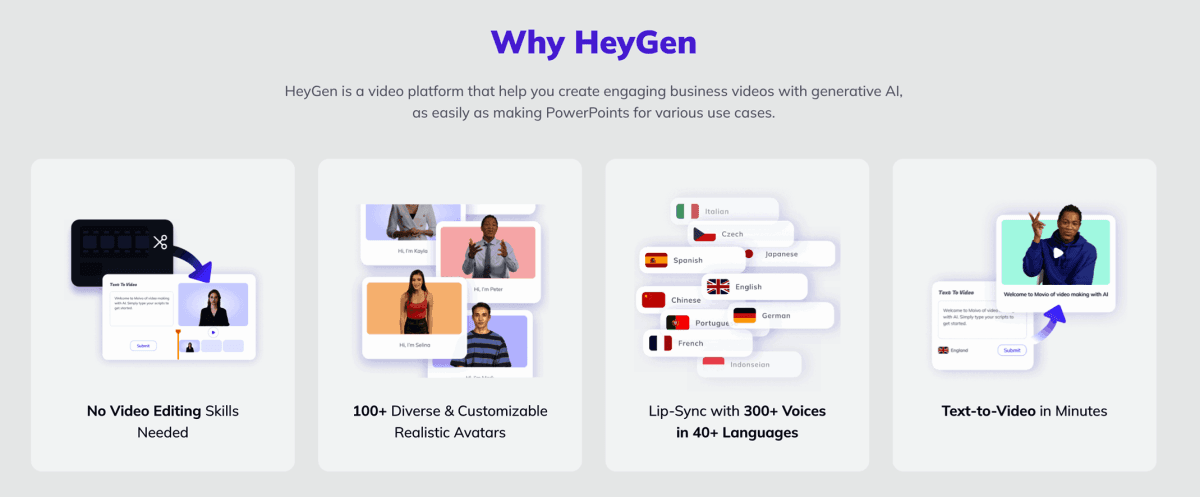
heygen · heygen-translate.png
fig · Video Translate with lip-sync · source: the-decoder.com
Where HeyGen falls short
No honest review earns trust without being direct about the failure modes. HeyGen has five consistent weaknesses worth understanding before you commit to a plan or a production workflow.
The credit wall is not obvious from the pricing page
The Creator plan at $29/month sounds generous until you do the math. Avatar IV costs 20 credits per minute. Creator gives you 600 credits. That is 30 minutes of Avatar IV footage per month — fine for occasional use, constraining for teams with regular output volume. Heavy users discover the practical cost sits at $59–99/month once you factor in priority processing and credit top-ups. The pricing is not dishonest, but the marketing page does not do the arithmetic for you. Do it before you sign up.
Long-form content shows its seams
Avatar IV and Avatar V were clearly optimized for short and medium-format content. For videos beyond seven to eight minutes, expression patterns begin to loop in subtle ways — the same micro-expression appearing in the same speech rhythm context, detectable to attentive viewers on second watch. For a 2-minute ad or a 5-minute explainer, this is invisible. For a 45-minute training module, it can break the illusion for engaged learners.
No real video editing layer
HeyGen is a video generation tool, not a video production environment. There is no timeline, no multi-track audio, no scene assembly, no B-roll integration within the platform. If your workflow requires cutting away from the presenter, assembling a story from multiple clips, or adding lower-thirds over a complex background, you will be exporting from HeyGen and importing into another editor. This is a real workflow cost that HeyGen’s marketing materials underplay.
Enterprise compliance is not certified yet
HeyGen is SOC 2 Type II certification in progress as of mid-2026. Synthesia cleared that bar earlier. For organizations where security certification is a procurement gate — which includes most regulated industries and most companies over a few hundred employees with a real IT security function — this can delay or block adoption entirely. “In progress” is not the same as “certified,” and enterprise security teams rightly treat that distinction as meaningful.
Challenging language pairs in Video Translate
Arabic, Mandarin, Thai, and several other languages with phoneme patterns significantly different from European languages still show detectable lip-sync lag or mismatch in Video Translate output. The gap has narrowed substantially from 2024. For most marketing and education use cases, the current quality level is acceptable. For broadcast or high-stakes professional contexts in those language markets, it is not yet there.
API and developer access
HeyGen’s API is a genuine product offering, not an afterthought strapped onto a consumer tool. The REST API covers all major platform capabilities — avatar video generation, video translation, digital twin creation, streaming interactive avatars — with straightforward JSON request structures and a webhook-based completion model for the asynchronous render pipeline.
The primary endpoint for video generation is POST /v2/video/generate, which accepts an avatar ID, a script (plain text or SSML for voice expression control), a voice ID, and optional scene parameters. The response returns a video_id; a polling call or webhook callback delivers the final video URL when rendering completes. Standard Avatar IV renders take 3–5 minutes; Avatar V renders run 8–12 minutes.
API credit consumption follows the same per-feature rates as the platform UI: Avatar IV at 20 credits/minute, Video Translate at 5 credits/minute, Avatar III at 3 credits/minute. For the personalized onboarding case study above — 2,000 videos per month averaging 45 seconds each at Avatar V rates — the monthly API cost runs into significant territory. API usage costs should be modeled separately from platform subscription costs; they can dwarf them at scale.
Pricing, in real terms
HeyGen’s pricing page looks simpler than it is. Here is what you actually pay in 2026, with the numbers that the marketing copy glosses over:
Free at $0/month gives you three videos per month (max one minute each), access to the stock avatar library, and 30+ languages. It is the right starting point for evaluating whether HeyGen fits your workflow, but it will cap out in a single session of real testing. Treat it as a free trial, not a production option.
Creator at $29/month ($24/month billed annually) is the meaningful entry point. 600 credits, videos up to 30 minutes, 1080p export, voice cloning, 175+ languages. For a solo creator or small team with moderate output — a few videos per week — this tier works. The 600 credits mean 30 minutes of Avatar IV footage monthly. If you are doing Video Translate primarily, 600 credits goes much further (5 credits/min = 120 minutes of translated video).
Pro at $49/month (base; scales to higher-volume tiers with more credits at proportionally higher prices) adds 4K export, faster render priority, 1,000 credits at the base tier, and translation script editing before render. That last feature is the reason most serious multilingual teams upgrade from Creator. Know your primary use case before picking between Creator and Pro.
Business at $149/month plus $20/seat adds team collaboration, 1,500 shared credits, 5 custom digital twin slots, SAML/SSO, SCORM export for LMS delivery, and the interactive avatar embed SDK. Required for organizations that want to deploy interactive avatars externally or that need centralized team access control.
Enterprise at custom pricing adds unlimited duration, dedicated account management, multi-workspace control, and enterprise security provisions. Required for organizations where procurement demands contractual compliance commitments — and where HeyGen’s SOC 2 progress is being watched as a condition of signing.
Power-user tips
TIP 01 · edit translation scripts before rendering
On Pro and above, always review the auto-translated script before running the lip-sync render. Fix product names, branded terms, and formality mismatches before the render step. Renders cost the same credits as originals. Twenty minutes of review prevents a frustrating and expensive re-render.
TIP 02 · record Avatar V source in your natural speaking style
Avatar V extracts your motion and gesture patterns from the source clip. Record in your natural environment — the way you actually move when you speak, not a formal sit-still presentation style. The digital twin will carry whatever energy you put into the source recording into every future video. A stiff source produces a stiff twin.
TIP 03 · use SSML tags for voice control
HeyGen’s text-to-speech engine accepts SSML tags in scripts. Use <break time="500ms"/> for deliberate pauses, <emphasis level="strong"> for stress on key points. Plain text scripts produce flat delivery. SSML scripts produce something that sounds like a person who means what they are saying.
TIP 04 · use webhooks for API volume, not polling
If you are using the API for volume generation, use webhook callbacks rather than polling the status endpoint. Polling at volume creates rate limit pressure; webhooks are event-driven and do not count against your API quota. The webhook_url field in the generate request is the correct pattern at any meaningful scale.
TIP 05 · prototype with photo avatars, commit with Avatar V
Before spending credits on an Avatar V render for a new concept, test the script and pacing with a photo avatar. Photo renders are faster and cheaper. Use them to validate the concept and confirm the script angle. Run the Avatar V version only when the script is locked and approved by everyone who needs to sign off.
TIP 06 · set aspect ratio at project creation, not export
HeyGen exports natively in 9:16, 1:1, and 16:9. Set the aspect ratio at the project level before writing the script. Avatar framing is composed differently for vertical versus horizontal, and cropping a horizontal video to vertical after generation produces visually cramped output. Build the format into the project from the start.
heygen · heygen-pricing.png
fig · Plans and pricing · source: softwaresuggest.com
What’s next for HeyGen
// roadmap · signals from HeyGen product releases and communications · mid-2026
SOC 2 Type II certification — actively in progress as of mid-2026. HeyGen has indicated a Q3 2026 target without a public commitment. Completion would unlock procurement at organizations currently blocked by the missing certification. This is the single most important milestone for enterprise adoption.
Speed Mode for Video Translate — trades some lip-sync precision for roughly 2x faster render throughput. Useful for high-volume teams where turnaround speed matters more than frame-level accuracy. Precision Mode remains the default for quality-focused outputs.
Video Agent brand kit support — the prompt-to-complete-video workflow (Video Agent) is being extended with brand kit profiles: locked colors, fonts, intro and outro templates, and tone guidelines that every Video Agent output respects automatically. Reduces the post-production cleanup work for brand-consistent content.
Streaming avatar latency improvements — interactive avatars currently average approximately 1.8-second response latency. HeyGen’s infrastructure roadmap targets sub-1-second for the streaming pipeline, which would make interactive avatars viable for real-time customer service scenarios currently blocked by the delay.
Enterprise multi-workspace controls — centralized billing, avatar library governance, and output review workflows for organizations managing multiple teams or brands under a single enterprise contract. Currently in closed beta with design partners.
Filmmakers, creative agencies, generative video beyond the talking-head format
Gen-4 cinematic quality, video-to-video stylization, motion brush, full creative latitude beyond avatar constraints
$15/mo
FAQ
Is HeyGen actually better than Synthesia for marketing?
For short-form marketing content, yes. Avatar V expressiveness and Video Translate are things Synthesia does not offer at comparable quality. For enterprise training at scale with compliance requirements, Synthesia’s governance features and SOC 2 certification make it the safer choice. The tools are converging, but the current expressiveness and translation gap clearly favors HeyGen for marketing use in 2026.
Can I create an avatar of another person?
No. HeyGen’s Terms of Service require explicit consent from any person whose likeness you are creating a digital twin from. Consent verification is part of the digital twin creation workflow. Creating an avatar of another person without consent violates terms and is increasingly subject to civil and criminal liability under deepfake legislation in multiple jurisdictions. This is not a gray area.
How realistic is Avatar V compared to real recorded footage?
At normal social media playback speeds on mobile, most viewers cannot reliably distinguish Avatar V output from real recorded footage in controlled tests. Detection accuracy drops significantly at high resolution on desktop displays and during complex hand gestures, which Avatar V handles more conservatively than a live human. For 1080p social content, the realism is production-grade. For 4K broadcast scrutiny, trained eyes can identify it.
Do Video Translate outputs look natural?
For European language pairs — Spanish, French, German, Italian, Portuguese — the output is near-broadcast quality and most viewers would not flag it. For East Asian and Semitic languages, detectable lip-sync imperfections remain during rapid speech. The quality is improving quarterly. For marketing and education use cases at social media resolutions, current quality is acceptable for most applications.
How does the credit system actually work?
Each plan includes a monthly credit allocation. Credits are consumed per-feature: Avatar IV/V generation at 20 credits/minute, Video Translate at 5 credits/minute, Avatar III at 3 credits/minute. Unused credits on monthly plans roll over one billing cycle. Annual plan credits accumulate until renewal. Additional credit packs are available as add-ons on any paid plan. Know your primary use case and calculate expected monthly usage before choosing a plan.
Is HeyGen compliant for healthcare or financial services?
Not without enterprise-level diligence and a custom agreement. HeyGen is SOC 2 Type II certification in progress as of mid-2026 but not yet certified. HIPAA Business Associate Agreements and financial sector compliance frameworks require the Enterprise plan and a dedicated legal review. Do not deploy HeyGen in regulated contexts on a self-serve plan without speaking to their enterprise team first.
Can I use HeyGen videos in paid advertising on Meta or TikTok?
Yes, with caveats. Both Meta and TikTok require disclosure labeling for AI-generated content in paid advertising. HeyGen outputs qualify as AI-generated under current platform definitions. Ensure your creative includes required disclosure labels and that your ad account complies with each platform’s AI content policies. These policies are actively evolving — review them before scaling spend, not after.
What happens to my voice clone and digital twin data?
HeyGen’s data policy states voice clones and digital twin data are stored and used solely for your account’s video generation. The data is not used to train HeyGen’s models by default. Enterprise plans include contractual data isolation provisions. If you have specific data residency requirements, verify with HeyGen enterprise sales directly — their public privacy policy is US-centric and may not satisfy all regional regulatory requirements.
HeyGen or Descript if I want to edit as well as generate?
Descript, without hesitation. Descript is a real video editing environment with AI features layered in. HeyGen is a generation tool with no editing layer. If you need to cut, assemble, add B-roll, or work with a multi-track timeline, HeyGen will make you export and open another tool for every edit. Use HeyGen for generation and Descript for the production work that follows.
The best AI video tool for marketers who need to move fast and reach everywhere.
HeyGen earns its reputation by doing one thing better than any competitor in the category: making it easy to produce realistic, expressive avatar video at volume and in any language. Avatar V raised the realism bar to a point where short-form output is genuinely indistinguishable from filmed content at social media resolutions. Video Translate remains a category-defining feature with no direct competitor at the same quality and language breadth. For marketers, course creators, and any team that needs to publish video across languages without re-recording, HeyGen is the clearest choice in 2026.
The score is 8.5 rather than 9 for two reasons. First, the credit system obscures real costs until you are past the trial period and committed to a workflow — a frustration that recurs consistently in user feedback. Second, the enterprise compliance story is not complete: SOC 2 Type II certification in progress is a real procurement obstacle at organizations that need it. Synthesia closes that gap with standardization and certification. HeyGen closes the expressiveness and translation gap. These are genuinely different tools for genuinely different priorities, and choosing the right one is not hard if you are clear about what you actually need to ship.
// facts checked 2026-06-02
Keeping tabs
Change history
Every verified price, limit, and model change we have tracked for HeyGen.
No changes detected since we started tracking — that's a good sign.
Verified October 2026
Watch this tool
One email when HeyGen changes price or limits. No account, no spam.