AI Tool

Runway Gen-3
Runway
Runway Gen-3
AI video platform with Gen-4.5 text- and image-to-video, Aleph 2.0 video editing, Act-Two performance capture, Workflows, and an API.
AI video platform with Gen-4.5 text- and image-to-video, Aleph 2.0 video editing, Act-Two performance capture, Workflows, and an API.
Runway was founded in 2018 by Cristóbal Valenzuela, Alejandro Matamala, and Anastasis Germanidis — three graduates of NYU’s Interactive Telecommunications Program. Their early work was research into generative models for creative media.
The company built its name inside the video editing world before it became an AI video generator. The original Runway application was a browser-based video editor with AI-assisted features: background removal, object tracking, rotoscoping.
Gen-1 (2023) was the first generative video model — video-to-video style transfer that could transform footage into a painting or a different visual register. Gen-2 followed with text-to-video and image-to-video. Gen-3 Alpha was released in mid-2024. Gen-4 and Gen-4 Turbo arrived on April 7, 2025, and Gen-4.5 followed on December 11, 2025. As of this update, Gen-4.5 is the most recent frontier video model Runway has released, and Gen-3 Alpha Turbo was sunset in July 2026.
On February 10, 2026, Runway announced a $315 million Series E round led by General Atlantic, with participation from NVIDIA, Adobe Ventures, AMD Ventures, Fidelity Management & Research Company, and others. The company said the funds would go toward pre-training the next generation of world models.
Runway is a cloud-based creative platform built around AI video generation, with image and audio tools in the same workspace. It runs in the browser and also has iOS and Android apps. Generation happens on Runway’s servers, so files and renders live in its cloud and output volume is tied to the credit allowance on your plan.
The core offering is three generation modes:
Around these modes sit additional tools, including Act-Two for performance capture, Frames for image generation, and Workflows for multi-step pipelines.
Gen-3 Alpha, released in mid-2024, accepted text or image inputs. Runway’s announcement listed Motion Brush, Advanced Camera Controls, and Director Mode among its control modes. Gen-3 Alpha Turbo was later sunset: Runway’s API changelog lists it as retired on July 30, directing users to Gen-4.5 or Aleph 2.0.
Gen-4, released April 7, 2025, was positioned around consistency. Runway describes it as able to generate consistent characters, locations, and objects across scenes, and to use visual references combined with text instructions. Gen-4 outputs 5- or 10-second clips at 720p and 24 fps, requires an input image, and costs 12 credits per second.
Gen-4 Turbo, released alongside Gen-4, is the lower-cost variant. According to Runway’s help center it costs 5 credits per second (25 credits for 5 seconds, 50 credits for 10 seconds) and, like Gen-4, requires an input image: it does not support text-to-video.
Gen-4.5, released December 11, 2025, is Runway’s most recent in-house video model. At launch Runway reported that it ranked first on the Artificial Analysis text-to-video benchmark with 1,247 Elo points. Image-to-video support for Gen-4.5 was added on January 21, 2026. Per the help center, it outputs 720p video of 2 to 10 seconds at 24 or 25 fps and costs 12 credits per second, so a 10-second clip costs 120 credits.
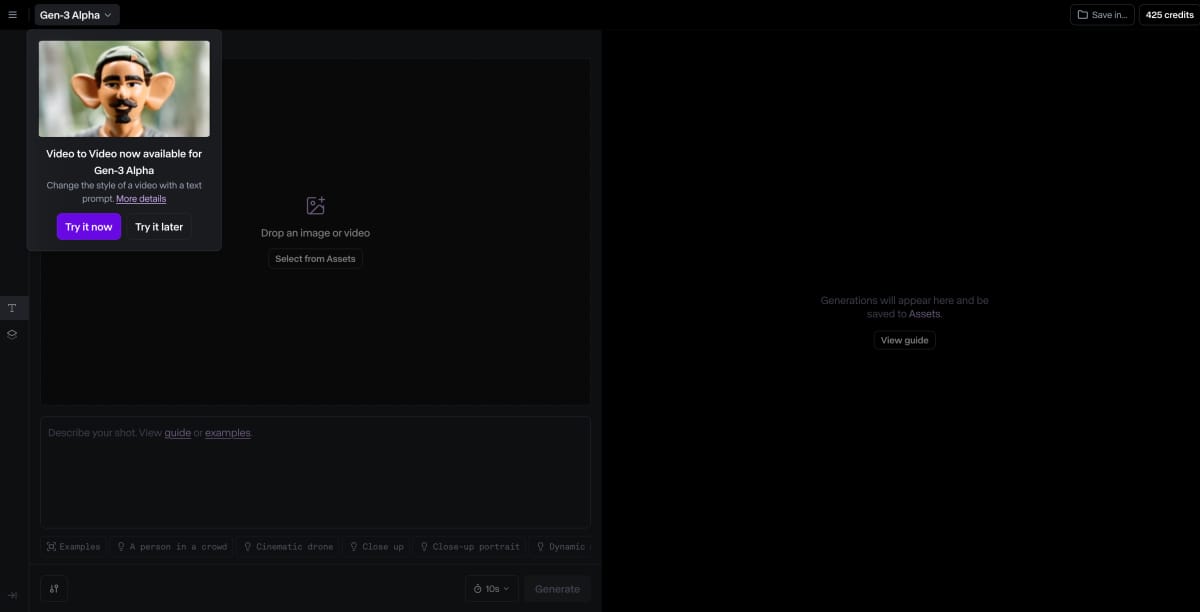
Runway uses a credit balance: each generation draws from it, and the cost depends on the model and the clip length. A 10-second Gen-4.5 clip costs 120 credits at 12 credits per second, while a 5-second Gen-4 Turbo clip costs 25.
A common starting point is image-to-video with Gen-4 Turbo: upload a still, such as a photograph, a render, or a painting, write a short description of the motion, and generate. Runway’s Gen-4 documentation advises keeping the text prompt almost entirely focused on the desired motion, since the input image already establishes the visual content.
Text-to-video is available with Gen-4.5. Runway’s documentation says the model handles detailed instructions about camera movement, scene composition, timing, and atmosphere within a single prompt.
The free plan includes 125 one-time credits. At 12 credits per second, a 5-second Gen-4.5 clip costs 60 credits, so the free allocation covers about two such clips. Gen-4 Turbo is listed at 5 credits per second, which makes a 5-second clip 25 credits.
Beyond the generation models, Runway offers editing, performance-capture, image, and pipeline tools. Two earlier control features, Motion Brush and Director Mode, are covered below because older reviews still describe them as current.
Motion Brush let users paint regions of an input image to assign motion to them. Runway introduced Multi Motion Brush in January 2024, allowing up to five independent regions, and its Gen-3 Alpha announcement listed Motion Brush among that model’s control modes. Runway’s Gen-4 and Gen-4.5 help-center pages do not list Motion Brush as an input, so check the in-app options for the model you plan to use.
Director Mode was the camera-control mode introduced with Gen-3 Alpha, alongside Advanced Camera Controls. Gen-3 Alpha Turbo was sunset in July 2026. For current models, Runway’s Gen-4.5 documentation describes specifying camera movement, such as pans, orbits, and handheld shots, in the text prompt itself.
Act-Two is Runway’s performance-capture model, released August 19, 2025 as the successor to Act-One (October 25, 2024). It uses a performance video to drive a character, and Runway’s API documentation lists an image or a video as the character input. In the API it costs 5 credits per second.
Aleph 2.0, released May 13, 2026, is Runway’s video-editing model, available in Edit Studio. According to the API documentation it takes video plus a text or image prompt and outputs video, and costs 28 credits per second with a 56-credit minimum. The original Aleph launched July 31, 2025.
Frames, released January 17, 2025, is Runway’s image generation model, producing stills from text rather than video. Runway also offers Gen-4 Image, which accepts reference images, and lists third-party image models such as Seedream 5.0 in its changelog.
Workflows, released October 14, 2025, is a node-based editor for building custom multi-step generation pipelines. Runway also offers Apps, collections of use-case-specific workflows, which launched September 11, 2025.
The following describes common ways teams use Runway’s documented features. It is general guidance, not a report of results.
Below is an example of an image-to-video prompt for Gen-4 Turbo, written for a still of a glass of water on a wooden table by a window. It states camera movement, subject motion, lighting, and depth of field in plain language. This is an illustration of prompt structure, not a recorded result.
For reference, a 10-second Gen-4 Turbo clip costs 50 credits and outputs 720p video, per Runway’s help center.
This section relies on published benchmark and press reporting. At launch in December 2025, Runway reported that Gen-4.5 ranked first on the Artificial Analysis text-to-video benchmark with 1,247 Elo points. In a July 23, 2026 report, TechCrunch wrote that Runway’s text-to-video and image-to-video models no longer lead the rankings, with models from Google, ByteDance, and Alibaba in top positions and no new Runway frontier video model since Gen-4.5.
a/runway b/veo-3
Google’s Veo 3.1 is Google DeepMind’s current Veo model. According to Google DeepMind, it generates audio natively, including sound effects, ambient noise, and dialogue, and outputs at 1080p and 4K.
Verdict: Veo 3.1 generates audio and outputs up to 4K; Runway’s documentation lists 720p output and no audio output for Gen-4.5, and Runway adds editing, performance-capture, and pipeline tools. Veo 3.1 is also listed in Runway’s API.
a/runway b/kling-3
Kling AI is Kuaishou’s video generator. Its current model on kling.ai is Kling 4.0, which the site describes as offering native 4K generation and audio-visual output.
Verdict: Kling 4.0 advertises 4K and audio-visual output, while Runway’s documentation for Gen-4.5 lists 720p output and no audio output. Runway also hosts Kling 3.0 among its third-party models, so the two are not mutually exclusive.
a/runway b/pika
Pika offers a Free plan and paid Starter, Creator, Fancy, and Enterprise tiers, according to pika.art/pricing. Its plans cover video, image, and audio generation.
Verdict: Pika’s paid plans start at a lower monthly price than Runway’s Standard plan ($15/month billed monthly, $12 billed annually); Runway adds editing, performance-capture, and workflow tools.
Based on Runway’s published documentation and press reporting, these are the main limits to plan around.
Runway’s documentation for Gen-4.5 does not list audio output, and Runway’s research page attributes audio generation to its GWM Worlds 2 research preview rather than to Gen-4.5. Runway does offer audio elsewhere: text to speech (added December 11, 2025), Seed Audio 1.0 for speech and sound effects up to 120 seconds, and third-party video models on its platform that support audio, such as Grok Imagine Video 1.5 (optional native audio) and Veo 3.1 (priced by Runway’s API at 20 to 40 credits per second depending on audio). Google DeepMind states that Veo 3.1 generates audio natively, and kling.ai describes Kling 4.0 as audio-visual.
Runway’s credit model charges per second of generated video. Gen-4.5 costs 12 credits per second, so eight 10-second attempts cost 960 credits, about 43 percent of the Pro plan’s 2,250 monthly credits. Gen-4 Turbo costs 5 credits per second but requires an input image. The free plan’s 125 one-time credits cover roughly ten seconds of Gen-4.5.
Gen-4.5 topped the Artificial Analysis text-to-video benchmark at its December 2025 launch. In July 2026, TechCrunch reported that Runway’s text-to-video and image-to-video models no longer lead the rankings, with Google, ByteDance, and Alibaba models in top positions and no new Runway frontier video model since Gen-4.5.
Per Runway’s help center, Gen-4, Gen-4 Turbo, and Gen-4.5 output at 720p. Paid plans list 4K upscaling (unlimited on Pro), and Runway’s API changelog lists 4K for the third-party Seedance 2.0 model at 150 credits per second. Google DeepMind lists Veo 3.1 at 1080p and 4K, and kling.ai describes Kling 4.0 as offering native 4K.
OpenAI discontinued the Sora web and app experiences on April 26, 2026, and the Sora API on September 24, 2026. Any comparison referencing Sora as a current competitor is out of date. Runway, Veo, and Kling are among the video generators that remain available.
Gen-4 Turbo costs 5 credits per second and Gen-4.5 costs 12. Because Gen-4 Turbo takes an image input and Gen-4.5 accepts text or image prompts, an image-to-video concept can be drafted on Turbo at less than half the per-second cost before moving to Gen-4.5.
For Gen-4 image-to-video, Runway’s documentation advises focusing the prompt almost entirely on motion, since the image already supplies the visual content. For Gen-4.5, it says a single prompt can specify camera movement, composition, timing, and atmosphere. One way to structure a prompt is: “Sunlit marble kitchen, late morning. Slow push in toward a bowl of fruit. The fruit is still; condensation droplets are visible on the bowl surface.”
Gen-4 Turbo requires an input image. Gen-4.5 supports text-to-video and image-to-video. Aleph 2.0 takes video plus a text or image prompt. Act-Two takes a performance video plus a character image or video, per Runway’s API documentation.
Runway retires older models. Its API changelog lists Gen-3 Alpha Turbo and Gen-4 Aleph as sunset on July 30 and directs users to Gen-4.5 or Aleph 2.0.
Runway’s credit model is more complex than a flat monthly subscription. Prices below are from runway.com/pricing; the lower figure is the annual-billing rate per month.
Free plan — 125 one-time credits, $0. At 12 credits per second, this covers roughly ten seconds of Gen-4.5 video. It includes 5GB of storage.
Standard plan — $12/month billed annually ($15/month billed monthly), 625 credits. Runway lists this as 52 seconds of Gen-4.5 or 104 seconds of Gen-4 Turbo per month. It includes no watermarks, 4K upscaling, and up to 5 parallel generations.
Pro plan — $28/month billed annually ($35/month billed monthly), 2,250 credits. Runway lists this as 187 seconds of Gen-4.5 or 375 seconds of Gen-4 Turbo per month. It includes unlimited 4K upscaling, up to 15 parallel generations, 1 Brand Kit, and 1 custom voice clone.
Max plan — $76/month billed annually ($95/month billed monthly), 9,500 credits. Runway lists this as 791 seconds of Gen-4.5 or 1,900 seconds of Gen-4 Turbo per month. Up to one month of unused credits rolls over, and the plan includes early access to new models and studio-grade output formats (HDR, ProRes, image sequences).
Team and Enterprise — custom pricing. Runway lists these plans as available through its sales team. Runway’s pricing page does not list an Unlimited plan.
Runway’s pricing page lists no credit rollover on the Standard and Pro plans. On Max, up to one month of unused credits rolls over.
Gen-4 Turbo costs 5 credits per second and Gen-4.5 costs 12, per Runway’s help center. Gen-4 Turbo requires an input image and does not support text-to-video; Gen-4.5 supports text-to-video and image-to-video. Both output at 720p.
Runway stores your uploads and generated outputs in their cloud. Review their current privacy policy for data retention terms — policies have evolved as the platform has grown. Enterprise customers should confirm data handling directly with Runway’s team. For sensitive commercial footage, check whether the workspace isolation options on Enterprise plans meet your requirements before uploading raw production material.
Runway’s pricing page lists “no watermarks” as a Standard-plan feature and does not state commercial-use terms for any plan. Read the commercial-use clause in Runway’s terms of use for your plan before delivering AI-generated content to a client.
Per Runway’s help center, Gen-4, Gen-4 Turbo, and Gen-4.5 output at 720p. Paid plans list 4K upscaling (unlimited on Pro), and some third-party models on the platform support higher resolutions: Runway’s API changelog lists 4K for Seedance 2.0 and 1080p for Seedance 2.5. Check the current model pages on runway.com for each model’s limits.
It depends on the brief. Runway offers Aleph 2.0 for editing existing footage, Act-Two for performance capture, Workflows, and an API, and its own Gen-4.5 is documented at 720p. Kling’s current model, Kling 4.0, is described on kling.ai as offering native 4K generation and audio-visual output. Runway also offers Kling 3.0 inside its platform, so both can be used from one account.
Yes. Runway has a documented API at docs.dev.runwayml.com. Credits are purchased in the developer portal at $0.01 per credit, and per-second costs are listed per model: Gen-4 Turbo 5 credits, Gen-4.5 12, Act-Two 5, Aleph 2.0 28 (56-credit minimum), and Veo 3.1 20 to 40 depending on audio. Review the current pricing guide before building a cost model for an application.
Runway is available in the browser and has iOS and Android apps, which runway.com links from its homepage. Feature availability in the apps may differ from the web version; check the app listing for the current feature set.
No. OpenAI discontinued the Sora web and app experiences on April 26, 2026 and the Sora API on September 24, 2026. Runway, Veo, and Kling remain available as of October 2026. Any review or comparison you find that still lists Sora as a current alternative is out of date.
Runway combines its own video models with editing (Aleph 2.0), performance capture (Act-Two), node-based Workflows, third-party models, and an API. Its own Gen-4.5 model is documented at 720p with no audio output listed, and as of July 2026 TechCrunch reported that Runway’s video models no longer lead the rankings, with Google, ByteDance, and Alibaba models in top positions.
The credit system is the main cost consideration. Gen-4.5 costs 12 credits per second, so the Pro plan’s 2,250 monthly credits ($28/month billed annually) equal 187 seconds of Gen-4.5, and the Max plan’s 9,500 credits ($76/month billed annually) equal 791 seconds. Whether that is worthwhile depends on how much the editing, performance-capture, and pipeline tools matter for the project.
For teams that want those tools alongside video generation, Runway is a reasonable fit. For text-to-video output with native audio or 4K, Google DeepMind’s Veo 3.1 and Kling 4.0 describe those capabilities on their own sites.
Runway is the right choice for many professional workflows — but not all. Here are tools to compare, based on where Runway’s own models differ from them.
Every verified price, limit, and model change we have tracked for Runway Gen-3.
One email when Runway Gen-3 changes price or limits. No account, no spam.