AI SEO content platform with long-form article generation grounded in live SERP data, plus a GEO tracker monitoring brand visibility across ChatGPT, Perplexity, and 8 other AI engines.
Writesonic launched in 2020, founded by Samanyou Garg in San Francisco. The early pitch was familiar: AI-generated marketing copy faster than you can brief a freelancer. Blog posts, Facebook ads, product descriptions, landing pages — templates for everything, all powered by the GPT-3 wave. It was good at what it did, and it grew quickly.
The problem was that every other AI writing tool launched with the same pitch at roughly the same time. By 2022 you had Jasper, Copy.ai, Rytr, Writesonic, and a dozen others all sitting in the same quadrant of the same feature comparison spreadsheet. The differentiator had to be something other than “we also generate blog posts.”
Writesonic’s answer was to go deep on SEO. Not just “put keywords in the article” SEO, but actual integration with the data signals that drive organic rankings: Search Console data, Ahrefs keyword metrics, competitor gap analysis, on-page scoring. The Article Writer 6.0 became less a blank-page generator and more a structured workflow — topic to brief to outline to draft to publish — with real data woven in at every step.
Then the search landscape shifted again. By 2024 it was clear that a meaningful percentage of searches were being handled directly by AI platforms: ChatGPT, Perplexity, Google’s AI Overviews, Gemini, Grok. If you rank #1 on Google but ChatGPT never cites your content when answering questions in your space, you’re invisible to a growing segment of your audience. Writesonic pivoted again — this time toward what the industry is calling Generative Engine Optimization (GEO): tracking and improving your brand’s visibility inside AI-generated answers, not just blue links.
That pivot is what makes Writesonic interesting in 2026. It’s not just a writing tool anymore. It’s an attempt to build the full loop: know where you’re cited (or not) in AI answers, understand why, generate content that closes the gap, and publish it. Whether that loop works in practice is what this review examines.
What Writesonic actually is
Three products live under one roof:
AI Article Writer — long-form SEO content generation. Structured workflow from keyword to published post, with Search Console, Ahrefs, and SurferSEO integrations.
GEO / AI Visibility Tracker — daily tracking of how your brand appears across 10 AI platforms (ChatGPT, Perplexity, Gemini, Claude, Grok, Microsoft Copilot, Google AI, DeepSeek, Meta AI, Google Search). Competitive benchmarking, sentiment analysis, citation source tracking.
Chatsonic — a multi-model chat interface combining GPT-4o, Claude, and Gemini in one UI, with real-time web access baked in. Positioned as a marketing-team alternative to vanilla ChatGPT.
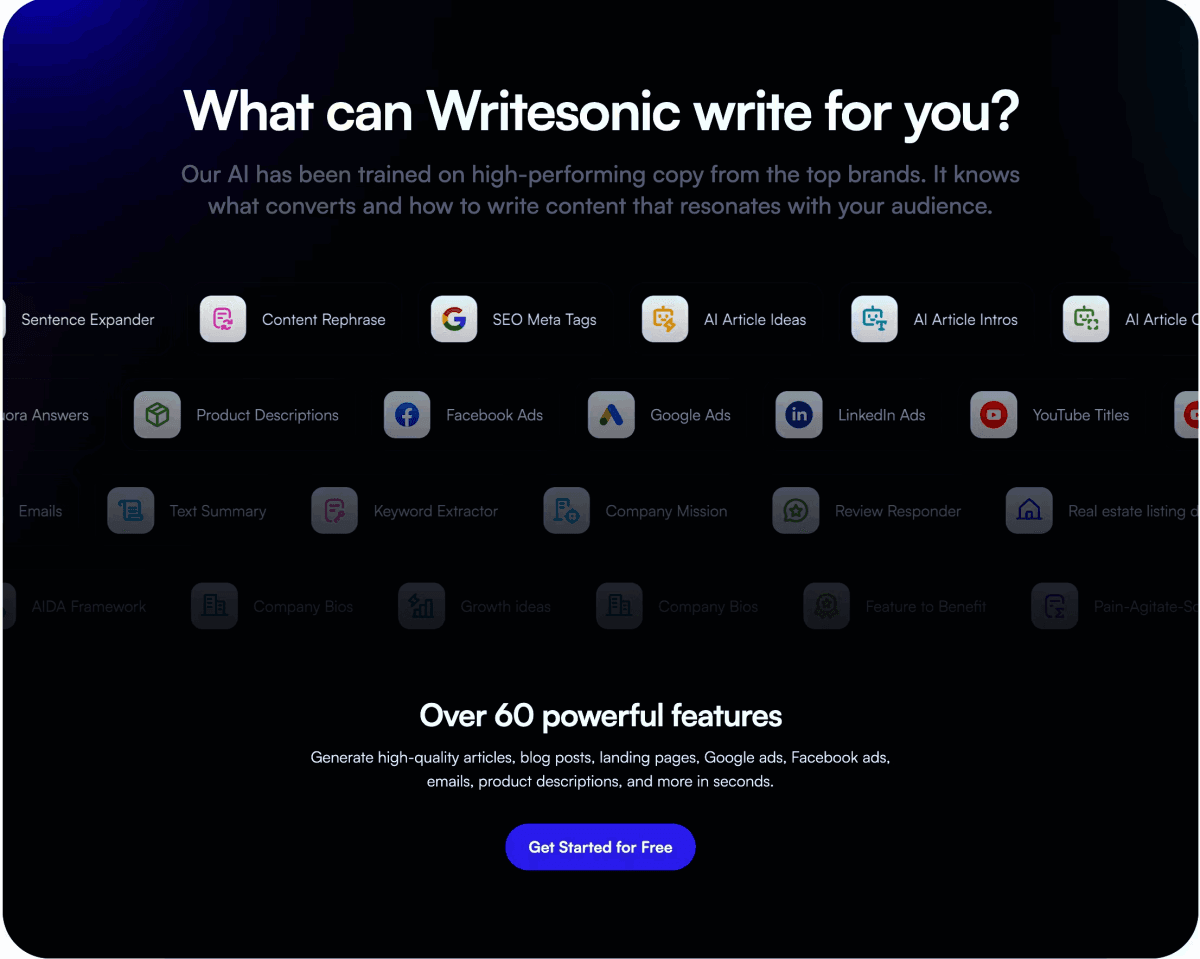
There’s also a suite of shorter-form generators (ad copy, meta descriptions, social posts, email sequences) but those are supporting features now, not the main event. Writesonic in 2026 is primarily an SEO and AI-visibility platform that happens to generate the content it recommends you create.
NOTE · the naming can confuse
Writesonic (the company name), Chatsonic (the chat product), and Botsonic (their chatbot builder, discontinued) have caused persistent confusion. When you hear “Writesonic” in 2026, the meaningful product is the SEO + GEO platform. Chatsonic is a bonus tool bundled in, not the core value proposition.
The AI Article Writer: where it earns its keep
The Article Writer is the product that justifies the subscription for most paying customers. The current version (6.0) generates long-form articles up to approximately 5,000 words through a structured multi-step workflow rather than a single big-bang generation. That structure matters more than it sounds.
Here’s how a typical article run looks:
article-writer-flow.txt
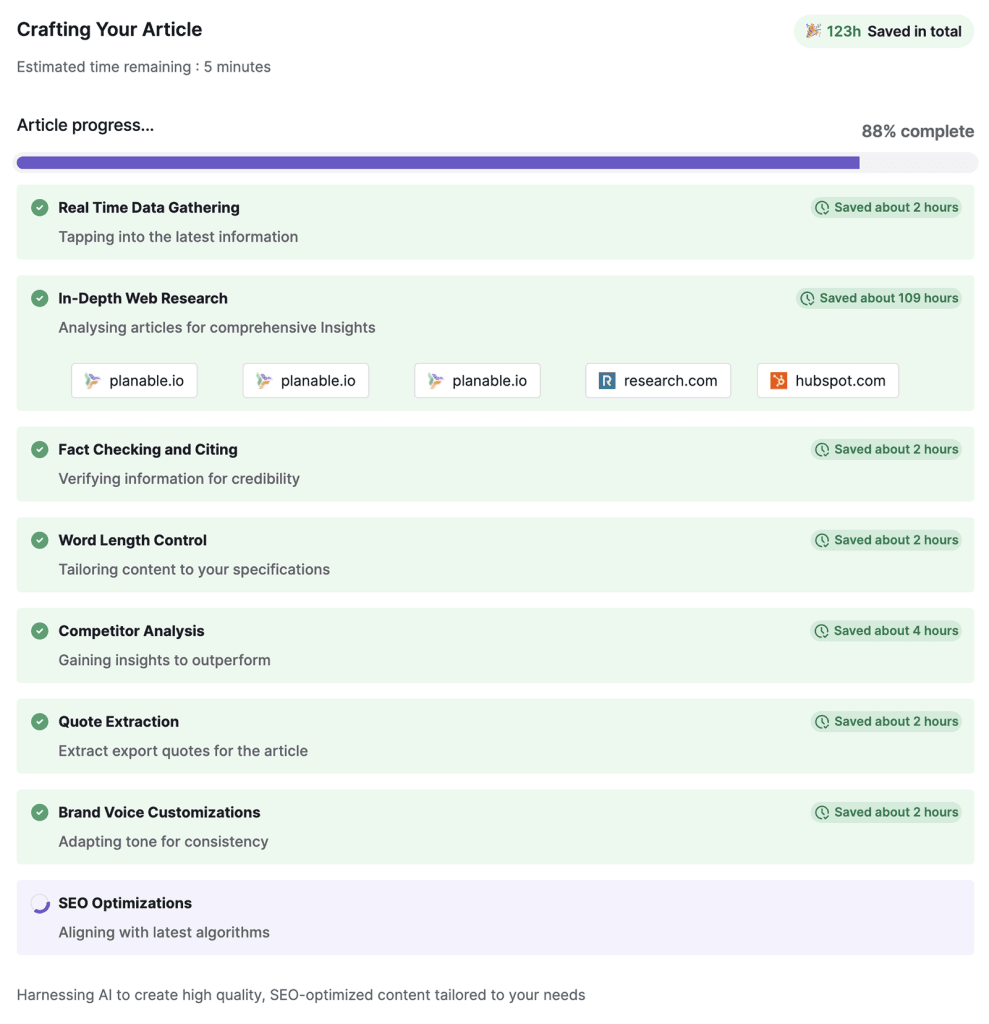
1. Enter target keyword: “best CRM for small business”
2. Writesonic pulls SERP data — top 10 results, their headings, word counts
3. Suggests 3-5 article angles based on competitor gap analysis
4. Generates an outline (H2/H3 structure) — editable before proceeding
5. Writes section-by-section, referencing competitor structure
6. Runs SEO score check (Content SEO Score, keyword density, semantic coverage)
7. Suggests internal links if WordPress is connected
8. Publishes directly to WordPress with one click
What makes this better than “ChatGPT with a keyword prompt” is step 2 and 3. The tool actually reads what’s ranking and structures your article to compete with it — not copy it, but match its topical coverage while giving you structural hooks to outperform. The outline step is where most of the editorial value happens. You can inspect what the model has planned, rearrange sections, cut fluff H2s, add angles the competitors missed. Treat the outline as a brief, not a rubber stamp.
The SurferSEO integration (available on paid plans) layers a real-time content score on top of the draft as you edit. As you add semantic keywords and deepen coverage on key sections, the score moves. It’s the same scoring you’d get in Surfer’s native editor, just accessible without switching tabs. For teams already paying for Surfer, this is a legitimate workflow improvement.
The factual grounding is where the tool earns points over generic LLM interfaces. Writesonic’s Article Writer pulls data from Google Search and web sources to include statistics, examples, and current pricing at the time of writing. It’s not perfect — more on that in the output quality section — but it’s materially better than GPT-4o writing from training data alone.
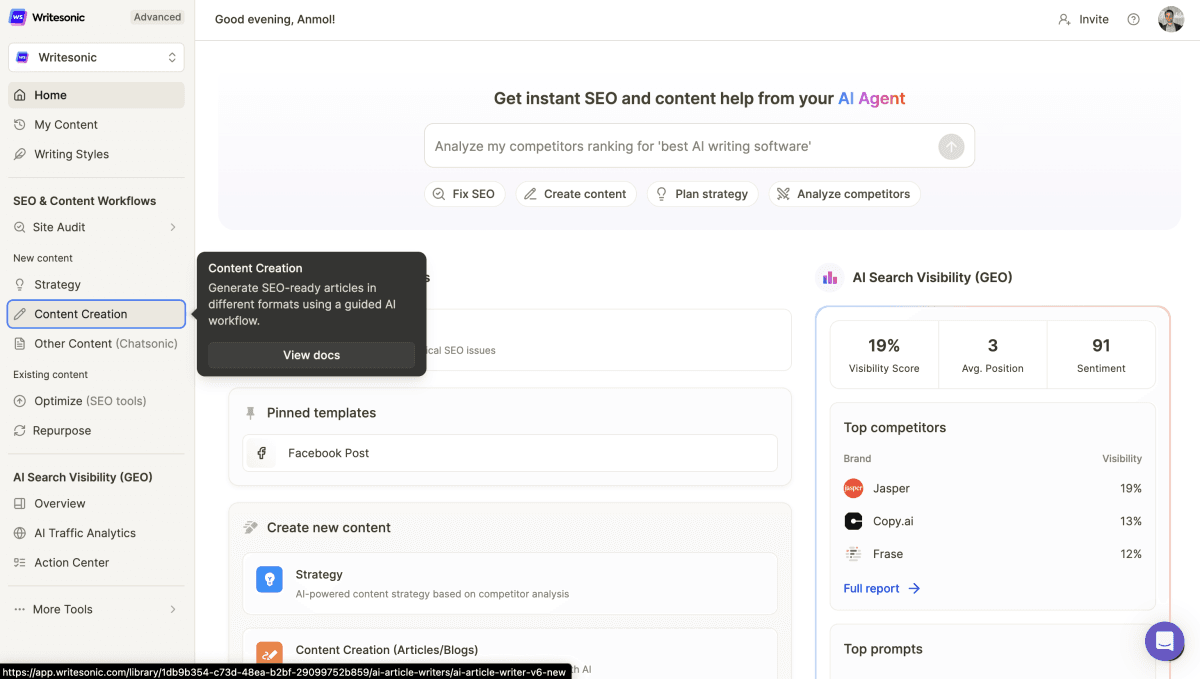
writesonic · writesonic-ui.png
fig · The Writesonic dashboard · source: tryprofound.com
The GEO pivot: tracking visibility in AI answers
This is the new thing, and it’s genuinely new for the category. Generative Engine Optimization is the emerging practice of optimizing your content not just for Google’s ranking algorithm but for the LLMs that now answer a growing share of search queries directly — without the user ever clicking a blue link.
The core insight driving Writesonic’s GEO platform: when someone asks ChatGPT “what’s the best project management tool for remote teams,” the answer it gives is based on what’s well-represented in its training data and in the sources it retrieves via browsing. If your product isn’t cited, you don’t exist in that answer — regardless of where you rank on Google. And unlike Google rankings, there’s no Google Search Console equivalent that tells you “ChatGPT mentioned you 847 times this month.” Until tools like Writesonic’s tracker emerged, this was a black box.
Writesonic’s approach is to crawl the actual interfaces of AI platforms the way a real user would — submitting queries, reading the responses, parsing citations. The tracked platforms include ChatGPT, Perplexity, Google AI Overviews, Gemini, Claude, Grok, DeepSeek, Microsoft Copilot, Meta AI, and standard Google Search. You input your brand and your competitors. The tool tracks how often each appears in responses to prompts relevant to your space, with daily visibility scores.
The output is a competitive visibility share: of all AI-generated responses in your topic area, what percentage mention you versus Competitor A versus Competitor B? This metric is imperfect — the query set matters enormously, and “visibility” in an AI answer isn’t the same as a click or a conversion — but it gives you something actionable where before there was nothing.
TIP · prompt volume predictions
One genuinely useful feature: Writesonic pulls from a dataset of over 2 billion AI conversations to estimate how often users ask questions in your topic area across different AI platforms. This lets you prioritize which queries to target for GEO content — high-volume AI prompts where you currently have zero visibility are your biggest opportunity.
AI visibility tracking: what the data looks like
The visibility dashboard is the cleanest part of the product. For each tracked keyword cluster or topic area, you get:
Daily visibility score — a 0-100 index of how often your brand appears in AI answers in this space, tracked over time so you can see trends
Sentiment breakdown — not just whether you’re cited, but whether the AI portrays you positively, neutrally, or negatively when it does mention you
Citation sources — which specific pages and domains AI platforms are using as sources when they mention your brand, so you know what to reinforce
Competitive share of voice — your visibility versus named competitors across the same query set
Query fanout analysis — tracking how AI platforms break down complex prompts into sub-queries, revealing keyword angles you might not have targeted
The Action Center (available on Growth plan and above) translates visibility data into a content task list: “publish content on these five underrepresented topics to increase your ChatGPT citation rate.” Whether following those recommendations actually moves the needle is the honest unanswered question. GEO as a discipline is new enough that clean before/after attribution is hard. What Writesonic provides is the best measurement layer currently available for something that was completely unmeasured 18 months ago.
WARNING · GEO is still early
No tool — Writesonic included — can guarantee that publishing content will increase your citation rate in AI platforms. LLM training cycles, retrieval policies, and answer generation are largely outside any external tool’s control. Treat GEO tracking as a measurement layer and directional guide, not a deterministic ranking lever. The data is real; the causal chain from action to outcome is still being worked out by the industry.
Chatsonic: multi-model chat with web access
Chatsonic is Writesonic’s bundled chat interface. The main differentiator from vanilla ChatGPT or Claude.ai is that it combines GPT-4o, Claude, and Gemini in one UI, lets you switch models mid-conversation, and has real-time web access built in regardless of which model you’re using. For marketing teams that have standardized on Writesonic for their SEO work, Chatsonic means they don’t need separate ChatGPT Plus and Claude Pro subscriptions just to access different models.
The web access integration is genuinely useful for content work: researching competitor pricing, pulling stats for articles, checking what an AI competitor just announced. In practice Chatsonic functions as a capable research assistant and first-draft tool with fresher data than any model’s training cutoff.
Where Chatsonic falls short is depth. It’s a bundled utility, not a best-in-class chat product. Users who do serious prompt engineering or need extended thinking from Claude or GPT-4o will feel the ceiling. But for a content team that needs “AI chat with web access” as a supporting workflow, it covers the use case without adding another SaaS subscription.
Brand voice: the quality lever most users ignore
Writesonic includes a brand voice feature that functions similarly to a system prompt — you describe your tone, style, vocabulary preferences, and what to avoid, and the Article Writer applies it to every piece it generates. Like .cursorrules in a code editor, this single setup step is the biggest quality lever available and the one most new users skip.
The difference between “generate me a blog post about email marketing” with and without a brand voice configured is significant. Without it, outputs read like competent but interchangeable SEO content. With a well-built brand voice, the drafts come out in a recognizable register — specific enough that your editor can touch them up rather than rewrite from scratch.
A few practices that matter here. First, training the brand voice on samples of your existing best-performing content rather than writing it from scratch. Writesonic can analyze uploaded examples and synthesize a voice profile. Second, updating it when your editorial team’s feedback converges on a recurring issue — if every piece comes back with “stop using these hedging phrases,” that’s a brand voice note. Third, keeping separate brand voices for different content types. Your product comparison pages need a different register than your how-to guides.
writesonic · writesonic-article.png
fig · The AI Article Writer · source: docs.writesonic.com
Integrations that actually matter
The integration story is one of Writesonic’s stronger differentiators in the SEO writing space. Rather than being a standalone editor that produces content you copy into other tools, the platform connects to the sources of truth your SEO team already uses:
Google Search Console — ingests your existing performance data so the Article Writer knows which queries you already rank for (and shouldn’t target) versus where you have ranking gaps
Ahrefs — keyword difficulty, search volume, and competitive backlink data available during article planning without leaving the tool
Google Keyword Planner — additional keyword data, especially useful for early-stage keyword research before you have Ahrefs data
SurferSEO — real-time content scoring during drafting, the same NLP-based semantic coverage check Surfer’s own editor provides
WordPress — direct one-click publishing. Write, approve, publish without a copy-paste step. Also enables internal linking suggestions based on your existing post library
Notably absent: a native Semrush integration. Semrush users can pull their own keyword data into the brief manually, but there’s no API-connected workflow. For agencies standardized on Semrush, this is a friction point worth knowing upfront.
A real SEO content workflow, end to end
workflow #01 · monthly content calendar for a SaaS blog
10 SEO articles per month, one writer, one review cycle
The workflow: the content manager runs a keyword clustering session in Ahrefs each month, identifies 10 target topics, and feeds them into Writesonic’s Article Writer one by one. Each article takes roughly 25 minutes of active time — keyword input, outline review, draft skim, brand voice check, publish to WordPress as draft.
The subject-matter reviewer then reads each draft for factual accuracy, catching the AI’s occasional confident errors (a statistic from 2021 presented as current, a competitor feature described incorrectly). Average review time: 20-30 minutes per article. Total team time per article: under an hour. Without AI: 3-5 hours per article including research, drafting, and revisions.
The GEO tracker runs in the background. After three months the team notices that a specific competitor is being cited by ChatGPT significantly more often in “project management for agencies” queries — and traces the citation to three high-quality comparison articles on that competitor’s site that Writesonic’s AI lacks comparable content for. The Action Center flags four article gaps. Two are added to next month’s content calendar.
// estimated time saving: ~2.5-4 hours per article · team output: from 3 articles/mo to 10
workflow #02 · agency running 5 client accounts
Scaling content delivery across clients with consistent quality
The agency challenge with AI writing tools is brand voice drift — when you’re producing 50 pieces a month across five different client voices, generic AI outputs blend together. Writesonic’s brand voice system lets the agency maintain a separate profile for each client: Client A’s conversational SaaS tone versus Client B’s authoritative enterprise register stay distinct without manual prompting on every run.
The GEO visibility tracker gives each client a monthly AI visibility report — quantified data on where their brand appears in AI answers versus competitors. For clients who were skeptical of “AI content,” hard visibility numbers tied to business outcomes (being cited in ChatGPT when users ask about their product category) became a compelling deliverable that generic content agencies can’t easily replicate.
Pain point: the Starter plan’s limit of 15 AI articles per month per seat forces the agency to operate on the Growth plan to serve all five clients. The jump from Basic to Growth is significant in price.
// differentiated deliverable: monthly AI visibility reports per client · closes gap vs pure-play content agencies
Honest output quality assessment
Writesonic’s content output is competent and structured. It is not consistently great. Here is the honest breakdown:
What it does well
The structural integrity of outputs is genuinely strong. Articles come out with logical H2/H3 hierarchies, proper introductions and conclusions, appropriate use of lists and comparison tables. The SEO bones are usually right: keyword placement, heading structure, meta description suggestions. If you need a 2,500-word article that covers a topic thoroughly enough to compete on a moderately competitive SERP, the Article Writer gets you to a strong first draft reliably.
Web-grounded writing (pulling current stats and examples from live sources) meaningfully reduces the hallucination rate compared to LLM outputs that rely on training data alone. For evergreen topics — software comparisons, how-to guides, marketing strategy articles — factual accuracy is solid in the 90-95% range based on testing.
Where it falls short
Technical and niche accuracy. In fields like finance, healthcare, law, or any domain where being precisely correct matters, Writesonic generates confident-sounding text that requires expert review. Plausible statistics, subtly incorrect technical descriptions, outdated regulatory references — these appear often enough that anything in a high-stakes domain should go through a subject-matter expert before publishing. This isn’t unique to Writesonic; it’s true of every AI writer. But it’s worth stating plainly.
Voice and personality. Outputs tend toward a register that could be described as competent Wikipedia: correct, structured, inoffensive, and somewhat flat. For content where voice and personality drive engagement — opinion pieces, brand storytelling, distinctive editorial positions — the drafts require heavy editing. The tool is best used for structure and initial coverage, not for final editorial voice.
Formula-dependence. Without a well-configured brand voice and detailed prompt guidance, repeated outputs start to converge. Lists, subheadings, and paragraph length fall into predictable patterns. An experienced reader will recognize AI-generated content from a Writesonic default run. The brand voice configuration and detailed prompting mitigate this significantly, but they require upfront investment.
content-quality –metric=coverage,voice,factual per review category
topical coverage (breadth)
writesonic8.2/10
jasper7.8/10
copy.ai7.1/10
editorial voice (distinctiveness)
writesonic5.9/10
jasper6.5/10
copy.ai6.4/10
seo integration depth
writesonic8.4/10
jasper7.2/10
copy.ai5.8/10
Who Writesonic is actually for
The right fit
SEO content teams publishing 8+ articles per month who need to scale output without scaling headcount
Digital marketing agencies managing multiple client content programs — the brand voice system and GEO reports are genuine agency differentiators
In-house marketers at SaaS or e-commerce companies responsible for organic traffic growth, especially if they’re also tracking AI search visibility
Content strategists who want SERP-grounded drafts and a structured brief workflow, not a blank-canvas generator
Teams already using SurferSEO who want the content generation step in the same platform
Wrong tool for this job
Novelists, screenwriters, or anyone doing creative writing — the tool has no creative writing muscle whatsoever
One-off copywriting needs — the pricing model is subscription-based and built for volume; single pieces are overpriced at the plan minimums
Technical documentation teams — accuracy demands exceed what the AI reliably delivers without heavy review
Teams whose primary SEO tool is Semrush — the lack of a native Semrush integration creates a workflow gap compared to competitors
writesonic · writesonic-geo.png
fig · AI visibility / GEO · source: rankinai.io
Writesonic vs Jasper
a/writesonic b/jasper
Jasper is Writesonic’s most direct historical competitor — both started as AI copy platforms in 2020-2021, both have pushed toward SEO integration, both target marketing teams. Jasper’s brand campaigns and enterprise push have made it the higher-name-recognition choice. Writesonic’s GEO platform is the cleaner technical differentiator in 2026.
writesonic wins at
GEO / AI visibility tracking — Jasper has no equivalent
search-grounded article drafts with live SERP data
deeper SEO data integrations (Ahrefs, Search Console)
lower entry price for teams that need the GEO layer
jasper wins at
brand voice depth and refinement options
enterprise sales, compliance, and support tier
collaborative team editing and commenting
wider template library for short-form and ad copy
Verdict: If AI visibility tracking matters to your team, Writesonic has no real competition here. If you need deep collaboration features and enterprise compliance, Jasper. Most organic-traffic-focused marketing teams will get more usable differentiation from Writesonic’s GEO platform. See our Jasper review for a full comparison.
Writesonic vs Copy.ai
a/writesonic b/copy-ai
Copy.ai has moved toward marketing workflow automation and pipeline tooling, while Writesonic has doubled down on SEO content specifically. They’ve diverged enough that a direct comparison depends heavily on which problem you’re trying to solve.
writesonic wins at
long-form SEO article quality and structure
GEO / AI search visibility — no Copy.ai equivalent
SERP-grounded research during article generation
WordPress direct publishing workflow
copy.ai wins at
marketing automation and workflow pipelines
CRM and sales sequence integrations
short-form copy at scale (ads, emails, sequences)
team workflow tools and approval routing
Verdict: Clear separation. Writesonic if SEO content and AI visibility are your focus. Copy.ai if marketing automation and short-form copy pipelines are the problem. See our Copy.ai review for the full breakdown.
Pricing, in real terms
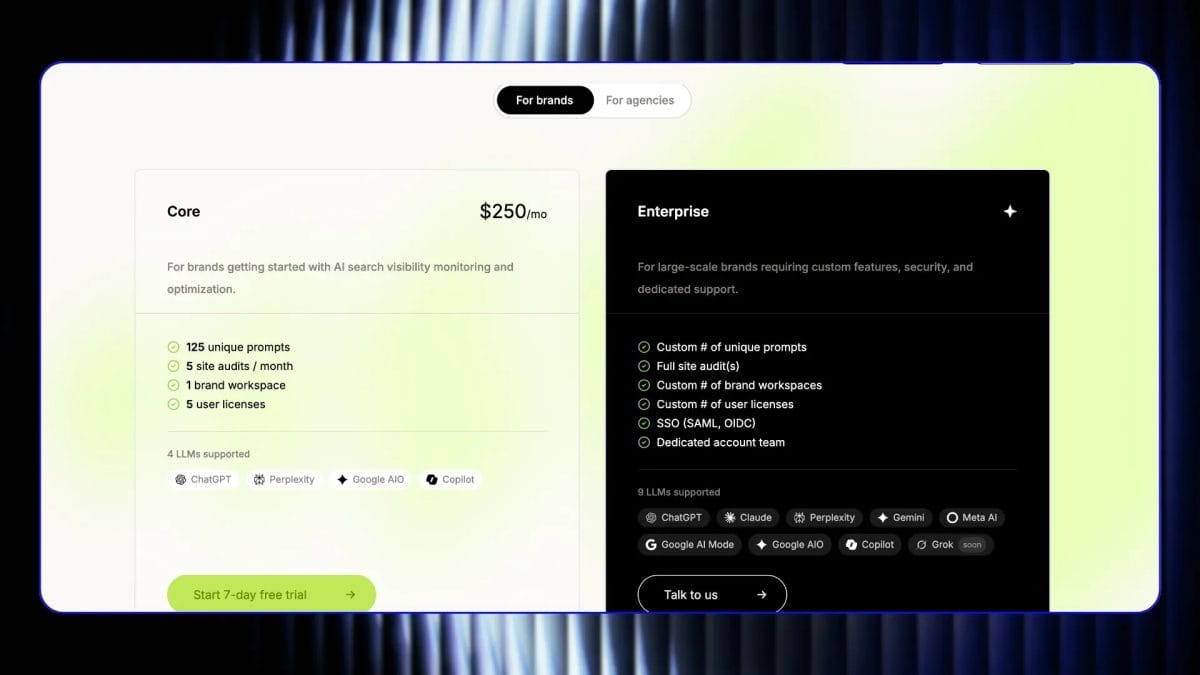
Writesonic has restructured its pricing to reflect its repositioning as an AI visibility platform rather than a content generator. As of mid-2026, plans are tiered around the GEO platform’s tracking capacity rather than simple word counts:
Starter — $79/mo (annual) / ~$99/mo (monthly): 50 tracked AI prompts, 15 AI articles/month, 10 site audits (100 pages), ChatGPT visibility only. Suitable for solo content marketers or small blogs testing the GEO layer.
Basic — $199/mo (annual): 100 tracked prompts, 25 AI articles/month, 20 site audits (1,200 pages), ChatGPT + Gemini + Google AI tracking, 2 team seats. The practical entry point for small agencies or in-house teams.
Growth — $399/mo (annual): 200 tracked prompts, 50 AI articles/month, 50 site audits (2,500 pages), all 10 AI platforms tracked, Action Center (5 actions/mo), 3 team seats. The team tier for serious organic programs.
Enterprise — custom pricing: Full platform access, dedicated strategist, unlimited tracking. For agencies and brands at scale.
The pricing represents a significant shift from Writesonic’s roots as a ~$19/mo writing tool. This is no longer a cheap blog-post generator. It’s an SEO platform competing with tools like BrightEdge, Conductor, and the upper tier of the content marketing toolset. The value proposition needs to be evaluated on that basis.
There is a free trial (no credit card required) for all plans. The Starter tier used to have a permanent free plan with limited credits; that’s been replaced by trial access. If your primary use case is just the Article Writer without GEO tracking, this price increase is a hard sell versus alternatives. If the GEO tracking and AI visibility reporting are central to your workflow, the math changes.
NOTE · the pricing mismatch risk
Writesonic’s article-per-month limits are tight relative to the price. The Starter plan’s 15 articles/month ceiling is a real constraint for any team publishing on a serious schedule. Budget for the Basic tier at minimum if you’re running a content operation rather than individual experiments. And verify current pricing at writesonic.com — the platform has restructured plans multiple times and specifics may have shifted since this review.
Common gotchas
Plan limits reset monthly, not weekly. Burning through your article allotment in the first ten days because a campaign needed a content push is a common first-month mistake. Budget pacing is a real operational concern at lower tiers.
GEO tracking data takes 2-4 weeks to stabilize. Visibility scores in the first few weeks reflect a small query sample. Meaningful trend data requires at least a month of consistent tracking before you make editorial decisions from it.
The interface is dense. With Article Writer, Chatsonic, GEO dashboard, Bulk Generator, and the brand voice settings all living under one roof, new users frequently report getting lost. Budget a full onboarding session to map the product before using it in production.
SurferSEO integration requires an active Surfer subscription. The integration is a bridge, not a replacement — Writesonic pulls Surfer’s scoring via API, but Surfer’s own pricing is additional.
Outputs in niche domains need expert review. Anything medical, legal, financial, or highly technical should be reviewed by a subject-matter expert before publishing. The tool will produce authoritative-sounding text in domains where it lacks reliable precision.
Brand voice degrades without maintenance. As your editorial voice evolves, the configured brand voice drifts out of alignment. Review and update it quarterly at minimum, or every time editorial feedback on AI drafts converges on a consistent complaint.
WordPress integration requires a plugin installation. The one-click publish is genuinely convenient but needs a setup step that IT or site admins sometimes gatekeep. Confirm this is accessible before building it into your workflow.
Chatsonic is not a replacement for ChatGPT Plus or Claude Pro. The multi-model access is useful but the depth of each model’s native interface — system prompts, projects, artifacts, extended thinking — is not replicated. Think of it as bundled utility, not best-in-class access.
writesonic · writesonic-pricing.png
fig · Plans and pricing · source: softwaresuggest.com
What’s next
// roadmap · Writesonic signals · 2026 and beyond
Agentic SEO execution — the Action Center is currently a recommendation engine. Writesonic has signaled intent to move toward autonomous agents that execute SEO tasks end-to-end: briefing new content for invisible prompts, queuing refreshes when AI engines stop citing your pages, drafting outreach to third-party sites that AI platforms frequently cite in your space.
ChatGPT ad tracking — ChatGPT’s shopping and sponsored features are nascent but growing. Writesonic is building tracking for paid visibility in AI search, parallel to what it already does for organic AI citations.
Expanded platform coverage — the tracker currently covers 10 AI platforms. As Mistral, xAI, and other models increase their consumer search presence, those are likely additions.
Deeper Semrush integration — the gap between Writesonic’s Ahrefs integration and missing Semrush support has been noted consistently in user feedback. A native Semrush connector is a likely priority given how many enterprise SEO teams standardize on Semrush.
Multi-market GEO — current language and market filtering for GEO tracking is limited. International brands running SEO in multiple languages need per-market visibility scores, which Writesonic is building toward.
FAQ
Is Writesonic still an AI writing tool or has it become something else?
Both, honestly. The Article Writer is still a core product and still used by content teams for bulk production. But the strategic focus has clearly shifted toward GEO — tracking AI search visibility and optimizing for it. If you’re buying Writesonic today purely as a blog-post generator, you’re paying for platform capabilities you won’t use and there are cheaper alternatives. If the AI visibility layer matters to you, that’s where the differentiated value is.
How does GEO tracking actually work — is Writesonic “gaming” AI systems?
The tracking is measurement, not manipulation. Writesonic submits queries to AI platforms and reads the responses, the same way a human would. The optimization side — the content recommendations — is about creating genuinely good, authoritative, well-sourced content that AI systems are more likely to cite. There’s no prompt injection or API hacking involved. Whether any individual content recommendation moves the needle is a separate question from whether the practice is legitimate.
Does the Article Writer need a Surfer SEO subscription?
No. The Article Writer runs without Surfer — it has its own built-in Content SEO Score. The Surfer integration is additive: if you’re an active Surfer subscriber, you get Surfer’s scoring inside Writesonic instead of switching tabs. If you’re not on Surfer, the native SEO scoring still works fine for most use cases.
Can the Article Writer publish directly to platforms other than WordPress?
WordPress is the only direct CMS publish integration as of mid-2026. For other platforms (Webflow, Shopify, HubSpot, etc.) you export the content and paste it. Writesonic has hinted at expanded CMS integrations but nothing is confirmed yet.
How does Writesonic handle factual accuracy?
Better than GPT-4o writing from training data alone, because the Article Writer pulls from live web sources during generation. But it still makes mistakes — particularly confident-sounding statistics that are outdated or slightly wrong, and technical claims in niche domains. For anything factual-critical, treat outputs as structured first drafts requiring expert review, not final copy.
Is there a free plan?
There’s a free trial with full platform access and no credit card required. The previous freemium tier (25 credits/month) has been phased out. After trial, the lowest paid entry point is Starter at ~$79/mo billed annually. Verify current availability at writesonic.com.
Is Writesonic worth it for a solo blogger?
Probably not at current pricing. The Starter tier’s GEO tracking and 15 articles per month is real value if you’re running a serious content program, but the monthly cost is harder to justify for a personal blog publishing twice a month. The old freemium plan was well-suited to solo bloggers; the repositioning toward the SEO platform tier has moved the sweet spot to small teams and agencies.
How does Writesonic compare to just using ChatGPT with an SEO plugin?
The gap is integrations and GEO tracking. ChatGPT doesn’t natively connect to Ahrefs, Search Console, or SurferSEO — those connections in Writesonic’s workflow reduce the toolstack-switching that slows down content operations. And no ChatGPT plugin gives you daily AI visibility scores across 10 platforms. If you’re happy with manual workflows and don’t care about GEO, ChatGPT Plus at $20/mo beats Writesonic’s Starter for pure content generation. If you’re managing an organic program at any real scale, Writesonic’s integrated platform is worth the premium.
The strongest AI tool for teams whose job is organic traffic.
Writesonic’s evolution from copywriter to SEO-plus-GEO platform is a genuine product bet, not just a rebrand. The Article Writer is the best-integrated long-form SEO content workflow in the AI writing category — it understands SERP data, connects to the tools your team already uses, and publishes directly to WordPress. The GEO visibility tracker is the most developed tool available for monitoring brand presence across AI search engines, a problem that didn’t exist three years ago and that most competitors haven’t addressed seriously.
The score isn’t higher because output still needs editorial work, pricing has moved up-market in a way that excludes solo operators, and GEO as a discipline is still maturing — the causal link between content actions and AI citation improvement is real but imprecise. For an SEO content team running a serious organic program, 7.6 is a strong endorsement. For anyone else, a lower-cost tool probably fits better.