AI Tool

ElevenLabs
ElevenLabs
ElevenLabs
The most realistic AI voice generator available — clone your voice, dub into 32 languages, and build conversational AI agents on one platform.
The most realistic AI voice generator available — clone your voice, dub into 32 languages, and build conversational AI agents on one platform.
ElevenLabs was founded in 2022 by Piotr Dabkowski and Mati Staniszewski — a former Google Brain researcher and a former McKinsey consultant, which tells you something about how the company operates: technically serious, commercially aggressive. The founding thesis was that text-to-speech was a solved problem in the wrong direction. Existing engines optimized for intelligibility. ElevenLabs optimized for emotional authenticity. Those are different targets, and closing the gap between them turned out to be a multi-year research problem that most incumbents weren’t willing to fund.
The first public demo in 2022 circulated on Twitter and immediately caused controversy: samples were indistinguishable from real human recordings. Within months, the company was simultaneously celebrated as a creative breakthrough and scrutinized as a potential misuse vector. Both reactions were earned. ElevenLabs responded with a detection tool and a policy framework, then kept shipping.
The fundraising curve reflects how quickly the market moved. The company raised $19M in 2023, then $80M in a Series B led by Andreessen Horowitz in early 2024. By 2025 they were a unicorn. By 2026 their platform had expanded from a text-to-speech API into three distinct product lines: ElevenCreative (audio generation), ElevenAgents (conversational AI infrastructure), and ElevenAPI (developer-facing synthesis and transcription). The TTS product that started everything is now one node in a much larger system.
The competitive landscape has also matured. Murf, PlayHT, Resemble AI, and Descript all compete at the creator tier. Microsoft and Google ship their own neural TTS through Azure and Cloud. What ElevenLabs has maintained through all of this is a consistent lead on perceptual quality — the thing that actually matters when a listener’s trust depends on a voice sounding real.
ElevenLabs is not a simple voice generator. In 2026 it’s a platform with four distinct capabilities that happen to share an infrastructure:
Most users land on ElevenLabs for the TTS and stay because the cloning and multilingual capabilities unlock workflows they didn’t know were possible. The Conversational AI product targets a completely different buyer — CX and product teams building voice-first interfaces — and is priced accordingly.
The core API processes one character as one credit. Flash models (faster, slightly lower quality) cost 0.5 credits per character — effectively doubling your output at the same tier. This credit mechanic matters when you’re budgeting at scale.
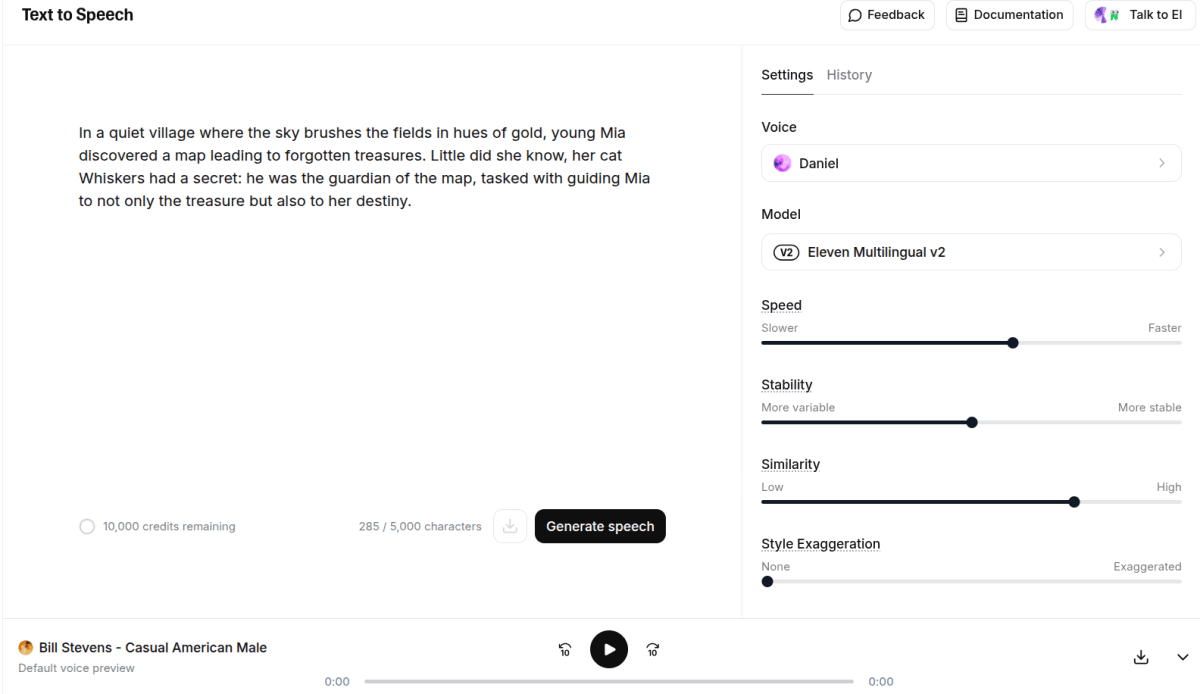
The onboarding is fast. Create an account, verify email, pick a voice from the library or paste text into the playground. Your first synthesis happens in under 30 seconds. The quality of the default output is the first genuine surprise: it doesn’t sound like a voice generator. It sounds like a voice.
The second surprise is the latency. Standard synthesis for a 500-word paragraph comes back in 3-6 seconds. Flash models cut that to under 2 seconds. For real-time applications — agents, live narration — the streaming API delivers audio within 200-400ms of the first token, which is comfortably within the threshold where human conversation feels natural.
The voice library is legitimately large — 3,000+ voices across styles, accents, and languages. The filtering UX could be better (this is a known complaint in the community), but once you find a voice that works for your brand, you save it to your workspace and that’s the end of browsing.
Where ElevenLabs’ interface shows its seams is in the Studio. It’s powerful, but it has the complexity of a non-linear editor wrapped around a voice tool, and new users hit the learning curve quickly. The playground for straight TTS is polished. The Studio feels like a different product team built it — more capable, less intuitive.
Before you clone anything, spend 20 minutes in the pre-built voice library with a piece of your actual content. ElevenLabs’ library voices are better than most people expect, and professional voice cloning takes a recording session. Know what you’re solving before you commit to the workflow.
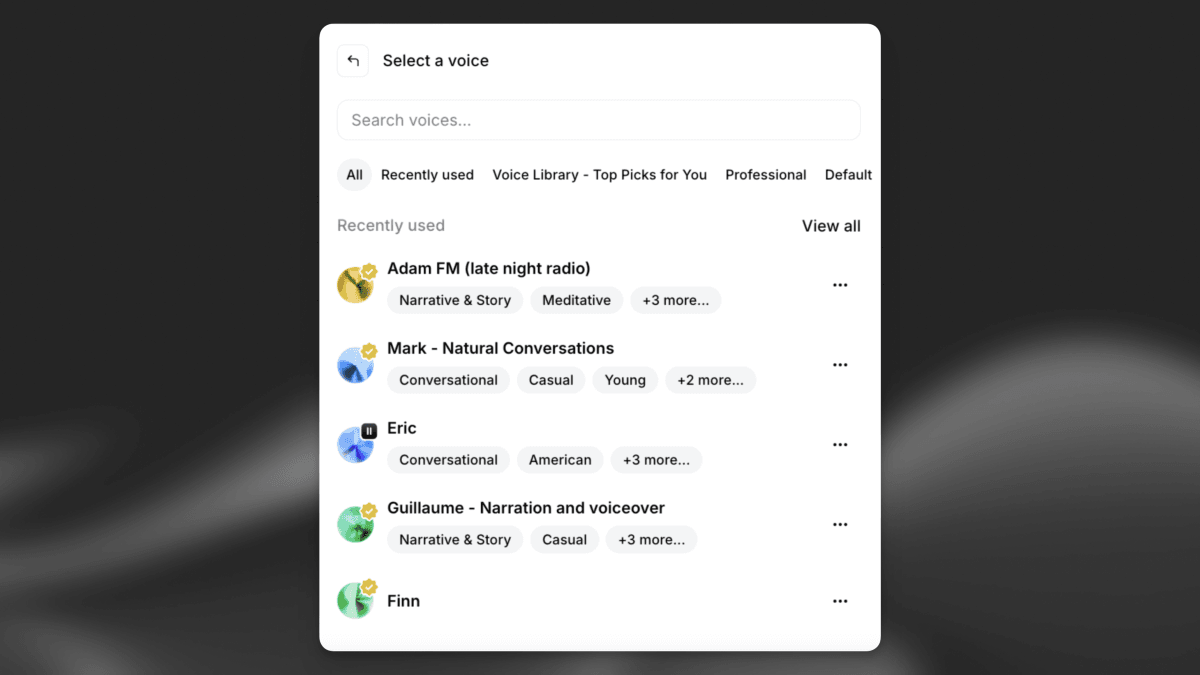
Eleven v3 rolled out to all paid plans on March 24, 2026, and it’s a meaningful upgrade, not a marketing release. The headline improvement is emotional dynamic range: where v2 voices sounded like a professional reader being careful not to make mistakes, v3 voices sound like a person who cares about what they’re saying.
The specific changes that matter in practice:
[whispers], [shouts], [laughs], [sighs]. The model interprets them as performance directions. This is a qualitative leap for dramatic content — audiobooks, game dialogue, scripted social media — where flat delivery destroys the writing’s intent.The emotion tags deserve a standalone mention because they change the creative ceiling. Before v3, getting a voice to sound sad required finding a sad voice in the library or hoping your clone happened to have that register. Now you write [sadly] before a sentence and the model delivers it that way. For anyone producing fiction audio, this is the difference between a serviceable tool and a genuinely useful creative collaborator.
ElevenLabs offers two cloning paths with very different use cases and quality floors.
Available from Starter ($5/mo) up. Upload 1-3 minutes of clean audio — ideally a recording with no background noise, consistent mic placement, and varied sentence structures — and the clone is ready in under 60 seconds. The quality is genuinely good for content production: podcasts, explainer videos, internal training. It doesn’t hold up under close listening for broadcast, and it won’t fool someone who knows the source speaker, but for most creator use cases it’s more than sufficient.
The 32-language crossover is the underappreciated instant clone feature. Record in English, generate in Portuguese, French, German, Japanese. The voice identity transfers across languages — same timber, same pacing idiosyncrasies, different language. For a solo creator publishing internationally, this eliminates the cost of finding a native-language voice actor for every market.
Available from Creator ($22/mo) up. This is a longer recording session — typically 30+ minutes of directed speech, captured in a professional environment — processed through a higher-fidelity pipeline. The output is broadcast-quality: suitable for audiobooks, documentary narration, brand voice systems where the voice will be heard by millions of people. The difference between an instant clone and a professional clone on a critical listening test is the difference between “that sounds like them” and “that is them.”
Professional cloning is also where ethical and legal complexity concentrates. ElevenLabs requires consent verification — the person whose voice is cloned must agree in writing. They have a Voice Verification system where the talent records a short consent phrase before the clone is activated. This doesn’t stop bad actors, but it creates an audit trail and shifts legal liability appropriately.
Cloning someone’s voice without their consent isn’t just an ElevenLabs policy violation — it’s illegal in a growing number of jurisdictions following AI Voice Protection legislation passed in several US states and under EU AI Act enforcement as of 2025. ElevenLabs’ detection tool can identify generated audio, but the downstream legal risk is yours, not theirs. Get written consent and keep the paperwork.
Studio (now on version 3.0) is ElevenLabs’ answer to the question: what if you didn’t need to leave the platform to produce finished audio-visual content? It combines text-to-speech, AI-generated music and sound effects, video import, and auto-captions into a single editor.
The workflow is: paste a script, assign voices to speakers, add background music from their library (AI-generated, cleared for commercial use), adjust timing, export. For talking-head content, social media narration, and course materials, it eliminates the multi-app pipeline of TTS tool → music tool → video editor → caption tool.
Where Studio 3.0 specifically improved is the audio tag integration. You can now tag emotional direction inline in the script editor — type [excitedly] before a line and the voice actor preview updates in real time. This makes direction fast enough to iterate on during the creative session rather than render-preview-adjust in a separate loop.
The AI music generation is competent rather than remarkable. It’s useful for background beds — something to fill the silence in an explainer video — but you won’t mistake it for a composed score. For anything requiring actual musical identity, bring in your own tracks. The sound effects library is better: punchy and usable for social content.
ElevenAgents is the product that explains why ElevenLabs raised at the valuation it did. The TTS market has a ceiling; the voice agent infrastructure market does not.
The platform lets you build, deploy, and manage AI voice agents that handle real-time phone and web conversations. These aren’t IVR systems that read menus. They’re agents with access to external tools — CRM lookups, payment processing, appointment booking — that speak with the emotional intelligence of the v3 model and respond with latency low enough to feel natural.
The 2026 version of ElevenAgents added several enterprise-significant features:
Real-world deployments in 2026 include Deutsche Telekom and Klarna for multilingual customer support, and MasterClass for interactive AI instructors. These aren’t proofs-of-concept — they’re at scale, handling call volumes that would require hundreds of human agents.
For most PixlRun readers, ElevenAgents is relevant in two situations: you’re building a SaaS product with a voice interface, or you’re running a support function at a scale where the economics of AI agents vs human agents are starting to favor AI. Below 50 calls/day, a human is probably cheaper once you factor in the integration work. Above 500 calls/day, the math has clearly flipped.
ElevenLabs supports 32 languages for voice synthesis and cloning, and the quality is not uniform across them. English is the clear flagship — every model optimization passes through English first, and it shows. Spanish, French, German, Portuguese, Japanese, and Mandarin are at professional quality. Languages with smaller training sets have acceptable but noticeably lower fidelity.
The Dubbing Studio is the multilingual product that has the most creative leverage. You upload a video — a talking head, an interview, a course lecture — and specify target languages. ElevenLabs transcribes the original, translates (via integrated LLMs), synthesizes the translation in the source speaker’s cloned voice, and aligns the audio to the video’s timing. Lip sync is approximate, not frame-perfect, but for content where the speaker isn’t on screen or where dubbing is conventional (documentaries, training videos), it’s faster than any human workflow by an order of magnitude.
The quality ceiling on dubbing is the translation step, not the synthesis. ElevenLabs integrates translation models but doesn’t build them. For nuanced content — marketing copy with cultural references, humor, or idiomatic phrasing — you’ll want a human translator to review the translation output before synthesis. The voice will sound right; the words may not say what you intended.
Don’t auto-dub and publish. Use ElevenLabs to generate the dubbed track, then have a native speaker review the transcript before you finalize audio. Catching one bad translation at the review stage costs 10 minutes. Catching it after publication costs your brand equity in that market.
A solo online educator produces a 4-hour course in English. Historically, releasing in Spanish, French, German, Portuguese, and Japanese meant hiring five voice actors in five countries — multiple weeks and several thousand dollars. With ElevenLabs, the workflow is: clone the educator’s voice (instant clone from 2 minutes of audio), run Dubbing Studio for each target language, review AI-generated transcripts with a native speaker for each market (2-3 hours per language via Upwork), export.
Total time: 3 days. Total additional cost: roughly $200 in reviewer fees plus $22/mo plan. The educator’s voice identity — their specific cadence and delivery, not a generic synthetic voice — reaches five new markets. Student reviews noted the voice “felt like the actual teacher, just in my language.” That’s not a sentence you get from traditional dubbing.
The catch: Dubbing Studio’s lip sync isn’t frame-accurate for on-camera content. For talking-head video where the speaker’s mouth is visible, a viewer watching closely will notice the mismatch. The educator’s solution was to cut to slides during narration-heavy sections, which masked the issue entirely. Structural edit decisions like this, made during original production, dramatically improve the dubbed output quality.
A B2C SaaS company receives 800 support calls per day. Roughly 65% are tier-1 — password resets, billing questions, plan changes. They deployed an ElevenAgents voice agent using a custom-cloned brand voice (professional clone, recorded in a studio session by their head of CX). The agent was connected to their Zendesk instance and Stripe API via ElevenAgents’ function calling.
Configuration took about two weeks: defining agent persona, writing the system prompt, connecting the integrations, training on their knowledge base, running QA on edge cases. The v3 emotion layer was specifically tuned for de-escalation — the agent speaks with calm, measured energy rather than the cheerful-but-hollow affect of most IVR systems. Testing showed it performed as well as human agents on resolution rate for the specific call types it handled.
Six months post-deployment: 58% of tier-1 calls resolved by the agent without human escalation. Human agents shifted to tier-2 and tier-3 only. The brand voice clone created an interesting side effect — customers who’d spoken to both the agent and human agents sometimes couldn’t identify which interaction had been AI. That’s the quality ceiling the v3 model creates.
A small fiction press producing audiobooks faced a familiar problem: professional narrators cost $200-400 per finished hour, and an 80,000-word novel runs to 8-10 hours of audio. At the low end, that’s $1,600 before editing — and the author doesn’t get a say in the narrator’s performance choices.
Their process: the author records 30 minutes of directed speech in a quiet room (variety of tones, speeds, emotional registers), using ElevenLabs’ professional voice clone intake script. The clone then narrates the entire manuscript. The author uses v3 audio tags — [whispering] for interior monologue, [urgent] for confrontation scenes, [wryly] for a particular character’s voice — to direct the performance at the line level.
The result is an audiobook narrated by a voice with the author’s identity baked in, with performance direction the author actually chose. ACX quality standards passed on the first submission. Reviewers on Audible noted the narration felt “unusually personal” — a common response when the author’s own vocal DNA is in the synthetic voice.
Credit usage for an 80,000-word manuscript at roughly 5 characters per word: 400,000 characters. The Creator plan’s 100,000 monthly credits required 4 months of generation, or a one-month Pro plan ($99) to do it in a single run. The math still wins: $99 vs $1,600+.

ElevenLabs uses a credit-based model. Each character of text costs one credit on standard models, 0.5 credits on Flash models. The monthly plans give you a credit bucket; the size of the bucket determines your output volume. Unused credits roll over for up to two months on active paid plans.
elevenlabs –pricing –plans=all verified June 2026
The practical translation: 100k characters is roughly 70-80 minutes of finished audio at average speaking pace. For a weekly podcast, that’s tight. For a daily newsletter read-aloud, it’s comfortable. For an audiobook, you’ll hit the ceiling and need Pro or a multi-month production schedule.
10,000 credits is about 7-10 minutes of audio. Enough to evaluate quality and test your use case, not enough to produce anything publishable. No commercial rights. You’ll hit the ceiling on your first session of actual testing. This is where you confirm the tool is worth paying for — not where you work.
Adds commercial rights, instant voice cloning, and 30k credits. For a creator producing two or three short-form pieces per week, this works. The $5 price point is deliberately designed to clear the first payment friction. For anyone producing meaningful volume, the 30k credit ceiling will frustrate you within the first month.
Professional voice cloning unlocks at this tier. 100k credits, extended audio generation (up to 20 minutes per synthesis run), access to all higher-quality voice models. This is the plan that supports active content creation — weekly episodes, course production, regular social content. The jump from Starter to Creator is where ElevenLabs’ full capability becomes available rather than the taster version.
500k characters monthly. For context: that’s a 300,000-word audiobook, or roughly 6 hours of weekly podcast content, or daily article narration for a media business. The API at 192kbps audio quality is unlocked at Pro — relevant if you’re building a product that embeds ElevenLabs audio. Multiple workspace seats begin appearing at this tier.
Scale gives you 2 million credits monthly — enough for an AI-native media business or a high-volume agent deployment. Business adds 10 professional voice clone slots, 10 workspace seats, low-latency TTS at rates as low as 5¢/minute (relevant for real-time agent infrastructure), and SLA commitments. Enterprise is custom pricing with HIPAA BAA, SSO, and dedicated support — the contract you sign if your agents are in a regulated industry.
Any plan’s effective output doubles if you use Flash models (0.5 credits per character). The quality gap versus the standard model is real but narrow for most use cases — casual listening, podcast narration, explainer content. Save the full-credit models for content where quality is the product itself: audiobooks, ad voiceovers, brand voice systems.
a/elevenlabs b/everything-else
These are the five things ElevenLabs does better than anyone, and the four areas where it either has genuine gaps or where the category limitations hurt it specifically.
Net: the quality lead is decisive enough that the UX friction and credit economics are acceptable trade-offs for most professional use cases.
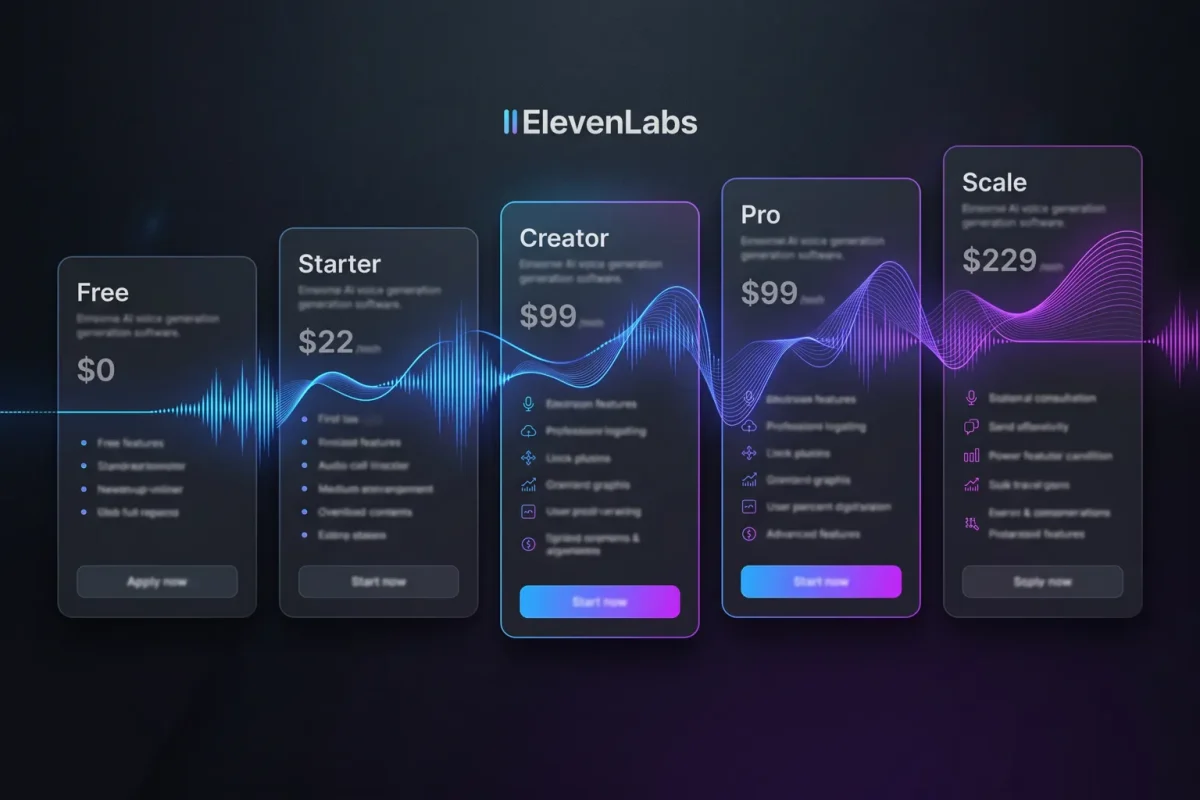
The pattern in the alternatives is consistent: every competitor has a niche where it’s comparable or better on a specific dimension. Murf has a cleaner team workflow. Resemble has deeper custom model training. Descript integrates editing and audio replacement for podcasters specifically. PlayHT has a simpler credit structure for occasional use.
What none of them have is ElevenLabs’ end-to-end scope — TTS at this quality level, plus cloning, plus multilingual dubbing, plus a Conversational AI platform. If you’re building an audio-native product and want to stay on one infrastructure stack, ElevenLabs is the defensible choice. If you’re producing content in English only and don’t need agents, Murf or Descript may be a better operational fit.
Increasingly difficult to detect. ElevenLabs’ own AI Speech Classifier can identify generated audio from their own models, but with high-quality clones and v3 processing, detection tools have meaningful false-negative rates. In regulated contexts (news, legal proceedings), you should disclose AI audio regardless of detectability. Transparency is both the ethical choice and, in several jurisdictions, the legal one.
Yes, on paid plans. Starter and above grants full commercial rights to generated audio — you can publish, sell, license, or embed it in products. The Free tier requires attribution. ElevenLabs does not claim rights to your output. Check the ToS for your specific plan, as terms evolve.
ElevenLabs exposes a REST API with streaming support. The basic call: POST your text and voice ID, receive audio. The streaming endpoint delivers the first audio chunk within 200-400ms, making it suitable for real-time applications. Rate limits and concurrent stream capacity scale with plan tier. The Python and Node.js SDKs are well-maintained. API credits draw from the same pool as web UI usage.
On casual listening, both are convincing. On focused comparison, a professional clone captures idiosyncratic vocal features — a specific laugh register, a particular way of hitting consonants — that instant clones average out. For broadcast content or brand voice systems heard by millions, pay for professional. For content production where you’re the audience, instant is sufficient.
Yes, and it’s one of the strongest creator use cases. Clone your voice, write your script, generate the audio. For a solo creator managing a weekly show, this unlocks production on days when you can’t record. Platforms like Spotify have accepted ElevenLabs-generated audio. Disclosure norms vary by platform — check each one before publishing synthetic audio.
English, Spanish, French, German, Portuguese, Japanese, and Mandarin are the strongest. Korean, Italian, Polish, and Hindi are close. The remaining languages on the 32-language list have varying fidelity — adequate for some use cases, not broadcast-ready for others. Test your specific language with your actual content before committing to a production run.
The free tier functions as the trial — you get 10,000 credits to evaluate quality and workflow. There’s no time-limited trial of paid features like professional cloning. Most users find the free tier sufficient to evaluate synthesis quality, which is the main decision factor, before upgrading to access cloning and higher volume.
ElevenLabs is GDPR-compliant and processes data on EU-hosted infrastructure for EU customers. Voice clone data is stored encrypted and isolated per account. Business and Enterprise plans include Data Processing Agreements and options for data residency. The Enterprise plan includes HIPAA BAA for healthcare use cases. For sensitive workloads, review the DPA before signing a Business contract.
ElevenLabs started as the best TTS available and has become something larger: a full audio platform for building voice-native products at scale. The v3 model’s emotional range closed the last meaningful gap between synthetic and human audio. The voice cloning pipeline is professional-grade. The Conversational AI product is enterprise-deployable. And the pricing, while not cheap at volume, is a fraction of the human alternatives it replaces.
The $22/mo Creator plan is the right starting point for almost everyone. It unlocks professional cloning, full language support, and enough credits for active production work. Upgrade to Pro when your volume demands it. Skip if you only need a one-off voiceover — hire a human for that and get the nuance that comes with a real director in the room.
For the rest of the use cases — the creator publishing globally, the SaaS team building a voice interface, the producer who needs an audiobook narrated in the author’s voice — ElevenLabs is not just the best choice. In 2026, it’s the obvious one.
Every verified price, limit, and model change we have tracked for ElevenLabs.
One email when ElevenLabs changes price or limits. No account, no spam.