Tome was an AI-powered storytelling and presentation tool that went viral with 20 million users before shutting down in April 2025 after failing to find a sustainable business model.
Tome shut down its AI presentation tool on April 30, 2025. Any decks not exported before that date were permanently deleted. There is no active consumer product to sign up for. This review covers what Tome was, what happened, and — most importantly — what to use instead. Jump straight to Alternatives if you just need a replacement.
What Tome was
Tome launched in 2020 as a storytelling-forward alternative to PowerPoint and Google Slides. It was built by a San Francisco startup co-founded by Keith Peiris and Henri Liriani, two product veterans with backgrounds at Instagram and Facebook. Their thesis: slide decks were the wrong format for modern communication. Long-form documents were too boring. What the world needed was something in between — a flowing, visual canvas that combined narrative prose with AI-generated visuals, embeds, and data.
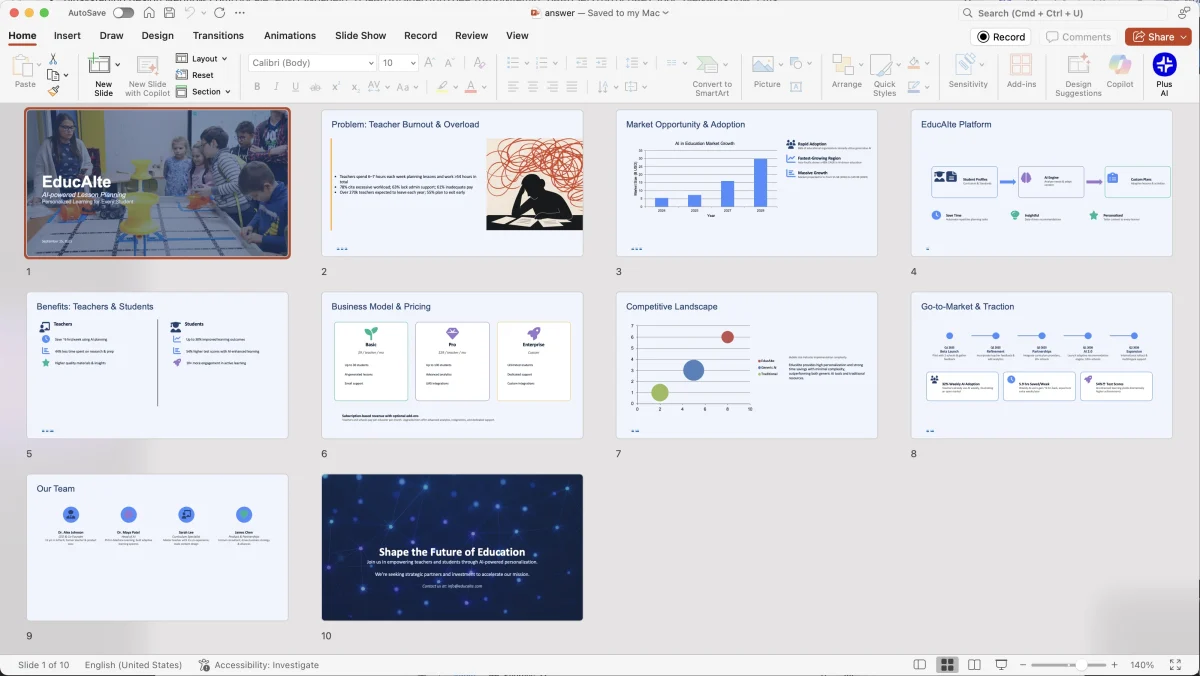
The original product was called Tome Slides, and it was genuinely beautiful. You typed a prompt, and the tool would generate a complete multi-page presentation — with layouts, text, and AI-generated imagery — in under a minute. The output looked nothing like a PowerPoint deck. It looked like a polished digital report, the kind of thing a design-forward agency might produce by hand in several days. For early adopters, it felt like a genuine step-change in how content could be created.
Between 2020 and 2023, Tome raised $81.6 million in venture funding, culminating in a $300 million valuation. Users flooded in. By 2023, the platform claimed 20 million users in just 18 months — a growth rate that would make most SaaS companies jealous. The company was covered by every major tech publication, featured in AI tool roundups everywhere, and regularly showed up in Twitter threads about “tools that feel like cheating.”
In 2026, Tome no longer exists as a consumer product. The original team pivoted to an enterprise sales tool called Lightfield. The Tome brand itself was acquired by AngelList for an unrelated document-summarization project. This review is a post-mortem as much as a product review — and a guide to what you should use instead.
The rise: 20 million users and $81.6 million raised
To understand why Tome’s collapse is such an instructive story, you have to understand how real the momentum was. Tome hit viral growth through a combination of factors that are hard to replicate: the AI generation was genuinely impressive by 2022–2023 standards, the output was immediately shareable (every presentation had a public URL), and the use case — “create a deck in one minute” — was something every knowledge worker had wished for.
The growth curve was almost parabolic. The tool went from niche AI demo to household name among product managers, marketers, and founders inside of a year. Creators posted side-by-side comparisons on Twitter: old PowerPoint deck made in four hours vs. Tome deck made in forty seconds. The engagement was enormous. Investors noticed. The $300M valuation looked conservative given the user numbers.
The warning sign — invisible in the moment — was buried in the conversion data. Twenty million users. Under $4 million in annual recurring revenue. That is a conversion rate so low it signals a structural problem with the business model, not a sales or marketing execution problem. Users loved Tome. They used it, shared it, wrote about it. They just would not pay for it. And at the inference costs required to generate AI presentations at scale, “free but viral” was a slow bankruptcy.
The company reportedly burned through three-quarters of its Series B funding on model inference costs alone before the business model crisis became impossible to ignore. Each AI-generated slide cost Tome real money in GPU compute. Free users — the overwhelming majority — never converted those costs into revenue.
What the product actually did (while it existed)
For those who never used it, here is what made Tome genuinely different from the tools that came before it.
AI generation from a single prompt
Type “Series A pitch deck for a B2B SaaS company that does invoice automation” and Tome produced a complete presentation — eight to twelve pages, with narrative copy on each page, a coherent visual layout, and AI-generated images where appropriate. The quality was not always perfect, but the starting point was dramatically better than a blank slide. For most users, the AI output was 70% of the way to something they would actually send.
Canvas-based layouts instead of slide grids
Where PowerPoint and Google Slides operate on a fixed rectangular canvas with boxes you drag around, Tome used a more flowing page model. Sections could contain text blocks, embedded media, data charts, video clips, and image grids. The result felt more like a premium web page than a traditional deck — which was the point, and also the thing that made it hard to use in corporate environments where .pptx files were required.
One-click sharing with live URLs
Every Tome presentation had a live URL. You sent a link, not a file attachment. The recipient saw the deck in their browser at full fidelity — no file download, no “you need PowerPoint to open this.” For founders pitching investors, this was a meaningful UX improvement. For people working inside enterprises that required file attachments for security reasons, it was a problem.
Embeds, video, and interactive content
Tome pages could embed live data from Figma, Airtable, YouTube, and other tools. A deck about product performance could pull in a live Looker chart. A pitch deck could embed a Loom walkthrough. This was genuinely ahead of the curve in 2022. By 2024, several competitors had caught up, and PowerPoint itself had added more embedding capabilities.
Collaboration
Real-time collaborative editing — standard for anything in the Google Workspace world — was available on paid plans. The free tier was effectively single-player. This gating of collaboration behind a paywall was one of the structural reasons conversion rates stayed low: teams could see Tome was good, but could not use it as a team without paying.
tome · tome-ui.png
fig · The Tome app · source: slidespeak.co
What Tome used to cost
Before shutdown, Tome ran three tiers. The numbers are worth knowing because they explain part of why the business failed.
pricing –product=tome-slides –status=discontinued archived April 2025
plans (no longer available)
Free$0/mo
Pro$16/mo
Enterprise$60/user
The Free tier included up to five presentations, 500 AI credits, and unlimited public sharing. It was enough to experience everything Tome was good at. It was also enough for a significant percentage of users to get everything they needed and never upgrade. The feature set on the free tier was simply too generous for a product with high inference costs per user action.
The Pro tier at $16/month unlocked unlimited AI credits, custom branding, PDF export, and custom fonts. It was priced below Gamma’s equivalent tier and did not have a strong enough paywall to force conversion from heavy free users. Users who needed unlimited AI generation were exactly the users generating the most inference costs — and many of them churned rather than pay.
The Enterprise tier at $60 per user per month — $7,200/year for a ten-person team — was correctly priced for enterprise value but required a sales motion Tome was not set up to execute. The product was bottoms-up and viral; the enterprise tier required top-down procurement. The company never successfully bridged that gap.
Why the business failed
Tome’s failure is a clean case study in the specific pathology of “viral but not monetizable.” The product genuinely delighted users. It solved a real problem. It spread organically. None of that translated into revenue at the scale the cost structure required.
Inference costs at scale with low conversion
Every AI-generated page required multiple model calls: one for the text content, one or more for layout decisions, and at least one for image generation. At 20 million users, the majority on the free tier, the GPU bills were enormous. Tome reportedly exhausted most of its Series B on inference alone. The unit economics were negative at scale: the more the product grew, the more money it lost per user.
No export to standard formats
The single most-cited reason users stayed on the free tier was the absence of PowerPoint export. The overwhelming majority of business presentations end up as .pptx or .pdf files attached to emails, uploaded to shared drives, or sent to clients who cannot receive URLs. Tome’s canvas format — intentionally different from a slide grid — was impossible to convert cleanly to a .pptx. PDF export existed on Pro, but a PDF is a one-way print output; it kills the interactivity that made Tome interesting. Until Tome solved the export problem, it would always be a tool for the subset of users who worked entirely in browser-native environments.
The storytelling format was niche
Tome’s flowing page format was genuinely beautiful. It was also not what most organizations actually needed. Corporate slide decks are bullet-point lists for a reason: they are scannable in thirty seconds, printable, forwardable, and compatible with every stakeholder’s workflow. Tome’s visual-narrative format required that all recipients engage with a URL in a browser at a specific time. That is a hard constraint for many use cases — board decks, client proposals, internal reviews — where the deck is reviewed asynchronously by a dozen people in a dozen different contexts.
Competition caught up fast
In 2022, Tome had a one-to-two year head start on the AI presentation category. By 2024, Gamma had matured significantly, Beautiful.ai had added AI generation, Canva had launched AI slide-generation at massive scale, and Microsoft had embedded Copilot directly into PowerPoint. The differentiation that made Tome feel like magic in 2022 was table stakes by 2024.
The October 2024 pivot
In October 2024, Tome announced a strategic pivot away from the consumer presentation market. The company laid off approximately one-third of its staff and announced that its focus was shifting to enterprise sales automation. The new product would use AI to help sales teams research accounts, personalize outreach, and prepare for customer meetings.
The pivot logic was coherent on paper. Sales teams have high willingness-to-pay (enterprise SaaS), a measurable ROI (closed deals), and a clear use case for AI (automating research and personalization that takes hours per account). Tome’s technology — AI-generated narrative content, visual presentation of information — translated reasonably well to sales decks and account briefings.
NOTE · reading the October 2024 announcement
Tome’s pivot announcement was framed positively — a new chapter, a focus on enterprise value, exciting new capabilities. Reading between the lines: the free consumer product had burned through most of its funding, the conversion rate was not improving, and the board required a path to unit economics that the consumer product could not provide. The pivot was a necessity, not a strategic choice.
The new product was described as an “AI assistant for sales” — one that could pull data from CRM systems, generate personalized account research briefs, create meeting-prep summaries, and produce tailored sales decks in minutes. It was a real product with real potential. It was also fundamentally not what the 20 million existing Tome users had signed up for.
tome · tome-deck.png
fig · A Tome deck · source: plusai.com
The April 2025 shutdown
On April 30, 2025, Tome officially discontinued its presentation product. The shutdown was not a surprise — the October 2024 pivot announcement had signaled the direction. But the execution was painful for users who had built libraries of presentations on the platform.
The data loss was total. Any presentation not exported before the shutdown date was permanently deleted. Tome offered a PDF export window in the weeks before shutdown, but the format was a lossy representation of the original — no interactivity, no embedded content, static layouts that did not always translate cleanly. Users who had built extensive libraries of live presentations effectively lost them.
In their public shutdown statement, the Tome team acknowledged: “We made every effort to improve Tome Slides and turn it into a viable business but ultimately failed to find a sustainable path.” That admission — rare for a startup, usually given to euphemism — was honest and, in its honesty, instructive.
WARNING · do not sign up for Tome
As of June 2026, tome.app redirects to Lightfield or AngelList properties depending on which part of the old domain you visit. There is no active presentation product. Any website offering “Tome Pro for $X/month” is either outdated, a scam, or refers to an unrelated product using the same brand name. Use Gamma, Beautiful.ai, or Canva AI instead.
What Lightfield is — the current reality
The founders of Tome — Keith Peiris and Henri Liriani — are still working in AI. Their current company, Lightfield, is a sales-intelligence platform. It is aimed squarely at enterprise sales teams and is not a consumer product. There is no free tier, no self-serve signup that resembles what Tome offered, and no presentation tool in the traditional sense.
Lightfield positions itself as an AI that researches prospects, synthesizes CRM data, and generates briefing documents before sales calls. Think of it as an AI sales researcher — not a deck builder. It is early-stage, enterprise-only, and requires a sales conversation to access. It is not a product that PixlRun readers looking to build decks will find useful.
Meanwhile, the Tome brand and intellectual property were acquired by AngelList in August 2025. AngelList is using the Tome name and some of the underlying technology for AI-powered document summarization for legal and investment use cases — again, nothing to do with presentations. The Tome brand name now belongs to a completely different company working on a completely different problem.
There is no version of Tome you can use today to build a presentation. The company, the product, and the brand have all moved on.
Lessons for AI product builders
Tome’s arc — viral growth, 20 million users, $81.6M raised, shutdown in five years — is one of the most instructive stories in the 2020s AI product wave. A few things that are worth internalizing:
User count is not a business
Twenty million users with $4M ARR is a conversion rate of roughly 0.02% on a $16/month product. The aggregate number was enormous and real. The business was tiny. The lesson is not that virality is bad — it is that virality without a monetization path that can scale alongside usage is a liability, not an asset. Every free user who generates AI content costs you money. At Tome’s scale, that was a budget-destroying number.
Free-tier generosity is a trap for inference-heavy products
Products where the core value is generated by expensive model calls — image generation, video creation, AI writing — cannot afford the same free-tier generosity as, say, a project management tool where the marginal cost of a new user is near zero. Tome’s free tier let users generate unlimited AI content up to a low credit ceiling. That ceiling was high enough for most users to get what they needed and never pay. The correct design in hindsight: much smaller free allowances, faster conversion pressure.
The export problem is a real moat
The absence of PowerPoint export was not a UX oversight. It was a philosophical choice — Tome was explicitly trying to replace the .pptx format, not feed into it. That philosophy made the product beautiful and limited the addressable market simultaneously. Gamma and Beautiful.ai both export to PowerPoint. That single feature difference expanded their addressable market by an order of magnitude. Being ideologically opposed to the incumbent’s file format is a legitimate product strategy; it just has to be paired with a market segment large enough to sustain the business without the mainstream users who will always need .pptx.
tome · tome-format.png
fig · Tome's storytelling format · source: decktopus.com
What to use instead — AI presentation tools in 2026
If you landed on this review looking for an AI deck tool, here is the current landscape honestly assessed. Tome is gone. These three tools are the credible alternatives.
Teams already in Canva; broad design + presentation in one tool
Massive template library; AI generation + full design suite; free tier
Free / $13/mo
The short version: Gamma is the closest spiritual successor to what Tome was trying to be. It generates multi-page presentations from a single prompt, the output quality is excellent, and it has a functional free tier. If you were a Tome user and want the least amount of re-learning, start with Gamma.
Gamma vs what Tome was
a/gamma b/tome-slides (archived)
Gamma launched publicly in 2022, about a year after Tome, and has since become the dominant AI-native presentation tool. Where Tome bet on a proprietary canvas format, Gamma works more like a structured document that exports cleanly to PowerPoint and PDF.
gamma wins
still exists — actively maintained in 2026
exports to .pptx and PDF (Tome couldn’t)
functional free tier with real AI generation
better model improvements year-over-year
team collaboration on all plans
tome had
more distinctive visual aesthetic at peak
better embed support (Figma, Airtable, etc.)
unique flowing canvas that felt premium
stronger early viral word-of-mouth
no longer available to evaluate
Verdict: Gamma has everything Tome had, plus PowerPoint export, plus it isn’t shut down. This is the tool to use.
Beautiful.ai vs what Tome was
a/beautiful-ai b/tome-slides (archived)
Beautiful.ai is the more corporate-facing alternative. It predates the AI generation wave but has since added AI slide drafting. Its strengths are in consistent design quality and brand compliance — areas where Tome was weaker.
beautiful.ai wins
still exists and actively maintained
strong brand kit and consistency tools
smart layouts auto-adjust as you add content
PowerPoint export built in
better enterprise positioning
tome had
AI generation was faster and more complete
more visually distinctive output
better for narrative-first storytelling
more flexible layout model
no longer available to evaluate
Verdict: Beautiful.ai is the better fit for marketing teams and brand-conscious organizations. Less “AI magic,” more reliable output quality.
tome · tome-lightfield.png
fig · The team pivoted to Lightfield · source: lightfield.app
Canva AI vs what Tome was
a/canva-ai b/tome-slides (archived)
Canva added AI presentation generation to its already enormous design platform. It is the least similar to Tome in philosophy — Canva is a design-first tool with AI added, where Tome was AI-first with design as output. But the scale and free tier are unmatched.
canva ai wins
still exists at massive, well-funded scale
enormous free tier with real capability
full design suite alongside presentations
best brand-kit and asset management
exports everywhere — .pptx, PDF, MP4
tome had
more focused and coherent AI generation
less overwhelming interface for simple decks
faster to a complete first draft
more distinctive visual output
no longer available to evaluate
Verdict: Canva AI is the right answer if you need a design tool that also does presentations, or if you’re already in the Canva ecosystem. For pure presentation work, Gamma is sharper.
FAQ
Can I still use Tome in 2026?
No. Tome shut down its presentation product on April 30, 2025. The product is gone. The domain now redirects to Lightfield (the founders’ new sales-intelligence startup) or AngelList properties. There is nothing to sign up for.
What happened to my old Tome presentations?
Any presentations not exported before April 30, 2025 were permanently deleted. Tome offered a PDF export window in the weeks before shutdown. If you did not export in time, the content is gone with no recovery path.
Is Lightfield the same as Tome?
No. Lightfield is a completely different product — an enterprise sales-intelligence platform aimed at helping sales teams research accounts and prepare for customer meetings. It is not a presentation tool, it is not consumer-facing, and it does not accept self-serve signups in the way Tome did.
Did AngelList buy Tome?
AngelList acquired the Tome brand and some underlying IP in August 2025. They are using the Tome name for an AI document-summarization product for legal and investment workflows. It is unrelated to the presentation product that existed before. The Tome you knew is gone; the brand now belongs to a different company working on a different problem.
What is the best Tome alternative for making AI presentations?
Gamma is the closest equivalent — AI generation from a single prompt, polished visual output, functional free tier, and crucially, it exists and is actively maintained. Start there. Beautiful.ai if you need strong brand controls. Canva AI if you need a full design platform alongside presentations.
Why did Tome fail if it had 20 million users?
User numbers do not equal revenue. Tome had 20 million users but under $4M in annual recurring revenue — a conversion rate near zero on a $16/month product. Every free user generating AI content cost the company real money in GPU inference fees. The free tier was too generous for a product with high per-user compute costs, and the company burned through most of its $81.6M in funding before being able to find a sustainable model.
Was Tome actually good when it existed?
Yes, genuinely. The AI generation quality was excellent for its era, the canvas format was beautiful, and the one-click sharing via URL was a real improvement over emailing .pptx files. The product failed for business-model reasons, not product-quality reasons. That makes its shutdown more instructive — a great product can still be an unsustainable business if the unit economics are wrong from the start.
I saw a website offering “Tome Pro” — is that legit?
Almost certainly outdated, a clone, or a scam. The Tome presentation product was shut down in April 2025. Any site currently selling “Tome Pro” subscriptions for presentation creation is not offering the original product. Do not enter payment information. Use Gamma instead.
The verdict
tome-review · v1.0 · archived product Shutdown April 2025
6.2/10
+ beautiful output + strong AI gen – no longer exists – data deleted
A genuinely good product that failed as a business. Use Gamma instead.
Tome was worth the hype when it existed. The AI generation was real, the output was polished, and the one-click sharing was a genuine improvement on the status quo. The score reflects what it was at its peak — not an indictment of the product, but an honest accounting that includes the fact that it no longer exists, it deleted user data on shutdown, and it signals a cautionary story about viral-but-unconvertible consumer AI tools.
If you are reading this looking for an AI presentation tool: Gamma is the answer. It does what Tome did, it exports to PowerPoint, and it is not going anywhere. Beautiful.ai and Canva AI are credible alternatives depending on your workflow. Tome itself is not an option.
// product shutdown confirmed April 30, 2025 · brand acquired by AngelList August 2025 · founders at Lightfield · last verified 2026-06-02
Keeping tabs
Change history
Every verified price, limit, and model change we have tracked for Tome.
No changes detected since we started tracking — that's a good sign.
Verified October 2026
Watch this tool
One email when Tome changes price or limits. No account, no spam.